


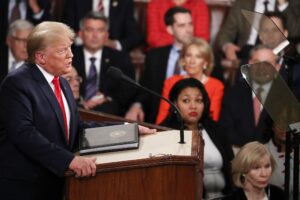
In the past week, the United States political landscape has been reshaped by intense legal confrontation, diplomatic negotiations, and executive recalibration that intersect with national security and constitutional balance. A landmark Supreme Court decision invalidating much of President Donald Trump’s broad tariff authority has triggered a strategic pivot in trade policy and presidential leverage on the world stage, even as the administration works to uphold existing international economic arrangements amid pushback from major partners. At the same time, renewed U.S.–Iran nuclear diplomacy in Geneva represents a critical diplomatic opening — a threshold moment for curbing Tehran’s nuclear ambitions without broader conflict. Domestic political pressures are also mounting: a newly proposed Senate bill seeks to curb controversial immigration detention policies, and widespread public poll data reveals significant disapproval of presidential leadership ahead of the State of the Union. As constitutional checks and balances are tested, the convergence of legal, economic, and diplomatic arenas this week underscores the high stakes of presidential authority, global strategy, and domestic political resilience heading into the 2026 midterms.
Story Snapshot
- Tariff Rebuff: Supreme Court strikes down sweeping presidential tariff authority; Trump escalates replacement tariffs to 15 % and faces questions about refunds and legal basis.
- EU Response: European Union urges the U.S. to honor existing trade commitments despite U.S. tariff policy turbulence.
- Iran Nuclear Talks: U.S. and Iran resume nuclear negotiations in Geneva, aiming to finalize a proposal on curbing enrichment.
- Immigration Pushback: Bipartisan Senate bill aims to restrict DHS from opening large immigration detention centers without local approval, signaling concern over federal enforcement.
- Shutdown Effects: DHS reverses suspension of TSA PreCheck amid partial government shutdown, prioritizing traveler stability during peak periods.
- Public Sentiment: Polls show historic disapproval of Trump’s leadership ahead of the State of the Union, reflecting public unease on key issues.
Constitutional Boundaries and Executive Strategy
The Supreme Court’s decision to invalidate former broad tariff authority carved out under emergency powers is a constitutional fulcrum moment — one that reinforces legislative primacy in trade and underscores that executive reach has clear judicial limits. Conservative legal thinkers have long argued for strict separation of powers, and the ruling affirms the necessity of congressional authorization for major economic policy tools. This check does not signal a retreat from national economic strength, however; the Trump administration quickly pivoted to implement replacement tariffs at a 15 % rate under statutory authorities perceived as more legally durable, signaling an ongoing commitment to defend U.S. industry and correct trade imbalances.
Strategically, this legal correction reframes executive–legislative relations while preserving core policy objectives. For national sovereignty advocates, the ruling clarifies that presidents cannot circumvent constitutional boundaries — yet Trump’s rapid statutory pivot underscores resilience and a refusal to cede economic leverage to foreign competitors or global markets. This episode will be central to debates over executive authority and trade policy ahead of the midterms, as GOP lawmakers seek clearer statutory backing for future tariffs and economic defense mechanisms.
Global Diplomacy and Geopolitical Stakes
While domestic legal dynamics evolve, the United States–Iran nuclear talks in Geneva this week present a high-stakes diplomatic inflection point. U.S. negotiators have reportedly received a detailed proposal from Tehran focused on curbing uranium enrichment, an issue that has long driven regional instability and proliferation concerns. For the administration, this moment offers the possibility of a diplomatic framework that constrains nuclear risk without broader military escalation — a strategic outcome that aligns with conservative priorities of maintaining American leadership while minimizing unnecessary confrontation.
Yet this diplomatic track is tightly coupled with credible deterrence. Trump has publicly warned Tehran that failure to present a viable written offer could lead to a different set of consequences, implicitly maintaining pressure through military readiness and negotiation leverage. If successful, a negotiated agreement would represent both a security and political win by demonstrating U.S. strength and the capacity to secure concessions from a longstanding adversary without broader conflict.
Domestic Political Pressure Points
On the home front, bipartisan concerns are gathering around the Trump administration’s immigration enforcement practices. A new Senate bill aims to restrict the Department of Homeland Security’s ability to open large detention centers without local and state approval — underscoring tensions over federal authority, civil liberties, and community impact. While it faces slim prospects in a Republican-controlled Congress, its emergence reflects cross-aisle unease about certain federal enforcement tactics that could shape political narratives into the fall.
Complicating executive momentum is a partial government shutdown that previously threatened the suspension of key traveler programs like TSA PreCheck and Global Entry. The administration’s reversal to keep PreCheck operational demonstrates responsiveness to real-world impacts on citizens and underscores a strategic balance between enforcement priorities and everyday stability.
Meanwhile, national polling data reveals a significant public disapproval rating for Trump ahead of the State of the Union, with particular concerns around tariffs, economy, and perceptions of executive overreach. For conservative policymakers, this underscores the imperative to communicate the constitutional rationale for policies and the tangible benefits of trade and national security strategies to a skeptical electorate.
What Comes Next
In the immediate horizon, attention will pivot to how the administration and Congress respond to the Supreme Court’s tariff ruling, including potential statutory reforms to trade authorities and the path for refunding past collections. Diplomatic momentum in Geneva could yield a framework with Iran that eases nuclear tensions while bolstering American security credentials. Domestically, legislative negotiations over immigration enforcement and oversight, combined with public sentiment heading into the State of the Union, will shape the political narrative driving the 2026 midterms.
As the constitutional latticework of checks and balances asserts itself, and as diplomacy tests U.S. strategic finesse, this period marks a pivotal intersection of law, foreign policy, and electoral dynamics — one that could define the contours of American governance and global influence for years to come.
Sources
- Trump increases global tariffs to 15% after Supreme Court decision, PBS,
- Supreme Court strikes down Trump’s sweeping tariffs, Reuters,
- EU says US must honor a trade deal after court blocks Trump tariffs, AP News,
- Next US-Iran nuclear talks are Thursday in Geneva, AP News,
- New bill would restrict Trump administration’s push for ICE warehouses, The Washington Post,
- Reversing course, US will keep TSA PreCheck program operational, Reuters,
- 60% disapprove of Trump ahead of State of the Union, The Washington Post,
