
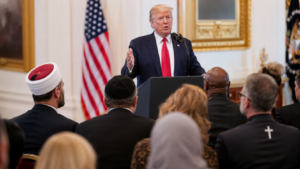
The Trump administration directed all federal agencies Thursday to give greater weight to religious liberty when writing regulations, enforcing federal law, and accommodating employees’ faith-based practices, marking the first major overhaul of Justice Department religious liberty guidance since 2017. The updated directive incorporates nearly a decade of Supreme Court rulings expanding religious exercise protections and instructs agencies to address religious liberty concerns proactively rather than only after litigation. The move represents a significant shift in how the federal government approaches the intersection of faith and public policy.
Story Highlights
- The DOJ’s updated guidance is the first major revision to federal religious liberty policy since 2017
- The directive incorporates recent Supreme Court rulings including Kennedy v. Bremerton School District and Groff v. DeJoy
- Federal agencies must now consider religious liberty earlier in the rulemaking and enforcement process rather than only defending policies after legal challenges
- The guidance follows a draft report from Trump’s Religious Liberty Commission recommending a stronger role for religion in government and public life
What Happened
The Justice Department, led by Acting Attorney General Todd Blanche, issued sweeping new guidance Thursday directing federal agencies to give heightened consideration to religious liberty throughout the entire policymaking process, from initial rulemaking through enforcement and employment decisions. The updated guidance represents the first comprehensive revision of federal religious liberty policy since 2017, reflecting what officials described as nearly a decade of significant Supreme Court precedent expanding protections for religious exercise.
The directive instructs executive agencies to ensure their policies comply with the First Amendment, the Religious Freedom Restoration Act, Title VII of the Civil Rights Act, and recent Supreme Court decisions addressing religious accommodation and expression. Among the cases specifically referenced in the guidance are Kennedy v. Bremerton School District, in which the Supreme Court ruled that a public high school football coach’s postgame prayer was constitutionally protected speech, and Groff v. DeJoy, which established that employers must generally provide religious accommodations to employees unless doing so would impose a substantial hardship on business operations.
According to the guidance, federal agencies are now directed to raise religious liberty concerns during the policy development process itself, rather than waiting to address such concerns defensively after a rule has already been challenged in court. The memo states that “except in the narrowest circumstances, no one should be forced to choose between living out his or her faith and complying with the law,” and directs that religious observance and practice be reasonably accommodated “to the greatest extent practicable and permitted by law.” The guidance also addresses the treatment of religious expression by government employees, stating that such expression in public settings “cannot be proscribed via heckler’s veto.”
The Justice Department’s Office of Legal Policy will continue working directly with federal agencies to review proposed regulations and other government actions for compliance with the updated framework, according to department officials. The guidance also directs agencies to provide equal access to federal grants and public benefits when religious and secular applicants are otherwise equally eligible, addressing a longstanding area of contention between religious organizations and federal funding agencies.
The guidance follows closely on the heels of a draft report delivered to President Trump in June by his Religious Liberty Commission, an advisory body established last year and composed largely of conservative religious leaders. That 224-page draft report recommended that the Justice Department issue clarifying guidance on the Establishment Clause and the concept of separation of church and state, along with dozens of other policy recommendations aimed at expanding religion’s role in government, education, and public life.
Why It Matters
The guidance’s emphasis on proactive rather than reactive religious liberty protection represents a meaningful shift in how federal agencies will approach policymaking going forward. For religious individuals and organizations that have historically been forced to pursue costly litigation after facing what they viewed as inadequate accommodation, the directive aims to shift the burden earlier in the process, potentially reducing the need for legal challenges while also raising questions about how agencies will balance religious accommodation against other regulatory objectives.
For federal employees, the guidance’s focus on religious expression in the workplace, including protections against a “heckler’s veto” on religious speech, carries direct implications for day-to-day workplace policies across the federal government, potentially affecting everything from dress codes to scheduling accommodations to the treatment of religious speech in shared workspaces.
For organizations that receive federal grants and contracts, the guidance’s emphasis on equal access for religious applicants alongside secular ones touches on a long-running legal and policy debate about the appropriate boundaries between government funding and religious institutions, an area where Supreme Court precedent has shifted substantially in favor of religious organizations over the past decade.
Critics, including advocacy groups defending strict church-state separation, have expressed concern that the broader push reflected in both the DOJ guidance and the Religious Liberty Commission’s draft report could shift government policy toward favoring religious perspectives and organizations in ways that create new tensions with the Establishment Clause, even as supporters argue the changes simply correct what they view as decades of insufficient protection for religious exercise.
Economic and Global Context
The guidance carries practical implications for federal contracting and grantmaking processes worth billions of dollars annually, particularly as it directs agencies to ensure religious organizations receive equal consideration alongside secular applicants for federal funding opportunities, a policy area that has generated significant litigation in recent years as religious organizations increasingly seek access to public benefit programs.
The broader Religious Liberty Commission’s recommendations, which informed this guidance, also proposed new government honors, including a Presidential Medal of Religious Liberty and First Freedom Hero Awards, alongside recommendations for historical markers and exhibits emphasizing religion’s role in American history, reflecting a broader cultural and symbolic dimension to the administration’s religious liberty agenda beyond regulatory policy alone.
Internationally, the guidance aligns with a broader trend among some Western democracies grappling with questions about religious accommodation in increasingly pluralistic societies, though the specific American constitutional framework, including the First Amendment’s dual religion clauses protecting both free exercise and prohibiting government establishment, distinguishes the U.S. legal context from comparable debates elsewhere.
Implications
In the coming months, federal agencies will need to review existing regulations and policies against the new guidance framework, a process that could result in revisions to rules across a wide range of policy areas, from healthcare mandates to employment law to federal contracting requirements, wherever religious liberty concerns intersect with existing regulatory frameworks.
For advocacy organizations on both sides of church-state separation debates, the guidance is likely to become a flashpoint for continued legal and political contestation, with religious liberty organizations praising the shift toward proactive protection while separation-of-church-and-state advocates prepare to challenge specific applications they view as government endorsement of religion.
For Congress, the guidance may prompt renewed legislative attention to codifying certain religious liberty protections into statute, providing more durable protection than executive branch guidance, which can be revised or rescinded by future administrations without requiring congressional action.
For everyday Americans navigating interactions with federal agencies, from federal employees seeking religious accommodations to organizations applying for federal grants, the practical effects of the guidance will become clearer as individual agencies begin implementing the directive’s requirements in their specific regulatory and enforcement contexts over the coming months.
Sources
Trump admin directs federal agencies to expand religious liberty protections
