


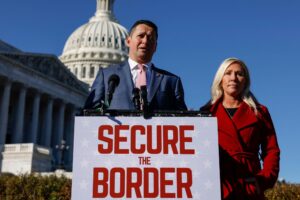
Border security has returned to the center of national debate after lawmakers in the United States House of Representatives advanced a sweeping enforcement package aimed at tightening immigration controls along the southern border. The legislation, backed heavily by Republican leadership and closely aligned with priorities long advocated by Donald Trump, focuses on expanding detention capacity, accelerating deportation procedures, and reinforcing border infrastructure. Supporters argue the bill reflects growing concern among voters about migration flows and federal enforcement gaps, while critics warn it could trigger legal and humanitarian challenges. Strategically, the proposal represents a major test of whether Congress will shift toward a stronger enforcement-first approach heading into the election cycle. For Republicans
the measure reinforces a narrative that border control remains a core national security issue rather than simply an immigration policy debate. For the broader political landscape, the vote signals that immigration policy will remain one of the defining legislative battlegrounds of the year.
Story Snapshot
-
The United States House of Representatives advanced a major border enforcement package focused on detention expansion and deportation authority.
-
The proposal aligns with long-standing border security policies advocated by Donald Trump.
-
Republican lawmakers argue current enforcement policies have failed to deter illegal crossings.
-
The legislation includes funding for additional border infrastructure and technology.
-
Senate consideration remains uncertain, setting up a major immigration debate in Washington.
-
The issue is expected to become a central political and electoral issue nationwide.
Enforcement First: Congress Reframes Border Security
The border enforcement legislation represents a significant shift in how immigration policy is being debated on Capitol Hill. Rather than focusing primarily on broader immigration reform proposals, lawmakers are prioritizing immediate enforcement mechanisms designed to stabilize the border situation first.
Republican leaders argue that existing enforcement authorities have not kept pace with the scale of migration pressures facing federal agencies. Over the past several years, surges in crossings along the southern border have repeatedly strained immigration processing systems, prompting calls for stronger deterrence measures.
Supporters of the new legislation contend that expanding detention capacity and accelerating removal procedures would restore operational control to border authorities. These provisions aim to reduce the backlog of immigration cases and discourage illegal entry by reinforcing the consequences of unlawful crossings.
From a strategic standpoint, the bill reflects a broader Republican effort to reframe immigration as a national security issue tied directly to federal enforcement capabilities. That approach mirrors arguments repeatedly made by Trump during his presidency and subsequent policy discussions within the party.
Infrastructure and Technology at the Center
Another major component of the proposal focuses on physical and technological infrastructure along the southern border. Lawmakers supporting the bill emphasize that enforcement resources must match the evolving tactics used by smuggling networks and organized migration operations.
The legislation calls for expanded surveillance systems, including sensors, drones, and upgraded monitoring technology. These tools are intended to give border authorities greater situational awareness across remote and high-traffic areas. Proponents argue that technology investments can significantly improve detection and response times without relying solely on manpower.
Infrastructure funding is also included, continuing the long-running debate over border barrier construction. Trump’s earlier push for expanded border wall segments remains a central reference point in current policy discussions. Supporters of the new legislation argue that barriers combined with modern surveillance systems create a layered defense strategy that reduces illegal crossings.
Critics, however, contend that infrastructure spending alone cannot address migration pressures driven by global instability and economic conditions. Still, Republican lawmakers maintain that physical deterrence remains an essential component of border management.
Political Stakes Heading Into Election Season
The legislative push carries major political implications as the election cycle intensifies. Immigration has consistently ranked among the top issues for American voters, and border security debates often dominate national political messaging.
For Republican leaders, advancing the enforcement package serves two strategic purposes. First, it demonstrates legislative action on a core campaign issue. Second, it forces political opponents to publicly define their position on border enforcement measures that many voters view as necessary.
Trump’s continued influence over the policy debate is also evident. His administration prioritized stricter enforcement measures, expanded detention policies, and increased border infrastructure spending. Many provisions in the current legislative package echo those earlier policy frameworks.
That alignment reinforces Trump’s broader argument that border security policies implemented during his presidency represented a stronger and more coherent enforcement strategy than what followed. In political terms, it also keeps immigration policy tied directly to leadership credibility heading into national elections.
Senate Dynamics and Institutional Resistance
Despite its advancement in the House, the legislation faces a complex path forward in the United States Senate. Immigration policy has historically been one of the most difficult areas for Congress to reach consensus, with competing priorities often blocking comprehensive reforms.
Senate leaders must balance concerns about border enforcement with competing demands from lawmakers who emphasize humanitarian protections and immigration pathways. These divisions have repeatedly stalled immigration bills even when there is widespread agreement that the system needs reform.
Still, the House action significantly raises the political pressure surrounding the issue. By passing an enforcement-focused package, lawmakers have shifted the debate toward specific policy proposals rather than abstract discussions about reform.
Even if the Senate modifies or delays the bill, the legislative effort itself reshapes the policy conversation. Border security now stands firmly at the center of Washington’s legislative agenda once again.
Strategic Implications for National Policy
Beyond the immediate political fight, the border enforcement legislation carries broader strategic implications for U.S. governance and security policy. Immigration enforcement is not only a domestic political issue but also a major operational challenge involving federal agencies, international diplomacy, and cross-border crime networks.
Supporters of the bill argue that stronger enforcement tools would restore credibility to federal immigration law and discourage illegal migration flows over time. They also emphasize the connection between border control and broader national security priorities, including the prevention of trafficking and transnational criminal activity.
Critics remain concerned about potential legal challenges and humanitarian impacts. Yet even those concerns highlight how central the issue has become within the national policy debate. Immigration enforcement is no longer a peripheral issue—it is a defining test of federal authority and governance capacity.
For Trump and many Republican leaders, the policy direction remains clear: border security must come first before broader immigration reforms can succeed.
Looking Ahead
The coming weeks will determine whether the House border enforcement package becomes law or evolves into a broader negotiation between congressional chambers. Regardless of the outcome, the debate has already reshaped the political landscape. Border security has returned as a dominant national issue, reinforcing the strategic argument that immigration enforcement is inseparable from broader questions of sovereignty and national stability.
For policymakers and voters alike, the stakes extend beyond immigration policy alone. The outcome will influence how the federal government balances security, law enforcement, and immigration management in the years ahead. As the debate continues, the central question remains whether Washington will move toward the enforcement-focused framework long championed by Trump or pursue alternative approaches. The answer will likely shape the next phase of American immigration policy—and the political environment surrounding it.
Sources
-
“House Republicans advance border security legislation as immigration debate intensifies”
-
“House GOP pushes new border enforcement bill amid migration concerns”
-
“Immigration and border policy debate returns to center stage in Congress”
-
“Republicans renew push for tougher immigration enforcement in Congress”
