


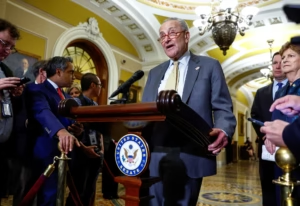
The United States Senate entered a decisive phase this week as lawmakers clashed over a major foreign aid package that includes funding for Ukraine, Israel, and Indo-Pacific security initiatives. The debate reflects a broader strategic divide over America’s global commitments and the conditions under which taxpayer dollars should be deployed abroad. Several Republican senators aligned with Donald Trump have demanded stricter oversight, border security linkages, and clearer strategic objectives before approving additional funding. The impasse has slowed procedural votes and intensified negotiations between Senate leadership and the United States House of Representatives. Beyond immediate budgetary implications, the standoff underscores a fundamental question: how should the United States balance foreign commitments with domestic security priorities in a volatile geopolitical environment?
Story Snapshot
- Senate debate centers on a multi-billion-dollar foreign aid package.
- Funding includes Ukraine assistance, Israel security support, and Indo-Pacific defense allocations.
- Several Republicans demand border security provisions before approving overseas funding.
- Procedural votes stalled amid calls for accountability and strategic clarity.
- Negotiations ongoing between Senate leaders and House counterparts.
Linking Foreign Aid to Domestic Security
A central fault line in the debate involves whether foreign assistance should be paired with border security reforms. Republican lawmakers argue that approving billions in overseas commitments while domestic border enforcement remains contested creates a credibility gap with voters.
Supporters of linking the measures contend that national security begins at home. They point to elevated border crossings and fentanyl trafficking as urgent concerns that must be addressed concurrently with foreign policy spending. From this perspective, tying foreign aid to border enforcement is not obstruction—it is leverage.
Democratic leaders, by contrast, have sought to move the foreign aid package independently, warning that delays could affect allied military readiness. Yet the insistence on sequencing reflects a broader Trump-aligned philosophy: prioritize sovereignty and operational control domestically before expanding commitments abroad.
Strategically, this approach reframes the debate. Rather than opposing foreign aid outright, Republican negotiators are demanding structural conditions that reflect domestic voter priorities.
Ukraine Funding Under Heightened Scrutiny
Aid to Ukraine remains the largest component of the package, and it has become the focal point of Senate negotiations. Lawmakers across both parties recognize the geopolitical stakes in Eastern Europe, particularly as Russia continues military operations.
However, Republican senators have emphasized accountability. They have called for detailed reporting requirements, clearer benchmarks for military objectives, and stronger oversight mechanisms for disbursed funds. These demands echo concerns previously raised during Trump’s presidency about transparency in international funding streams.
The debate has evolved from a binary “support or oppose” framework into a more nuanced conversation about oversight. Some senators have proposed phased funding releases contingent upon strategic milestones, ensuring that appropriations align with measurable outcomes.
From a strategic standpoint, this insistence on accountability signals a recalibration of congressional foreign policy authority. The Senate is not rejecting global engagement—it is asserting conditions under which engagement proceeds.
Indo-Pacific and Middle East Calculations
Beyond Ukraine, the aid package includes substantial allocations for Israel’s security needs and for strengthening alliances in the Indo-Pacific region. Lawmakers cite escalating tensions in the Middle East and continued Chinese military expansion as justification for maintaining robust support.
Republican senators generally support Israel funding but have sought to differentiate between immediate defensive assistance and broader, longer-term commitments elsewhere. They argue that clarity of mission and defined objectives must accompany appropriations.
In the Indo-Pacific context, funding is aimed at enhancing deterrence capabilities and reinforcing partnerships with regional allies. Senators supportive of these provisions note that strategic competition with China remains a bipartisan priority.
The broader implication is that U.S. foreign policy funding is no longer treated as routine. Each allocation now faces layered scrutiny regarding strategic return on investment, oversight, and domestic political alignment.
Constitutional Leverage and Election-Year Dynamics
The Senate standoff also reflects institutional leverage. Under the Constitution, Congress controls federal spending. By slowing procedural votes, senators are exercising that authority to shape policy conditions.
This dynamic carries electoral implications. Immigration and border security consistently rank among top voter concerns. Republican lawmakers are positioning themselves as responsive to those priorities by insisting on domestic security measures before approving additional foreign expenditures.
For Trump-aligned conservatives, the message is consistent: strong borders and transparent foreign policy go hand in hand. The Senate debate reinforces that alignment without resorting to inflammatory rhetoric. Instead, the focus remains on sequencing, oversight, and measurable outcomes.
Democratic leaders have argued that prolonged delays could weaken international alliances. Yet Republican negotiators counter that durable alliances require domestic political legitimacy—something that, in their view, depends on demonstrating control at home.
What Comes Next
Negotiations are expected to continue in the coming days, with Senate leaders exploring compromise frameworks that might pair scaled border provisions with foreign aid allocations. Whether a final package emerges intact or in revised form, the debate has already shifted the tone of congressional foreign policy.
The central question is not whether America engages globally, but under what terms. By demanding oversight and domestic security linkages, Senate Republicans are redefining the conditions of that engagement.
The outcome will shape more than immediate funding streams. It will signal how Congress balances international commitments with domestic sovereignty during a pivotal election year. In that balance lies a broader strategic principle: American strength abroad depends on confidence and control at home.
Sources
- “Senate Republicans Press for Border Security as Foreign Aid Debate Intensifies”
- “Senate Faces Standoff Over Ukraine, Israel Funding Package”
- “GOP Lawmakers Demand Accountability in Ukraine Aid Talks”
- “Senate Leaders Continue Talks on Foreign Aid Compromise”
- “Indo-Pacific Security Funding Included in Senate Aid Proposal”
