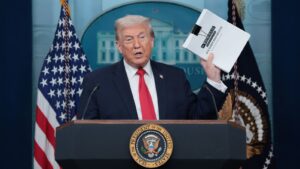
In a consequential ruling issued within the past week, the Supreme Court of the United States blocked a sweeping federal student loan relief initiative, determining that the executive branch lacked clear congressional authorization for the scale of debt cancellation proposed. The decision reasserts constitutional boundaries around spending authority and reinforces Congress’s exclusive power of the purse. President Donald Trump responded by emphasizing fiscal discipline and legislative accountability, framing the ruling as a victory for constitutional order rather than a policy setback. The judgment arrives amid broader debates over executive authority in trade, immigration, and national security — underscoring the judiciary’s active role in clarifying statutory limits. For markets, taxpayers, and borrowers alike, the immediate question is what relief pathways remain legally viable. As Congress re-enters the spotlight, the decision may recalibrate how future administrations approach large-scale economic programs.
Story Snapshot
- Supreme Court ruled executive branch lacked statutory authority for broad loan cancellation.
- Decision emphasized Congress’s constitutional spending power.
- Administration signaled support for targeted, congressionally authorized relief.
- Borrowers await clarity on repayment adjustments and hardship programs.
- Ruling adds to recent judicial scrutiny of executive economic authority.
Constitutional Spending Authority Reaffirmed
The Court’s majority opinion centered on separation of powers, concluding that the statute cited by the executive branch did not clearly authorize mass debt cancellation of the magnitude proposed. The ruling echoed prior jurisprudence emphasizing that major fiscal commitments require explicit congressional authorization. Legal observers noted that the decision reinforces the “major questions doctrine,” requiring clear legislative intent for transformative economic actions.
For constitutional conservatives, the judgment represents a reaffirmation of enumerated powers. By delineating the boundary between administrative discretion and legislative authority, the Court underscored that broad economic interventions must originate in Congress. This principle applies regardless of policy preference, serving as a structural safeguard rather than a partisan outcome.
President Trump’s public remarks highlighted this theme, arguing that durable economic reform requires legislative partnership rather than unilateral action. The administration indicated openness to narrower, targeted programs that align with statutory authority and budgetary transparency.
Economic and Political Implications
The blocked initiative would have affected millions of borrowers and carried significant fiscal implications. Treasury analysts previously estimated substantial budgetary costs tied to forgiveness mechanisms. Markets reacted with measured stability following the ruling, reflecting expectations that large-scale cancellation would now require congressional debate and appropriation.
Politically, the decision sharpens distinctions heading into the 2026 midterms. Democrats have signaled renewed efforts to pursue legislative solutions, while Republican lawmakers emphasize affordability reforms and targeted hardship relief rather than blanket cancellation. The debate now shifts squarely to Capitol Hill, where legislative arithmetic and fiscal priorities will determine any future action.
For the administration, the ruling provides an opportunity to advocate structural reforms focused on interest recalibration, repayment flexibility, and transparency in higher education financing — policies positioned as fiscally responsible alternatives to sweeping forgiveness.
Borrower Pathways and Administrative Adjustments
In the immediate aftermath, education officials confirmed that existing income-driven repayment plans and hardship deferment options remain operational. Borrowers currently enrolled in authorized programs will continue under established terms, though no new broad cancellation authority will be implemented without congressional approval.
Policy analysts expect renewed emphasis on targeted relief measures — such as adjustments for public service workers or streamlined repayment calculations — provided they fall within clearly defined statutory boundaries. The administration has indicated it will review all available legal tools to assist borrowers without contravening constitutional constraints.
This recalibration may reduce legal uncertainty for financial institutions and servicers, who faced operational complexity amid shifting executive directives. Stability in program administration could mitigate confusion among borrowers navigating repayment schedules.
Broader Executive Authority Context
The student loan ruling follows closely on other recent judicial decisions scrutinizing executive authority in trade and regulatory domains. Collectively, these cases reflect a judiciary attentive to statutory clarity and constitutional allocation of power. For governance, the pattern reinforces institutional equilibrium: ambitious policy objectives must rest on explicit legislative foundations.
Supporters of the ruling argue that long-term fiscal health depends on transparent budgeting and democratic accountability. Critics contend that congressional gridlock can delay needed relief. Yet both perspectives converge on the recognition that transformative economic measures ultimately require legislative legitimacy.
For President Trump, the decision aligns with messaging centered on fiscal restraint and constitutional fidelity. By embracing the Court’s reasoning and inviting congressional collaboration, the administration positions itself as operating within defined constitutional parameters while pursuing policy reform.
What Comes Next
Congress now holds the decisive role in shaping any future student loan relief. Legislative proposals may emerge in committee hearings over the coming weeks, though partisan divides suggest negotiation will be complex. In the meantime, borrowers will continue under existing repayment frameworks while monitoring potential statutory changes.
For American governance, the ruling underscores the enduring relevance of separation of powers in economic policymaking. As debates unfold over affordability and fiscal responsibility, the Court’s decision serves as a structural reminder: enduring reforms require legislative consensus.
The coming months will reveal whether Congress can translate political rhetoric into actionable statute. Until then, the balance between economic relief and constitutional discipline remains at the forefront of national policy discussion.
Sources
- Supreme Court blocks sweeping student loan forgiveness plan, Reuters, February 2026
- High court says White House exceeded authority on debt cancellation, Associated Press,
- What the Supreme Court ruling means for borrowers, PBS NewsHour,
- Trump comments on constitutional limits following student loan decision, Reuters,
