


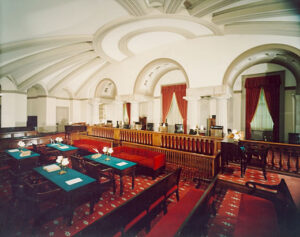
A major case now before the Supreme Court of the United States could redefine how much authority American presidents possess to impose tariffs in the name of national security and economic policy. The legal dispute centers on the scope of presidential power under federal trade laws, particularly statutes used to justify tariffs during the administration of Donald Trump. Business groups and trade advocates have challenged aspects of those tariffs, arguing that Congress — not the executive branch — should maintain the primary authority over trade policy. Supporters of strong executive authority counter that modern economic competition requires presidents to act quickly to defend domestic industries and national security interests.
As the Court hears arguments, the outcome could shape the future of U.S. trade policy and determine how far future administrations can go in deploying tariffs as a strategic economic tool. The case also touches on broader constitutional questions involving the separation of powers between Congress and the presidency, placing one of the defining policy tools of Trump’s economic agenda under judicial review.
Story Snapshot
-
The Supreme Court of the United States is reviewing presidential authority to impose tariffs.
-
The case examines trade laws used during the administration of Donald Trump.
-
Business groups argue Congress should retain primary authority over tariffs.
-
Supporters say presidents need flexibility to respond to economic threats.
-
The ruling could reshape U.S. trade policy and executive power.
-
The decision may influence how future administrations address global economic competition.
A Constitutional Battle Over Trade Authority
At the center of the case lies a long-standing constitutional question: how much authority the executive branch can exercise in matters traditionally handled by Congress. The U.S. Constitution grants Congress the power to regulate commerce with foreign nations, yet Congress has historically delegated portions of that authority to the executive branch through legislation.
Several statutes passed over the past century allow presidents to impose tariffs under certain conditions, particularly when national security concerns are involved. During his presidency, Donald Trump used those authorities to impose tariffs on imported steel and aluminum, arguing that reliance on foreign metals threatened America’s industrial base and military readiness.
The legal challenges now reaching the Supreme Court of the United States argue that these statutory delegations may give presidents too much discretion without sufficient congressional oversight. Plaintiffs claim that allowing the executive branch to impose broad tariffs risks undermining the constitutional separation of powers.
Supporters of presidential authority counter that Congress deliberately granted these powers to ensure the United States could respond quickly to emerging economic threats and unfair trade practices.
Trump’s Tariff Strategy and Its Legacy
The tariff policies implemented during the Trump administration marked one of the most significant shifts in U.S. trade policy in decades. Trump argued that previous trade arrangements allowed foreign competitors — particularly China — to gain unfair advantages while American manufacturing declined.
His administration used tariff authorities to pressure trading partners, renegotiate agreements, and promote domestic industrial capacity. These actions became central to the “America First” economic strategy that defined much of Trump’s presidency.
Supporters say those policies successfully forced international negotiations that addressed longstanding trade imbalances. They also argue that tariffs helped highlight the national security implications of relying on foreign suppliers for critical materials.
Critics, however, argue that tariffs can increase costs for American consumers and businesses that depend on imported components. The case before the Court reflects these competing perspectives on how trade policy should be conducted in an era of global economic rivalry.
Strategic Stakes for Global Economic Competition
The outcome of the case carries implications far beyond the immediate dispute over tariffs. In today’s global economy, trade policy functions not only as an economic instrument but also as a strategic tool used to influence geopolitical relationships.
Countries frequently deploy tariffs, export controls, and industrial policy measures to strengthen domestic industries and protect national security interests. For the United States, maintaining flexibility in trade policy is increasingly seen as essential for competing with major economic rivals.
If the Supreme Court of the United States were to limit presidential tariff authority, Congress might need to take a more active role in trade enforcement decisions. Such a shift could slow the government’s ability to respond quickly to international economic disputes.
Alternatively, a ruling affirming broad executive authority could reinforce the ability of future presidents to deploy tariffs as part of broader strategic competition with other global powers.
Separation of Powers at the Center
Beyond trade policy itself, the case highlights deeper constitutional questions about how power is distributed within the federal government. The balance between Congress and the presidency has long been debated in areas ranging from national security to regulatory oversight.
Trade policy presents a particularly complex example because it intersects with both economic regulation and foreign policy considerations. Presidents often argue that rapid decision-making is essential when dealing with international trade disputes.
At the same time, members of the United States Congress emphasize that tariffs function as taxes on imports — a power historically associated with legislative authority.
The Supreme Court’s decision could therefore influence how broadly Congress can delegate authority to the executive branch in the future, not only in trade policy but across other areas of federal governance.
Looking Ahead
The ruling expected from the Supreme Court of the United States will likely have lasting consequences for American trade policy and constitutional governance. If the Court affirms the current framework, presidents will retain broad authority to use tariffs as strategic economic tools in response to global competition.
If the Court limits those powers, lawmakers in the United States Congress may be forced to revisit trade legislation and establish clearer guidelines for when tariffs can be imposed.
Either way, the decision will shape how the United States navigates economic rivalry in the decades ahead. For policymakers aligned with the economic strategy advanced by Donald Trump, the case represents a critical moment in determining whether strong trade enforcement tools remain available to defend American industry and national security.
