
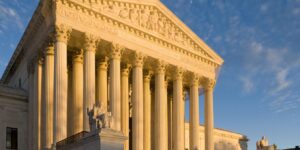
A consequential Second Amendment case moved to the forefront of national debate this week as the Supreme Court of the United States heard oral arguments in a challenge to a state-level firearms restriction that could reshape the legal landscape for gun regulation nationwide. The case, brought by gun owners and a firearms advocacy organization, tests the limits of post-Bruen jurisprudence and asks whether certain modern licensing and possession restrictions align with the Constitution’s text and historical tradition.
The outcome carries sweeping implications not only for state regulatory authority but also for how lower courts interpret the Second Amendment moving forward. For conservatives and many Republicans, including Donald Trump, the case represents a critical inflection point in restoring what they argue are foundational constitutional protections. Strategically, the ruling could influence election-year narratives around public safety, federalism, and the proper role of courts in balancing individual liberty with state police powers.
Story Snapshot
- Supreme Court hears major Second Amendment case challenging state gun restrictions.
- Case builds on 2022 Bruen decision requiring historical-tradition test.
- Central question: Do modern licensing and possession rules align with constitutional text?
- Ruling could limit or uphold state-level gun control frameworks nationwide.
- Decision expected before summer recess; high political and constitutional stakes.
The Constitutional Framework After Bruen
The Court’s current review builds directly on its 2022 decision in New York State Rifle & Pistol Association v. Bruen, which established that gun regulations must be consistent with the nation’s historical tradition of firearm regulation. That ruling rejected interest-balancing tests and shifted the analytical framework toward textual and historical inquiry.
In this latest case, challengers argue that the state’s firearm restrictions — including expanded licensing requirements and certain location-based carry prohibitions — exceed historical precedent and effectively nullify the right to bear arms in practice. State officials counter that public safety considerations justify tailored regulations and that historical analogues exist for reasonable limits.
The justices’ questioning during oral arguments reflected a deeper inquiry: how narrowly or broadly should courts interpret “historical tradition”? Some appeared skeptical of overly rigid historical comparisons, while others emphasized that constitutional rights cannot be diluted by modern policy preferences. The debate signals a continued judicial effort to clarify how far Bruen extends.
Federalism, State Power, and Judicial Authority
At its core, the case tests the balance between state police powers and constitutional protections. Under American federalism, states retain broad authority to regulate for public safety. However, that authority is constrained by the Bill of Rights, incorporated against the states through the Fourteenth Amendment.
If the Court rules in favor of the challengers, it could significantly restrict the scope of permissible state gun regulations, forcing legislatures to redraft statutes nationwide. Conversely, if the justices uphold the law, states may view the decision as a green light to maintain or expand regulatory frameworks under a more flexible historical analysis.
For lawmakers in both the United States Senate and the United States House of Representatives, the case underscores the enduring tension between legislative policymaking and judicial review. Congress itself is not directly at issue in this case, but federal firearms legislation could be indirectly influenced by how the Court defines constitutional boundaries.
The broader constitutional question is whether the judiciary will reinforce a strict originalist interpretation of the Second Amendment or allow more deference to contemporary legislative judgments. That choice will shape legal doctrine for decades.
Political Reverberations and Election-Year Messaging
Gun rights remain one of the most mobilizing issues in American politics. For Republican leaders, including Trump, a strong pro-Second Amendment ruling would reinforce campaign messaging centered on constitutional fidelity and protection of individual liberties. Trump has consistently framed judicial appointments as instrumental in safeguarding gun rights, pointing to prior Supreme Court decisions as evidence of long-term institutional impact.
Democrats, meanwhile, have emphasized public safety concerns and the need for states to address gun violence through targeted regulation. The Court’s decision could energize voters on both sides — either as validation of constitutional protections or as a catalyst for renewed legislative efforts at the state level.
In competitive districts and swing states, the ruling may become a defining talking point. Candidates will likely tailor messaging around the Court’s reasoning rather than simply its outcome, especially if the opinion delineates a nuanced middle ground rather than an absolute stance.
Strategic Implications for Governance and Law
Beyond politics, the ruling will influence how lower federal courts evaluate Second Amendment claims. Since Bruen, district and appellate courts have issued varied interpretations, creating legal uncertainty. A clarifying decision could harmonize standards across jurisdictions and reduce conflicting rulings.
Operationally, law enforcement agencies and state governments will need to adjust compliance frameworks depending on the outcome. If key provisions are struck down, states may face immediate injunctions and statutory revisions. If upheld, regulatory models could become templates for other jurisdictions.
The Court’s credibility is also at stake. As one of the most scrutinized institutions in American governance, its handling of high-profile constitutional disputes influences public trust. A carefully reasoned opinion grounded in precedent and historical analysis may help stabilize jurisprudence in an area long characterized by political volatility.
What Comes Next
A final decision is expected before the Court’s summer recess. Whatever the outcome, it will mark another pivotal chapter in the evolving interpretation of the Second Amendment.
For American governance, the implications extend beyond firearms policy. The case will signal how firmly the Court intends to anchor constitutional rights in historical understanding versus contemporary legislative judgment. That interpretive stance will ripple into other areas of constitutional law, from free speech to administrative authority.
As the nation awaits the ruling, one principle remains clear: the Supreme Court’s interpretation of foundational rights continues to shape not only legal doctrine but also the broader political and cultural trajectory of the United States.
