


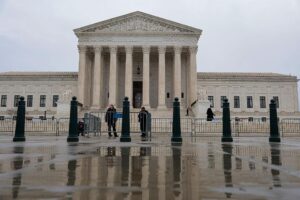
A fresh judicial setback on presidential tariff authority has intensified the debate over executive power and economic leverage in Washington. In a ruling issued within the past week, the Supreme Court of the United States determined that portions of the administration’s broad global tariff structure exceeded statutory limits under emergency authorities. President Donald Trump responded by directing trade officials to implement a revised 15% tariff framework under alternative provisions of existing trade law, signaling that the policy objective remains intact even as legal boundaries tighten. The decision has shifted the battleground from courtroom to Capitol Hill, where lawmakers now face pressure to clarify or expand presidential trade powers. For markets, trading partners, and voters, the episode underscores how constitutional checks intersect with economic strategy. As midterm dynamics intensify, the ruling may become a defining case study in executive recalibration under judicial scrutiny.
Story Snapshot
- Supreme Court invalidated parts of the administration’s emergency tariff authority.
- White House pivoted to a revised 15% tariff plan under Section 301 authorities.
- Senate leaders weigh potential legislative clarification of trade powers.
- European officials urged stability in existing trade commitments.
- State of the Union expected to address constitutional balance and economic leverage.
Judicial Check on Emergency Powers
The Court’s majority opinion centered on statutory interpretation, concluding that emergency economic authorities were not intended to authorize sweeping global tariffs unrelated to a defined crisis. The ruling emphasized Congress’s constitutional role in regulating commerce with foreign nations.
Legal analysts described the decision as part of a broader judicial trend scrutinizing expansive executive interpretations of delegated authority. By narrowing the use of emergency statutes, the Court reinforced the principle that transformative economic measures require explicit legislative backing.
For the administration, the ruling represented a procedural correction rather than a policy reversal. Officials stressed that the objective — confronting unfair trade practices and protecting domestic manufacturing — remains unchanged. The recalibration to alternative statutory tools reflects an effort to preserve leverage within clearer legal boundaries.
Strategic Pivot to Durable Authority
Within days of the ruling, trade officials announced that a revised tariff structure would take effect under Section 301 and related provisions historically used to address discriminatory trade practices. The 15% framework is designed to maintain negotiating leverage while reducing exposure to further judicial challenge.
Supporters argue that the swift pivot demonstrates institutional adaptability — respecting judicial review while sustaining economic strategy. Critics warn that continued tariff escalation could strain supply chains and invite retaliatory measures.
International reaction has been measured but attentive. European Union representatives publicly urged the United States to honor existing trade agreements and avoid destabilizing cycles of retaliation. Markets showed short-term volatility but stabilized as clarity emerged around the revised structure.
Congressional Crossroads in the Senate
The ruling has placed renewed focus on the United States Senate, where lawmakers are debating whether to codify broader trade authorities or impose clearer guardrails. Some Republican senators have floated legislation to streamline presidential response powers in cases involving economic security. Others emphasize preserving congressional oversight to prevent future legal reversals.
The outcome carries institutional significance. Trade authority has historically oscillated between delegated executive discretion and congressional control. The Court’s decision effectively invites Congress to clarify its intent. Whether lawmakers choose expansion or restraint will shape the balance of power in economic policymaking.
From a political perspective, recorded votes on trade authority could sharpen campaign contrasts ahead of November. For the administration, legislative reinforcement would provide long-term stability; for Congress, inaction risks continued legal ambiguity.
Economic Leverage and Global Positioning
Beyond legal mechanics, the tariff dispute intersects with broader strategic objectives. The administration argues that assertive trade enforcement underpins domestic industrial resilience and counters unfair practices abroad. By maintaining a revised tariff framework, officials aim to signal continuity of economic leverage despite judicial recalibration.
Analysts note that sustained tariffs may influence inflationary dynamics and corporate planning decisions. Business groups have urged predictable implementation timelines to minimize uncertainty.
The White House has framed the episode as evidence that constitutional checks do not weaken executive resolve but refine it. By adapting quickly to judicial boundaries, the administration seeks to reinforce credibility both domestically and internationally.
What Comes Next
Attention now turns to legislative action and diplomatic engagement. Senate committees are expected to hold hearings on trade authority in the coming weeks. Trading partners may initiate dispute resolution mechanisms or seek negotiated adjustments under the revised framework.
For American governance, the episode illustrates the dynamic interplay of branches in shaping economic policy. The judiciary defined statutory limits; the executive recalibrated; the legislature now holds the power to clarify or constrain future authority.
As the State of the Union approaches, President Trump is likely to present the tariff pivot as a demonstration of constitutional respect paired with economic strength. Whether Congress codifies that approach or allows the revised framework to stand without further action will determine the durability of U.S. trade leverage in the years ahead.
Sources
- U.S. Supreme Court strikes down Trump’s global tariffs, Reuters, February 20, 2026
- Trump increases global tariffs to 15% after Supreme Court decision, PBS NewsHour, February 22, 2026
- EU says US must honor a trade deal after court blocks Trump tariffs, Associated Press, February 21, 2026
- Senate leaders weigh response to Supreme Court trade ruling, Reuters, February 2026
