


In the span of just over a week, the U.S. political and geopolitical landscape has undergone seismic shifts with far-reaching implications for American governance, global power balance, and the 2026 election cycle. President Donald Trump is driving a bold recalibration of U.S. strategy domestically and abroad — from a historic Supreme Court setback on executive tariff authority to a dramatic escalation in military operations targeting Iran’s regime. At home, the Supreme Court’s February 20 decision curtailed his claimed use of emergency authorities to impose tariffs, forcing a tactical retooling of trade policy under traditional statutes while raising constitutional questions about executive overreach and economic statecraft.
Abroad, an unprecedented U.S.–Israeli aerial campaign that eliminated Iran’s Supreme Leader and much of its political leadership has catapulted the Middle East into a new era of volatility and raised urgent questions about congressional war powers, regional stability, and global markets. These concurrent developments — legal, economic, and military — reveal a presidency unafraid to employ every tool of statecraft, even as institutional checks and geopolitical risks mount. Understanding these shifts is essential to grasp how Trump’s leadership is reshaping America’s strategic position at home and on the world stage.
Story Snapshot
- Supreme Court curtails tariff authority: SCOTUS ruled 6–3 that tariff powers under the International Emergency Economic Powers Act (IEEPA) do not vest in the executive, forcing policy reset.
- New 10% tariffs instituted under traditional law: The administration swiftly pivoted to Section 122 tariffs to maintain leverage.
- U.S.–Israeli strikes decapitate Iran’s leadership: Air warfare initiative escalates conflict, killing Ayatollah Khamenei and sparking regional retaliation.
- Lack of clear post-strike strategy alarms lawmakers: Bipartisan concern grows over exit strategy and congressional authorization.
- Election-year and constitutional pressures intensify: Tariff debate ties to economic messaging; war powers debate influences 2026 campaign narratives.
Tariffs, Courts, and Constitutional Boundaries
On February 20, 2026, the Supreme Court of the United States delivered a landmark 6–3 opinion in Learning Resources, Inc. v. Trump, holding that the International Emergency Economic Powers Act did not empower the President to unilaterally impose tariff duties. The decision underscored the Constitution’s explicit grant of “Power To lay and collect Taxes, Duties, Imposts and Excises” to United States Congress — a core check on executive economic authority long debated by constitutional scholars.
While the Court’s statutory analysis was narrow in scope, the practical implications are sweeping. The tariffs imposed under IEEPA had formed the backbone of the administration’s leverage in trade negotiations and were tied to high-profile economic messaging about foreign burden-sharing. With those tools invalidated, the White House rapidly instituted a 10% across-the-board tariff regime under Section 122 of the Trade Act of 1974, a statute with more explicit congressional roots. This tactical pivot reflects both a governor’s instinct for policy continuity and a stark reminder of the constitutional boundary between branches of government.
Operationally, these new tariffs are temporary — valid for 150 days unless Congress acts — placing the onus on lawmakers to either authorize a permanent regime or risk policy reversal. As economic commentators note, the Supreme Court decision has also created a scramble over how collected tariffs might be refunded, a legal quagmire that could tie up federal courts for months. Exterior trade partners are already seeking clarification from Washington, injecting uncertainty into global supply chains and negotiations.
From Negotiations to Warfare: The Iran Escalation
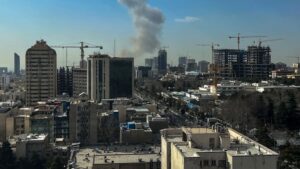
Concurrently, the administration’s Middle East strategy has undergone a dramatic escalation. A joint U.S.–Israeli aerial campaign — dubbed “Operation Epic Fury” by the Pentagon — has struck deep into Iran, resulting in the confirmed death of Supreme Leader Ayatollah Ali Khamenei and decimation of the Iranian leadership hierarchy. These strikes followed the collapse of diplomatic negotiations in Geneva over Iran’s nuclear program earlier this month.
The decision to authorize such extensive military action reflects a stark repudiation of the traditional “America Last” isolationist posture that once defined significant strands of Trump’s rhetoric. Instead, the administration argues that decisive action was necessary to disrupt a regime it deems a long-term strategic threat, particularly given Iran’s proxy activities across the Middle East.
However, the aftermath has been chaotic. Iran and its allied militias have launched missiles and drones at U.S. bases and regional partners, while United Nations agencies have warned of broader humanitarian risks. Oil markets have reacted to potential closures at the Strait of Hormuz, and global airline networks have experienced airspace disruptions. The strategic calculus now facing Washington — whether to absorb further escalation or pursue de-escalation — will define U.S. influence in the region for years.
Political Fault Lines: War Powers and Election Stakes
Domestically, the conflict has fractured consensus. United States Senate and United States House of Representatives members from both parties have voiced concerns about the absence of clear congressional authorization for hostilities potentially far exceeding self-defense actions. While many Republicans have praised decisive action, others caution against open-ended commitments without legislative oversight. Democrats, predictably, have framed the operation as a “war of choice,” highlighting the risks of mission creep and historical precedents of prolonged entanglement.
These debates have tangible election-year consequences. On economic issues, tariff authority and inflationary pressures continue to shape voter sentiment, especially among working-class constituencies. On foreign policy, the administration’s assertiveness may solidify support among hawkish conservatives, even as it energizes opposition narratives about executive overreach and misaligned priorities. The interplay of these dimensions will be a defining feature of the 2026 political landscape.
What Comes Next
The weeks ahead will test the resilience of U.S. constitutional governance and strategic policy alignment. On trade, Congress must decide whether to codify the interim tariff regime and clarify executive authority over economic statecraft. On the global stage, the administration must articulate a coherent exit strategy from the Middle East escalation, balancing deterrence with the imperative to avoid open-ended combat.
For American national interests, the stakes are clear: reaffirming institutional checks and balances while maintaining credible deterrence abroad. How Washington navigates these pressures — legally, economically, and geopolitically — will shape the country’s standing at home and around the world as 2026 unfolds.
Sources
- SCOTUS tariff ruling details and impact
- New Section 122 tariffs under U.S. law
- Diplomacy collapses into military action in Iran
- Trump administration outlines operational goals and warnings
- Lawmakers critique lack of post‑strike strategy
