


Story Highlights
- Trump’s March 31 executive order directs the USPS to send mail ballots only to voters appearing on lists compiled from DHS and Social Security Administration citizenship data — effectively banning mail-in voting for anyone not on those lists
- A previous Trump executive order on elections signed in early 2025 was substantially blocked by federal courts; legal experts say this order faces the same constitutional vulnerabilities
- UCLA election law professor Rick Hasen called the order “likely unconstitutional” and said there is “no way” DHS and USPS could implement it before November even if courts allowed it
What Happened
President Donald Trump signed an executive order on March 31 titled “Ensuring Citizenship Verification and Integrity in Federal Elections.” The order directs the Department of Homeland Security, in coordination with the Social Security Administration, to compile a list of verified U.S. citizens in each state who are eligible to vote. That list would be transmitted to state election officials no fewer than 60 days before each federal election. Critically, the order further directs the United States Postal Service to send mail ballots only to voters appearing on those lists — effectively prohibiting mail ballot delivery to any voter whose citizenship cannot be confirmed through the federal databases involved.
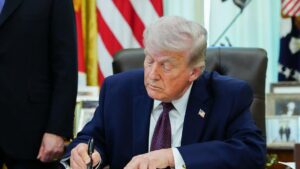
Trump signed the order in the Oval Office with Commerce Secretary Howard Lutnick present, telling reporters: “We want to have honest voting in our country, because if you don’t have honest voting, you can’t have, really, a nation.” He described the order as “foolproof” and acknowledged it might face legal challenges. The administration also directed the Attorney General to prioritize investigation and prosecution of election officials or private entities that distribute federal ballots to ineligible voters — a provision critics characterized as a direct threat to state and local election administrators.
The reaction from states was swift and unambiguous. Arizona Secretary of State Adrian Fontes called the order “a disgusting overreach” and vowed to meet the federal government in court. Massachusetts Attorney General Andrea Joy Campbell announced her office would take legal action to ensure every eligible Massachusetts voter could vote. Colorado Secretary of State Jena Griswold said her state’s lawyers were already engaged and called the order “unconstitutional overreach.” Scott McDonell, the clerk of Dane County, Wisconsin, told Votebeat the order was “just an empty threat” based on his attorneys’ assessment.
Rick Hasen, a professor of election law at the University of California, Los Angeles, offered a precise constitutional analysis. The fundamental constitutional problem, he said, is that “the Constitution doesn’t give DHS any power over elections.” Article I, Section 4 gives states and Congress — not the president — authority over the “times, places, and manner” of federal elections. The executive branch, Hasen wrote on his widely read election law blog, has no role in changing how states conduct elections. He added that even setting aside constitutionality, the order “makes this virtually impossible to implement in time for November’s elections” regardless of court outcomes.
Why It Matters
The constitutional objection to Trump’s mail-in voting order is not partisan — it reflects a structural principle that both Republican and Democratic legal scholars agree on. Election administration in the United States is a state function, protected by the Tenth Amendment and directly addressed in Article I. Presidents do not have inherent constitutional authority to issue executive orders governing how states handle voter registration or ballot transmission. Congress can regulate federal elections by statute; the president cannot do so unilaterally.
The order also represents a direct attempt to use the executive branch’s data infrastructure to reshape an election in which the sitting president’s party is competing. DHS and the Social Security Administration hold imperfect, often outdated data on citizenship status. Millions of naturalized citizens and native-born citizens may not appear on those lists due to database gaps, name changes, record errors, or other administrative failures. Removing those individuals from the pool of eligible mail-in voters based on administrative data deficiencies — without notice or remedy — would constitute a large-scale disenfranchisement of eligible American citizens.
This is the second executive order Trump has signed targeting elections. The first, signed approximately a year earlier, was substantially blocked by federal courts that found the president lacked constitutional authority to condition federal election funding on state compliance with his preferred voting rules. That ruling established a precedent directly applicable to the current order, and the same legal organizations that challenged the first are preparing to challenge the second.
Economic and Global Context
Mail-in voting is not a partisan practice in its origins. Several Republican-led states — including Arizona, Utah, and Colorado — built their election systems substantially around vote-by-mail precisely because it is cost-effective, increases turnout, and is logistically efficient. Arizona’s Republican Secretary of State predecessor and many Republican election officials in western states have been among mail-in voting’s strongest defenders. During the 2024 general election, the USPS successfully delivered over 99 million ballots with over 97 percent delivered within three days — a record that election officials across party lines have cited as evidence the system works.
The cost of implementing Trump’s order, if allowed to stand, would fall entirely on states and localities. Building new database integration systems, redesigning voter list protocols, retraining poll workers, and updating absentee voter lists to meet federal DHS specifications would require months of work and substantial appropriations that have not been provided. The Election Center, a nonpartisan association of election officials, noted that the barcode-based ballot tracking system contemplated in the order would require new envelope specifications that states do not currently use.
The legal industry surrounding this executive order will itself generate substantial expense. More than two dozen states have already been sued by the Trump administration over voter data access; those cases are proceeding simultaneously with the new round of litigation over the March 31 order. Federal court dockets in multiple districts are already backlogged with Trump-era election litigation.
Implications
The most immediate question is whether a federal court will issue a preliminary injunction blocking enforcement of the order before implementation becomes practically relevant. Given the prior court rulings on Trump’s first election executive order and the constitutional consensus among legal scholars, an injunction is widely anticipated. The administration may appeal, but the timeline for resolution — combined with Hasen’s assessment that implementation is impossible even without court interference — suggests the order will not affect the 2026 November elections as a practical matter.
The longer-term implication is the signal the order sends to state election administrators and would-be voters. Even orders that do not survive legal challenge can suppress participation, generate confusion, and undermine public confidence in election integrity if heavily publicized. Research on voter deterrence consistently finds that the announcement of new voting requirements — even legally invalid ones — reduces turnout among voters who are uncertain about their eligibility.
For the filibuster debate running in parallel, the executive order illustrates an alternative strategy. When legislative paths to election policy change are blocked by the 60-vote threshold, the administration is using executive orders as a parallel track — issuing orders it knows may not survive judicial review but that generate political content, motivate the base, and pressure courts to move as slowly as possible.
Sources
“Trump signs executive order limiting mail-in voting ahead of 2026 U.S. elections”
