


Story Highlights
- Banks announced his resignation effective immediately on May 14, citing 37 years of public service and a desire to spend time with his family
- His exit is the third high-profile DHS departure in two months, following acting ICE Director Todd Lyons and former DHS Secretary Kristi Noem
- No successor to Banks has been named, and the leadership vacuum coincides with an ongoing ICE director transition as well
What Happened
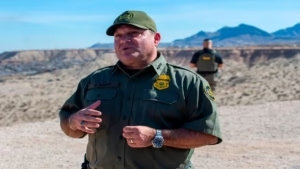
Michael Banks disclosed his resignation in a Fox News interview on Thursday, May 14, informing staff that he was stepping down from the nation’s top border enforcement post with no advance notice. “It’s just time,” Banks was quoted as saying. He said he had guided the agency from what he characterized as the chaotic conditions of the Biden era to the most secure border the country had ever recorded and framed his departure as a natural conclusion to a long career rather than a forced exit.
Banks brought a distinctive background to the job. He served nearly 37 years in government, including a prominent stint as border czar for Texas Governor Greg Abbott, during which he helped oversee the state’s multibillion-dollar border enforcement surge known as Operation Lone Star. That operation generated significant controversy, including legal battles with the Biden administration over state versus federal enforcement authority. His appointment to the federal Border Patrol role came as the Trump administration sought experienced immigration hardliners to execute its aggressive enforcement agenda.
U.S. Customs and Border Protection Commissioner Rodney Scott thanked Banks in a statement, saying the agency was proud of his “decades of service” and that under his watch the border had been “transformed from chaos to the most secure border ever recorded.” The statement did not name a replacement or indicate when one would be announced.
The resignation comes at a particularly disruptive moment for DHS. ICE Acting Director Todd Lyons also announced he is stepping down, with his final day set for May 31. His replacement, David Venturella — a longtime immigration official and former executive at a private prison company — has been selected but has not yet assumed the role. Meanwhile, Kristi Noem was replaced as DHS Secretary by former Republican Senator Markwayne Mullin of Oklahoma just two months ago, making Banks’ departure the third significant leadership change within the department in a very short period.
Why It Matters
The simultaneous leadership turnover across DHS’s key immigration enforcement agencies represents a significant disruption to the Trump administration’s signature domestic policy priority. Immigration enforcement has been the most high-profile component of Trump’s second-term agenda, with large-scale deportation operations, city-focused enforcement sweeps, and legal battles over federal authority all unfolding simultaneously.
Institutional continuity matters enormously in law enforcement agencies. The Border Patrol is a complex, sprawling organization responsible for securing thousands of miles of border with a workforce trained in field operations, intelligence, and legal protocols. Transitions at the top — particularly abrupt ones — can slow decision-making, reduce morale, and create openings for confusion about priorities and chain of command.
The absence of a named successor for Banks compounds this concern. With Lyons departing ICE at the end of the month and Venturella still transitioning into that role, the two agencies most central to Trump’s enforcement strategy are both operating in a leadership vacuum simultaneously. This is not a routine administrative challenge — it occurs while those agencies are actively conducting enforcement operations in American cities, operating family detention facilities, and processing removal orders at elevated rates.
The resignations also invite scrutiny about whether these departures are truly voluntary. Banks’ statement, framed around personal timing after claiming mission success, is consistent with an amicable exit. However, the pattern across DHS — multiple senior officials leaving in quick succession under a relatively new secretary — raises legitimate questions about internal tensions, shifts in strategic direction, or political pressure from above.
Economic and Global Context
Immigration policy intersects directly with labor market economics in ways that affect American businesses, workers, and consumers. The Trump administration’s enforcement posture has created significant uncertainty for industries that rely on immigrant labor, including agriculture, construction, food service, and hospitality. Any reduction in the consistency of enforcement policy resulting from leadership gaps could produce both practical and reputational consequences.
The administration has pursued a dual approach: aggressively removing undocumented individuals while simultaneously pursuing legal immigration reforms. Banks’ tenure coincided with dramatic reductions in illegal border crossings, a development the administration has highlighted repeatedly as evidence of policy success. Whether that trend holds through leadership transitions will be closely watched by both supporters and critics of the enforcement strategy.
The use of Border Patrol in city-based enforcement operations — a significant expansion from its traditional border mission — also represents a policy commitment that will require sustained leadership to maintain. Without a named chief, decisions about operational scope could slow or face internal resistance.
Implications
For the Trump administration, the optics of simultaneous leadership exits from its most politically central department are uncomfortable, regardless of the stated rationale. The White House will need to move quickly to name a credible successor for Banks to avoid extended disruption to Border Patrol operations and to reassure supporters that the immigration enforcement apparatus remains fully functional.
For federal immigration officials in the field, the uncertainty at the top can be demoralizing and practically complicated. Operations that require high-level authorization or strategic direction may face delays while acting leadership is established. Field agents and officers are typically professional enough to maintain operations, but long-term vacancies weaken institutional function.
For communities and advocacy organizations tracking immigration enforcement, the leadership changes provide a moment to assess whether policy direction will shift under new leadership or whether Mullin’s DHS will maintain the same operational posture. The selection of Venturella — with his private prison background — suggests the administration intends to maintain an aggressive enforcement approach at ICE.
Sources
“Border Patrol chief Mike Banks resigns in latest DHS leadership shake-up”
