
Story Highlights
- The Trump administration issued an executive order requiring federal agencies to eliminate at least ten existing regulations for each new rule, representing an unprecedented deregulatory approach
- Courts have begun questioning the constitutional authority for the “10 for 1” requirement and its compatibility with federal statutes and the Administrative Procedure Act
- The deregulatory initiative raises separation of powers questions about whether presidents can override statutory requirements and congressional regulatory mandates through executive orders
What Happened
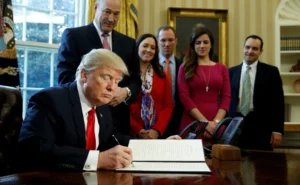
President Donald Trump issued an executive order titled “Unleashing Prosperity Through Deregulation,” in which the administration asserts that federal regulations impose significant costs and complexities on American citizens and businesses that hinder economic growth, innovation, and global competitiveness. The executive order requires agencies to identify at least 10 existing regulations for repeal when proposing a new regulation, known as the “10 for 1” tradeoff.
The “10 for 1” requirement goes well beyond a previous “2 for 1” executive order issued during the first Trump administration and represents a significantly more aggressive approach to deregulation. The executive order directs federal agencies to identify and repeal regulations across all policy areas, including those protecting environmental quality, worker safety, consumer protection, and public health.
The administration has issued additional executive orders reinforcing and expanding the deregulatory initiative. On February 19, 2025, President Trump issued Executive Order 14219, entitled “Ensuring Lawful Governance and Implementing the President’s ‘Department of Government Efficiency’ Deregulatory Initiative,” directing agencies to review all regulations for conformance with the law and the administration’s policy.
Federal agencies have begun implementing the deregulatory directive by identifying regulations for potential repeal. However, courts have raised questions about whether agencies can legally eliminate regulations that implement specific statutory mandates without violating the Administrative Procedure Act or conflicting with congressional directives embedded in federal law.
Why It Matters
The executive deregulatory order raises fundamental constitutional questions about presidential authority to override statutory requirements and congressional regulatory mandates. When Congress enacts legislation requiring specific regulatory protections, the question becomes whether the president can unilaterally overturn those requirements through executive order directing agencies to eliminate the implementing regulations.
The separation of powers framework suggests limits on presidential power to override congressional directives. Congress possesses the legislative power to enact statutes, while the president possesses authority to execute the laws Congress enacts. If the president can eliminate regulations implementing congressional mandates simply by ordering their repeal, the president’s power to execute laws would extend to the power to nullify them, potentially violating the separation of powers.
The deregulatory initiative also affects the rule of law principle that regulations implement statutory requirements enacted through democratic processes. When Congress enacts legislation protecting environmental quality, worker safety, or consumer interests, the resulting regulations reflect congressional policy choices. Presidential authority to eliminate those regulations without congressional involvement raises questions about whether the administrative state properly implements the constitutional framework of separated powers.
Courts applying the Administrative Procedure Act have suggested that agency decisions eliminating longstanding regulations must provide reasoned explanations and address the factors underlying the original regulations’ adoption. Eliminating regulations simply to comply with a “10 for 1” requirement without addressing the statutory basis for the regulations may violate the Administrative Procedure Act’s requirement that agency action be based on reasoned decision-making.
Economic and Global Context
The deregulatory initiative affects regulations across numerous industries and policy domains. Environmental regulations controlling air and water pollution, emissions standards, and climate-related policies face potential elimination. Labor regulations governing workplace safety, wage and hour requirements, and worker protection face pressure to be identified for repeal. Consumer protection regulations covering product safety, financial services, and food safety are potential targets for deregulation.
The economic effects of deregulation depend on specific regulatory changes. Some economists argue that eliminating costly regulations can reduce business expenses and promote economic growth. Others contend that regulations protecting environmental quality, worker safety, and consumer interests provide net economic benefits by preventing pollution, workplace injuries, and consumer harm that exceed the costs of regulatory compliance.
International trade partners have expressed concerns about the deregulatory initiative’s effects on environmental and labor standards. The European Union and other trading partners have suggested that eliminating environmental regulations could trigger trade disputes and tariffs, creating economic costs that offset deregulation benefits.
Implications
The deregulatory initiative will face ongoing constitutional challenges in federal courts addressing whether the executive order violates the Administrative Procedure Act and separation of powers principles. Courts will need to determine whether the “10 for 1” requirement represents a valid exercise of presidential authority or an impermissible override of congressional directives.
For federal agencies, the executive order creates legal risks when agencies eliminate regulations implementing specific statutory mandates. Agencies must balance pressure from the administration to comply with the deregulatory directive against legal risks if courts find that eliminating specific regulations violates the Administrative Procedure Act or conflicts with statutory requirements.
For Congress, the constitutional questions raised by the deregulatory initiative suggest that legislators considering future regulatory statutes should include explicit language limiting presidential authority to modify or eliminate implementing regulations. Congress may need to enact statutes specifying that implementing regulations cannot be eliminated or modified without congressional authorization.
For regulated industries and business sectors, the deregulatory initiative creates uncertainty regarding which regulations will ultimately survive judicial challenge. Businesses cannot confidently plan long-term compliance strategies without knowing which regulations will remain in force and which will be eliminated.
Sources
“President Trump’s Executive Order Seeks to Reduce Federal Regulation”
