

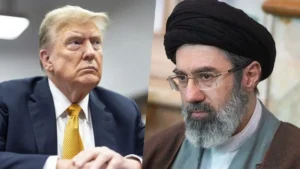
President Donald Trump gathered his full Cabinet at the White House on Wednesday as negotiations to end the ongoing military conflict with Iran entered a decisive and uncertain phase. The meeting comes just days after Trump declared a deal was “largely negotiated,” even as Iranian officials publicly disputed that characterization. With a draft memorandum of understanding reported on Iranian state television and Pentagon finances under strain, the pressure on the administration to close a deal has never been greater.
Story Highlights
- Trump had originally planned the Cabinet session at Camp David, but it was moved to the White House due to expected bad weather.
- Iranian state television reported a draft memo calling for U.S. military forces to withdraw from Iran’s vicinity and lift the blockade of Iranian ports in return for the reopening of the Strait of Hormuz to pre-war levels. The U.S. has not yet commented on the report.
- The Pentagon has been struggling financially, with uniformed military leaders pressing Congress to support additional funding as routine training and maintenance have been impacted by ongoing operations against Iran.
What Happened
President Donald Trump gathered his Cabinet on Wednesday at a precarious moment for talks aimed at ending the war with Iran, just days after insisting that his administration and Tehran had “largely negotiated” a settlement — though negotiations remained in a state of flux.
All Cabinet members were expected to attend, including outgoing Director of National Intelligence Tulsi Gabbard. The gathering came as the administration weighed next steps in high-stakes negotiations aimed at securing a broader agreement with Tehran amid a fraying ceasefire. Trump had in recent days suggested the sides were nearing a potential breakthrough, while Iranian officials publicly pushed back on claims that a deal was imminent.
According to a report on Iranian state television, the memorandum of understanding being negotiated between Iran and the U.S. would call for American military forces to withdraw from Iran’s vicinity and lift the blockade of Iranian ports in return for the reopening of the Strait of Hormuz to pre-war levels. The White House had not officially confirmed or denied the contents of the memo as of Wednesday morning.
On the ground inside Iran, the country imposed new restrictions on messaging and app stores, according to an internet watchdog, after yesterday partially easing a communications blackout that had lasted nearly 90 days. The mixed signals from Tehran have complicated the U.S. negotiating position, with the administration trying to read genuine Iranian intent from a government that simultaneously signals openness and defiance.
The Navy’s top officer, Admiral Daryl Caudle, told House Armed Services Committee lawmakers that his 2026 budget did not account for Operation Epic Fury and that the Navy faces impacts on routine operations as a result. That financial pressure has added urgency to administration efforts to reach a negotiated settlement rather than allow the conflict to drag on indefinitely.
Why It Matters
The Cabinet meeting represents the most significant formal deliberation the Trump administration has convened on Iran since the conflict began. While Camp David sessions are historically reserved for the gravest national security decisions, the decision to hold it at the White House due to weather does not diminish what is at stake. The administration is navigating a narrow corridor between military pressure and diplomatic resolution, with the Strait of Hormuz — one of the world’s most critical oil shipping lanes — at the center of the equation.
Multiple polls show Americans increasingly do not believe President Trump can end the Iran war with a clear-cut victory. A majority of polled voters want to end military operations in Iran even without a peace deal, and only 20 percent of Americans have a “great deal” of faith in Trump to make good decisions about Iran. That erosion of public confidence adds domestic political urgency to what is already a complex foreign policy challenge.
The reported draft memo, if accurate, suggests both sides have moved closer to a framework. The core exchange — American military withdrawal and removal of port blockades in return for reopening the Strait of Hormuz — reflects a transactional structure that aligns with how the Trump administration has approached foreign policy negotiations more broadly. However, the gap between a reported framework and a signed, verified agreement remains significant.
For the American military, the financial strain of the conflict is now a congressional and budgetary issue, not merely a logistical one. Lawmakers must weigh emergency supplemental appropriations for ongoing operations alongside the political question of what constitutes an acceptable end to the conflict.
Economic and Global Context
The Strait of Hormuz is the single most important maritime chokepoint for global oil trade, with roughly 20 percent of the world’s petroleum supply transiting the waterway on any given day. A sustained blockade or military presence in the region has already caused elevated oil price volatility throughout the duration of the conflict, affecting energy costs for American consumers and businesses alike.
Global shipping and insurance markets have repriced risk for vessels operating in or near the Persian Gulf throughout the course of the conflict. Any credible peace framework that reopens the strait to normal traffic would be expected to provide a meaningful downward push on oil futures and shipping insurance premiums, offering economic relief for allied nations and American consumers at the pump.
The Pentagon’s budget shortfall illustrates a broader structural issue: major sustained military operations were not anticipated in current appropriations cycles. Congressional pressure to authorize supplemental defense spending while simultaneously managing fiscal concerns around the national debt creates a legislative environment in which a negotiated resolution would be welcomed on both sides of the aisle.
Iran’s economy, under severe strain from U.S. sanctions and the ongoing conflict, also faces significant internal pressures. The communications blackout inside the country reflects a government trying to manage domestic dissent alongside military and diplomatic pressures from outside its borders.
Implications
If the draft memorandum reported by Iranian state television reflects the actual parameters under discussion, Congress and allied governments will be watching closely for what verification and enforcement mechanisms the administration can secure. Critics from both parties will scrutinize any deal that does not include robust provisions on Iran’s nuclear enrichment capacity, which has been a central American red line throughout the conflict.
The timing of the Cabinet meeting — held over the Memorial Day holiday period, with Trump calling in all top officials — signals that the administration views this window as consequential. A deal reached in this period could provide a political boost to the president and congressional Republicans ahead of the 2026 midterms, where polling has indicated significant Democratic headwinds for the GOP.
For American service members and their families, the urgency around reaching a resolution is personal. Extended deployments, constrained training budgets, and sustained operational tempo carry real human costs that extend beyond budget spreadsheets.
Allied nations in the region and in Europe will be watching the final terms of any agreement carefully. The reopening of the Strait of Hormuz is in virtually every major economy’s interest, but the geopolitical precedent set by the agreement’s terms will reverberate through American foreign policy credibility for years.
