


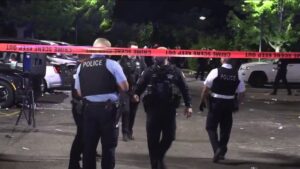
President Donald Trump publicly called on Chicago Mayor Brandon Johnson and Illinois Governor JB Pritzker to seek federal help after a violent Memorial Day weekend “teen takeover” left five police officers injured when a driver rammed into them while they attempted to disperse a large crowd. The incident has reignited the national debate over youth crime, parental accountability, and the role of federal intervention in Democrat-run cities. With summer approaching and similar incidents reported in cities across the country, the White House says its Safe and Beautiful Task Force stands ready to escalate its response.
Story Highlights
- An 18-year-old identified as Rashad Johnson was arrested and charged with five counts of first-degree attempted murder, five counts of aggravated assault, and weapons charges after allegedly striking five officers with a car while they were dispersing a crowd in Chicago’s Little Italy neighborhood around 3:20 a.m.
- Trump posted on Truth Social: “Teen takeover in Chicago. Five officers badly hurt. Mayor and Governor are terrible. Should call for help!”
- The White House stated that Trump’s Safe and Beautiful Task Force “has yielded tremendous results in a very short period of time” and remains committed to addressing new law enforcement challenges head on.
What Happened
Officers from the Chicago Police Department were attempting to disperse a large crowd in the city’s Little Italy neighborhood when Rashad Johnson, traveling westbound in the eastbound lane, struck the officers, drove over the curb, hit a CPD vehicle, and crashed into a pole and fence. The five officers were transported to nearby hospitals and are expected to recover. No other injuries were reported.
Neighbors described a chaotic scene when what looked like “a million kids” descended on the streets. The incident was part of a broader pattern of Memorial Day weekend gatherings that have been promoted through social media, drawing large crowds of teenagers to busy urban corridors and frequently escalating into disorder, property damage, and confrontations with police.
President Donald Trump reacted to the incident on Truth Social, writing that Chicago Mayor Brandon Johnson and Illinois Governor JB Pritzker were “terrible” and should call for federal help, though the president did not specify what form federal intervention would take.
Several large teen takeovers over Memorial Day weekend prompted Chicago lawmakers to reexamine how to stop them. Alderman Brian Hopkins indicated he wants the City Council to strengthen an existing ordinance that holds parents accountable, which currently allows fines for contributing to the delinquency of a minor.
The Trump administration has already moved toward a parental accountability framework in Washington, D.C., where U.S. Attorney Jeanine Pirro announced that parents of teenagers involved in violent teen takeovers could face prosecution, calling for “aggressively prosecuting parents” who violate curfew requirements with their children.
Why It Matters
Teen takeovers have emerged as one of the most politically charged urban public safety issues of 2026. The trend, amplified by social media, has moved beyond any single city and now affects communities from Atlanta to Milwaukee to Tampa. For the Trump administration, the incidents provide a recurring flashpoint to highlight what it characterizes as the failure of Democratic urban governance and to make the case for federal involvement in local law enforcement.
Experts have warned that communities could see an increase in teen takeover activity over the summer, noting that violent crime historically rises in warmer weather. Police presence is necessary but not sufficient, and curfews can provide officers with additional legal tools to disperse crowds or take juveniles into custody before situations escalate.
For Chicago specifically, the political dynamic is complicated. City officials noted that Chicago recorded 416 homicides in 2025 — the fewest since 2014 — arguing that the reduction in crime was due to the efforts of local police and public safety programs, not federal intervention. That data point puts the mayor’s office on stronger political ground to resist federal involvement, even as specific incidents like the Memorial Day officer ramming draw national headlines.
The constitutional and legal boundaries of federal involvement in local policing remain contested. Trump’s earlier deployment of National Guard troops to Chicago was blocked by the Supreme Court, limiting the most direct tools available to the administration. The current posture — public pressure, task force resources, and parental prosecution frameworks — represents a different model of federal engagement.
Economic and Global Context
The teen takeover phenomenon carries economic costs that extend beyond police overtime and medical bills. Businesses in affected corridors have reported temporary closures, revenue losses, and property damage during and after large gatherings. In a city like Chicago, which has invested significantly in downtown tourism and hospitality recovery, repeated incidents have a measurable chilling effect on commerce and visitor confidence.
The political economy of the issue also matters. Trump’s public pressure campaign on Chicago’s Democratic leadership is part of a broader midterm narrative in which urban public safety serves as a wedge issue. Republican strategists have consistently polled well on crime-related messaging, and each high-profile incident in a Democratic-governed city reinforces the party’s preferred contrast heading into November.
Insurance costs for small businesses in affected neighborhoods have climbed as carriers price in the risk of property damage from crowd incidents. For low-margin establishments already managing post-pandemic economic recovery, those cost increases compound an already difficult operating environment.
Nationally, the federal prosecutorial strategy for parental accountability, if upheld by courts and adopted in additional cities, could have far-reaching implications for how law is applied to juvenile curfew enforcement and the legal exposure of parents in jurisdictions across the country.
Implications
The most immediate question is whether Chicago’s political leadership formally requests federal assistance — something Trump has demanded but Mayor Johnson has consistently resisted. A formal request would represent a significant political concession, while continued refusal allows the mayor to maintain local control at the cost of ongoing public pressure from the White House.
The parental accountability framework being tested in Washington, D.C., will face legal challenges as it expands. Questions around enforcement capacity, due process, and prosecutorial discretion will need to be resolved before the model can be scaled meaningfully. Mayor Muriel Bowser herself raised doubts about whether the District had the resources to actually carry out parent arrests under Pirro’s announced plan.
For Congress, the teen takeover issue feeds into broader debates about federal law enforcement funding, juvenile justice reform, and the scope of federal authority in local public safety matters. Those debates will intersect with the ongoing midterm election environment, where crime messaging will be a defining theme for both parties.
For American cities as summer approaches, the practical challenge is managing large, social-media-organized youth gatherings before they escalate. More police, stronger curfew ordinances, parental accountability, and federal task force resources all represent tools — but no single measure has proven definitively effective at scale.
Source
“Inside the teen takeovers threatening to explode this summer”
