
Story Highlights
- Chief Justice John Roberts and other conservative justices questioned the Trump administration’s legal position that the 14th Amendment’s citizenship clause does not automatically confer citizenship on children born to non-citizen parents.
- Trump signed the birthright citizenship executive order on his first day back in office in January 2025, ordering federal agencies to refuse citizenship to children born in the United States if neither parent is a citizen or lawful permanent resident.
- All lower courts that have addressed the issue have either blocked the order or ruled it likely unconstitutional, citing 158 years of settled constitutional interpretation and Supreme Court precedent.
What Happened
President Trump signed his birthright citizenship executive order on January 20, 2025, his first day back in office, directing federal agencies to refuse to recognize U.S. citizenship for children born in America to parents who are neither citizens nor lawful permanent residents. The order represented a dramatic challenge to the Fourteenth Amendment’s citizenship clause, ratified in 1868 after the Civil War, which states that all persons born in the United States and subject to its jurisdiction are citizens. The Trump administration argued that the citizenship clause was originally intended narrowly, to protect formerly enslaved people and their descendants, rather than to grant citizenship broadly to all children born in America. U.S. Solicitor General D. John Sauer presented this argument before the Supreme Court on April 1, 2026, claiming that mass immigration was not contemplated when the amendment was adopted and therefore the broad citizenship grant was not intentional. Sauer further contended that the nation has experienced destructive consequences from the pervasive misinterpretation of the citizenship clause and should correct this longstanding error. Immediately after signing the order, the American Civil Liberties Union, immigrant rights organizations, and state attorneys general filed lawsuits challenging the executive order’s legality. In New Hampshire, federal Judge Joseph Laplante temporarily barred enforcement of the order against a group of babies who would be denied citizenship, writing that the executive order likely contradicts the text of the Fourteenth Amendment and century-old untouched precedent interpreting it. Similar temporary blocks issued from federal courts in other states, preventing the order from ever being implemented despite being signed five months before the Supreme Court heard arguments.
Why It Matters
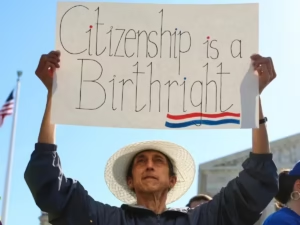
Trump’s birthright citizenship challenge matters profoundly because it directly attacks one of the Constitution’s most fundamental protections and one of America’s defining characteristics as a nation. For more than a century and a half, birthright citizenship has been understood as a basic American right, a principle that helped define the United States as a nation that grants its children born here full membership regardless of parental immigration status. The Supreme Court settled this question definitively in United States v. Wong Kim Ark in 1898, ruling that children born in America to Chinese immigrant parents are entitled to citizenship. That ruling has remained law for over 125 years. If Trump’s position prevails, millions of children born in the United States would potentially lose citizenship rights, creating a permanent underclass of people born on American soil but deemed non-citizens by the government. The matter carries enormous implications for liberty and constitutional interpretation because it demonstrates whether the Constitution’s text constrains presidential authority or whether executive interpretation can dramatically rewrite constitutional meanings. If courts defer to the Trump administration’s reinterpretation of a 158-year-old constitutional provision, it suggests that settled constitutional questions can be reopened by executive action, creating instability in fundamental rights. The issue also matters internationally because America’s commitment to birthright citizenship has been held up as a model of inclusive national membership. If America abandons this principle, it will likely inspire authoritarian governments to restrict citizenship rights more aggressively, using American precedent to justify greater ethnic or national-origin-based restrictions on belonging.
Economic and Global Context
The birthright citizenship fight occurs within a broader Trump administration immigration enforcement campaign that includes expanded deportation efforts, restrictions on asylum, and limitations on legal immigration pathways. The administration has terminated temporary protected status for nationals of Somalia, Venezuela, and Haiti. The State Department paused immigrant visa processing for seventy-five countries deemed to have migrants using welfare at unacceptable rates. The cumulative effect of these policies is a dramatic reduction in immigration and a message of fundamental skepticism toward immigration. From an economic perspective, ending birthright citizenship could affect labor supply and demographic trends. Economists have noted that immigration has been critical to economic growth, workforce expansion, and entrepreneurship in the United States. Children born in America to immigrant parents often become productive citizens who contribute to the economy, pay taxes, and start businesses. Denying citizenship to such children could reduce labor force attachment and human capital development among this population. Globally, other democracies including Canada, France, and other Western nations maintain birthright citizenship principles. If the United States abandons this principle, it would place America with countries like Germany and Italy that restrict birthright citizenship, changing America’s traditional role as a nation of immigration with relatively open citizenship practices.
Implications
If the Supreme Court sides with Trump’s position and rules that the citizenship clause does not require automatic citizenship for children born to non-citizens, it will create an unprecedented constitutional crisis requiring Congress to clarify the meaning of citizenship. The administration would likely immediately implement the order, denying citizenship to hundreds of thousands of children born after February 19, 2025, to non-citizen parents. These individuals would live in a legal limbo without citizenship rights. Conversely, if the Court sides with lower courts and civil rights groups, ruling that the executive order violates the Constitution, Trump would likely appeal or attempt to pursue the issue through legislation if Republicans gain sufficient congressional power. The political implications are significant because birthright citizenship affects immigrant communities disproportionately, and policies restricting citizenship rights could mobilize Hispanic voters and immigrant communities politically. For Trump’s broader governing agenda, a Supreme Court loss on birthright citizenship would represent a major constitutional defeat and could embolden critics to challenge other Trump executive orders on constitutional grounds. A Supreme Court decision either way will likely generate strong political reactions from different constituencies depending on the outcome.
Sources
“Supreme Court appears likely to side against Trump on birthright citizenship”
