
Story Highlights
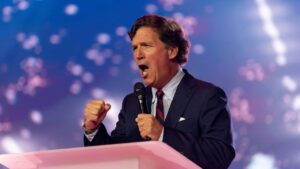
- Tucker Carlson publicly apologized in April 2026 for helping elect Trump, calling it a cause of personal torment and accusing the president of having low character
- Trump responded by calling Carlson, Megyn Kelly, Candace Owens, and Alex Jones “low IQ” critics who favor Iran having nuclear weapons
- The feud originated with Carlson’s opposition to U.S. military involvement in Iran following joint U.S.-Israeli strikes in February 2026
What Happened
Tucker Carlson had been one of the most influential conservative media voices in favor of Donald Trump’s presidential campaigns. He gave a featured address at the 2024 Republican National Convention. Donald Trump Jr. said at the convention that he would have been equally happy with either JD Vance or Carlson as his father’s running mate. Carlson and Trump appeared together on the campaign trail, and Carlson’s massive podcast audience was a key component of the media ecosystem that helped Trump return to the White House.
Carlson began criticizing Trump’s foreign policy direction as early as June 2025, shortly after U.S.-Israeli strikes on Iranian nuclear facilities that summer. After a brief reconciliation — during which Trump told reporters that Carlson had called to “apologize” — the feud resumed with far greater intensity following joint U.S.-Israeli strikes on Iran on February 28, 2026. Carlson responded to those strikes by publicly denouncing the action as “Israel’s war” and accusing Trump of being beholden to Israeli Prime Minister Benjamin Netanyahu’s ambitions rather than American interests.
The break became definitive in April 2026, when Carlson used his podcast to offer an extraordinary public apology to his listeners. He said he was “tormented” by the knowledge that he had helped mislead people into voting for Trump. He called the president a man of “low character” — a remark that appeared to directly respond to Trump, who had posted on Truth Social that Carlson and other anti-war conservative commentators including Megyn Kelly, Candace Owens, and Alex Jones had “low IQs” and effectively sided with Iran by opposing U.S. military involvement.
The feud has played out primarily through social media and podcasts, with Truth Social posts from Trump and extended commentary from Carlson’s show serving as the main venues. Trump dubbed Carlson “Kooky Tucker,” a characterization he began using as early as June 2025 when criticism of his foreign policy first emerged. Carlson’s interviews with Russian President Vladimir Putin and Iranian President Masoud Pezeshkian have been cited by critics as evidence of misplaced journalistic judgment, though Carlson has defended them as journalism.
Why It Matters
The Trump–Carlson split is not merely a celebrity feud. It represents the public emergence of a genuine philosophical division within MAGA and the broader American nationalist right about what America First actually means in practice. For Carlson and those aligned with his non-interventionist worldview, America First means keeping the United States out of foreign military entanglements, especially in the Middle East. For Trump’s administration, it means projecting American strength globally, denying Iran nuclear capability, and demonstrating that U.S. military deterrence is credible.
These are not simply tactical disagreements — they reflect different foundational beliefs about the relationship between American liberty and American foreign policy. The libertarian and paleoconservative strain of the right, represented by Carlson and figures like Owens and Jones, has long been suspicious of neoconservative foreign policy hawkishness under any administration’s label. The Iran conflict has forced that latent tension into the open in a way that previous policy disagreements never quite did.
For Trump, the political significance is real but measured. Carlson’s audience is large — estimated in the tens of millions — and overlaps substantially with the younger, more skeptical segment of Trump’s coalition. Polling has shown that Trump’s approval among voters under 35 has declined sharply in 2026. The extent to which Carlson’s sustained public criticism is contributing to that erosion versus merely reflecting it is difficult to disentangle, but the directional connection is clear.
Economic and Global Context
The Carlson–Trump feud has international dimensions that go beyond the domestic culture war. Carlson’s interviews with foreign leaders and his public alignment with anti-war positions have given foreign governments — including Iran and Russia — a visible example of significant American media and political opposition to the current administration’s foreign policy posture. That visibility, whatever Carlson’s intent, affects how adversaries read American political will and unity.
The Iran conflict, which has already resulted in approximately 200 deaths according to credible reporting, has had direct economic consequences. The disruption of shipping through the Strait of Hormuz and elevated geopolitical risk has kept energy prices elevated throughout early 2026, contributing to the inflation pressures that are already weighing on Trump’s approval ratings. The conservative critics of the war can point to these economic consequences as evidence for their argument that the conflict was strategically and economically costly regardless of its military objectives.
The broader media economy is also shifting. Carlson’s decision to leave Fox News in 2023 and build an independent podcast empire proved that large conservative audiences could be cultivated outside traditional network infrastructure. The Trump–Carlson split now means that a significant portion of that audience is receiving daily anti-war, anti-Trump content from within their own conservative media ecosystem — a dynamic that did not exist during Trump’s first term and complicates the administration’s information environment.
Implications
The long-term implications for American conservatism hinge on how the Iran conflict resolves. If Trump secures a ceasefire deal that he can credibly frame as a victory — denuclearizing Iran and reopening the Strait of Hormuz — the foreign policy critics within the right will have limited purchase. The war’s costs will be reframed as the necessary price of a historic achievement, and Carlson’s apology will stand as a premature capitulation. Trump has demonstrated repeatedly that winning has a way of dissolving internal dissent.
If the Iran conflict drags on without resolution, or if a deal is struck that critics can plausibly characterize as falling short of Trump’s stated objectives, the Carlson critique gains sustained momentum. In that scenario, the 2026 midterms could see a genuine suppression of turnout among the younger, skeptical MAGA voters who are most susceptible to Carlson’s messaging — voters who may simply stay home rather than actively defect to Democrats.
For the long-term architecture of the conservative movement, the feud poses a question that will outlast the current news cycle: is there room within Trump’s coalition for a meaningful non-interventionist right, or will that constituency be expelled and marginalized? The answer will shape who runs in 2028, what foreign policy positions are acceptable within the Republican Party, and whether the America First brand retains the coherence it had during Trump’s first term when domestic grievance rather than foreign policy was the primary animating force.
Sources
“The Breakdown of Trump and Tucker Carlson’s Alliance, Explained”
