


Story Highlights
- Gates testified voluntarily before the House Oversight Committee in a private, transcribed interview
- He told the committee he “should never have met with Epstein” and that Epstein later tried to use information about Gates’ affair to exert leverage
- The Justice Department’s release of millions of Epstein-related documents has implicated prominent figures across politics, business, and finance
What Happened
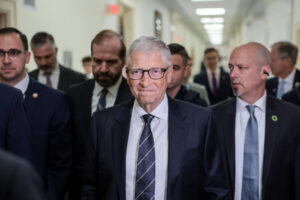
Bill Gates arrived at the Capitol Wednesday morning to a scrum of reporters, offering a brief statement before proceeding to a private room for his interview with House Oversight and Government Reform Committee members. Gates said he has “never victimized anyone” and told lawmakers he first met Epstein in 2011, three years after Epstein had already pleaded guilty in Florida to soliciting an underage girl for prostitution.
Gates explained that he had sought the relationship with Epstein as part of an effort to raise money for his philanthropic Gates Foundation and its global health initiatives. He acknowledged that Epstein’s promises of new donors never materialized in any actual contributions to the Foundation. Gates stated plainly: “I should never have met with Epstein in the first place. Based on what I know now, I understand that even if he had delivered the new donors he promised, it would not have justified associating with him.”
Perhaps most significantly, Gates disclosed that Epstein had attempted to use information about Gates’ affair with a woman at Microsoft — which later played a role in his divorce from his wife, Melinda Gates — as leverage to maintain their association. That disclosure represents a direct account of Epstein deploying blackmail-like tactics against one of the world’s most prominent billionaires, consistent with patterns documented elsewhere in the investigation.
Gates retained Jake Greenberg, a former top aide to Oversight Committee Chairman James Comer, as legal counsel for the hearing — a choice that drew attention given Greenberg’s prior relationship with the committee’s Republican leadership.
The hearing is part of a broader investigation triggered by the Justice Department’s release of millions of internal documents related to Epstein earlier this year, revealing his ties to an extraordinary range of prominent individuals in politics, finance, academia, and business.
Why It Matters
The Epstein investigation has evolved into one of the most consequential congressional inquiries in recent memory, not because of Epstein himself — who died in federal custody in 2019 — but because of the breadth of powerful figures his files implicate. The House Oversight Committee has now interviewed a succession of high-profile witnesses, each adding to a mosaic of how a convicted sex offender maintained access to and influence over global elites for decades.
Gates’ testimony is significant for several reasons beyond his individual case. His account of Epstein deploying leverage over him suggests a systematic pattern of coercion that may have extended to other individuals in Epstein’s orbit. Understanding the full scope of that leverage — who was targeted, what information was used, and whether any of it influenced public decisions — is central to the committee’s mandate.
The investigation also carries implications for accountability in America’s institutions. The Justice Department’s own handling of Epstein has been scrutinized repeatedly, with former Attorney General Pam Bondi, who was fired by Trump in April, facing criticism for allegedly attempting to shield certain individuals from scrutiny. The probe has forced a reckoning about whether powerful people routinely escape accountability through their connections and resources.
For the American public, the investigation represents a rare instance of Congress actually following the evidence regardless of political affiliation. Committee members from both parties have expressed interest in understanding the full scope of Epstein’s network, and the inquiry has retained unusual bipartisan support despite the politically charged context.
Economic and Global Context
The Epstein investigation does not operate in isolation from the broader political economy. The release of millions of Justice Department documents has revealed financial relationships between Epstein and major institutional actors — hedge funds, universities, philanthropic organizations, and technology companies — raising questions about how wealth and influence interact with accountability in the American system.
Gates’ testimony comes at a moment of heightened scrutiny of the technology sector’s intersection with government and philanthropy. The Gates Foundation, one of the most powerful private actors in global public health, has faced questions about governance and accountability that the Epstein revelations have amplified. Foundation donors and partner organizations are closely monitoring how Gates navigates the inquiry.
The international dimensions of the Epstein investigation are also significant. Epstein maintained properties and relationships across multiple jurisdictions, and his network included prominent figures from foreign governments. Several allied nations have expressed interest in the findings of the congressional investigation, particularly as they relate to individuals with cross-border influence.
Financial markets have not reacted significantly to individual testimony developments, but the broader reputational impact on major institutions linked to Epstein has been measurable, with some organizations reporting donor attrition and governance reviews in the wake of document releases.
Implications
The transcribed nature of Gates’ interview means his testimony will become part of the formal record available to committee members and potentially subject to future public release. Any material inconsistencies between his statements and documentary evidence in the Epstein files could become the basis for follow-up inquiries or referrals.
For the committee, Gates’ testimony represents a significant data point but not a conclusion. Representative Robert Garcia, a California Democrat on the committee, signaled that lawmakers remain focused on mapping the full scope of Epstein’s relationships and the nature of any leverage he exercised. Future witnesses are likely to include other individuals identified in the document releases.
The investigation’s long-term significance may lie less in individual accountability and more in systemic reform. If the inquiry produces credible evidence that Epstein exploited legal and institutional gaps to operate his network, Congress may move to close those gaps — a legacy outcome that would outlast the specific testimony of any single witness.
Sources
“Bill Gates tells House panel ‘I should have never met’ with Jeffrey Epstein”
