

Story Highlights
- Trump announced plans to seize Iran’s Kharg Island oil hub and threatened to “bomb the s—” out of Iran if Tehran does not sign a peace agreement
- Iran’s Revolutionary Guard struck U.S. bases in Kuwait, Bahrain, and Jordan, while closing the Strait of Hormuz to all marine traffic
- Kuwait reported intercepting 24 hostile drones over 48 hours, while Indian officials said three Indian sailors were killed in a U.S. strike incident
What Happened
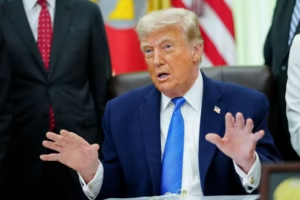
President Donald Trump escalated his military rhetoric dramatically on Thursday morning, announcing via social media and a Fox News interview that U.S. forces would strike Iran “VERY HARD TONIGHT” — a third consecutive night of American offensive operations against Iranian targets. The statement came after U.S. Central Command confirmed it had launched new strikes the previous day “in response to Iran’s unwarranted and continued aggression,” following the shoot-down of an American Apache helicopter that first triggered the latest round of attacks.
Trump went further on Thursday, threatening to seize Kharg Island — Iran’s primary oil export hub — along with other key Iranian oil infrastructure. Speaking on Fox and Friends, Trump told the host that U.S. forces would escalate if Tehran refused to sign a peace agreement, leaving little diplomatic room for de-escalation. Trump also claimed the United States had already been quietly seizing Iranian oil shipments, including 22 tankers, in covert nighttime operations.
Iran responded by formally announcing the closure of the Strait of Hormuz to all marine traffic. Before the war began, the strait facilitated roughly 20 percent of global oil flows. The Islamic Revolutionary Guard Corps also claimed responsibility for strikes on American military installations in Kuwait, Bahrain, and Jordan, calling the actions retaliatory. Kuwait’s Ministry of Defense confirmed that its forces had detected and engaged 24 hostile drones within its airspace over the prior 48 hours, with the country reporting limited material damage and no Kuwaiti casualties.
Despite both sides trading intense strikes, U.S. and Iranian officials said Thursday that peace negotiations technically remain ongoing. American negotiators were reportedly prepared to deliver a fresh peace proposal to Iran’s parliamentary speaker Mohammad Bagher Ghalibaf, but U.S. military operations proceeded before the proposal could be formally submitted, further complicating the diplomatic track. Iran’s foreign ministry condemned American actions as rendering any ceasefire “practically meaningless.”
Why It Matters
The escalation marks a defining moment in the conflict that began with joint U.S.-Israeli strikes on Iran on February 28, 2026. What began as targeted military operations aimed at eliminating Iran’s nuclear capacity has broadened into a sustained war involving retaliatory missile exchanges, drone campaigns, and now a naval blockade of one of the world’s most critical maritime chokepoints. The closure of the Strait of Hormuz represents an unprecedented strategic move with potential consequences that dwarf the immediate battlefield.
For American servicemembers and regional allies, the pace of escalation poses growing force-protection risks. With U.S. bases in Kuwait, Bahrain, and Jordan now confirmed as active Iranian targets, the Pentagon faces a growing challenge in protecting personnel spread across multiple theaters while sustaining offensive operations inside Iran. The death of Indian sailors reportedly caught in a U.S. strike also threatens to complicate diplomatic relations with New Delhi at a delicate moment.
On the domestic political front, the war’s trajectory is becoming a mounting concern for Republican strategists heading into the November 2026 midterms. With inflation spiking due to energy costs tied directly to the conflict, and American casualties accumulating, the administration faces increasing pressure to either achieve a decisive military outcome or negotiate an exit strategy that can be framed as a victory. Polling has shown steady erosion of public support for the conflict since spring.
The constitutional questions surrounding the war’s authorization also remain unresolved. The Trump administration has relied on executive war powers to sustain the conflict without a formal Authorization for Use of Military Force from Congress, drawing criticism from civil libertarians and some lawmakers on both sides of the aisle who argue that sustained offensive military campaigns require legislative approval.
Economic and Global Context
The Strait of Hormuz closure is sending shockwaves through global energy markets, though oil prices remained surprisingly stable Thursday morning, likely due to uncertainty about the closure’s duration and extent. Before the war began in February, the strait handled roughly 21 million barrels of oil per day. Its full closure would threaten energy supplies for Europe, Asia, and significant portions of the global economy. Saudi Arabia, the UAE, and other Gulf producers that route exports through the strait face immediate logistical crises.
Iran’s announcement that it would seize oil infrastructure adds a new economic dimension. Trump’s claim that the U.S. has already captured 22 Iranian oil tankers indicates the conflict has expanded into economic warfare, with each side attempting to deny the other revenue. The May Consumer Price Index already showed gasoline prices up 40.5 percent year-over-year, with energy costs accounting for the majority of America’s current 4.2 percent annual inflation rate.
Global financial markets are watching the Strait of Hormuz situation with heightened anxiety. Shipping insurers have sharply raised premiums for vessels transiting the Persian Gulf region, and several major carriers have rerouted cargo to longer pathways around the Cape of Good Hope. The economic cost of this rerouting alone runs into billions of dollars monthly in additional fuel, time, and logistical expense for global trade.
Implications
The most immediate implication is military: if Trump follows through on Thursday night’s threatened escalation, the United States will be conducting its third consecutive night of major strikes on Iranian territory. Each escalation raises the risk of miscalculation, including the potential for strikes that kill large numbers of civilians or that hit infrastructure with humanitarian consequences, which could crystallize international opposition to American operations.
For Congress, the war continues to pose an authorization dilemma. Several bipartisan voices have called for formal debate and a vote on war authority, but with the House leaving for recess until June 23, that debate will not happen imminently. The absence of congressional oversight over what has become a sustained military campaign remains a significant constitutional flashpoint.
For energy-dependent economies, the duration of the Hormuz closure will determine the severity of the downstream impact. If the closure extends more than a few weeks, supply shocks will cascade through European and Asian energy markets, potentially triggering a global economic slowdown. American consumers will continue to feel the effects at the gasoline pump regardless of how quickly a deal is reached.
The peace negotiations that both sides claim remain active represent the last realistic off-ramp from full-scale war. The administration’s apparent willingness to simultaneously negotiate and escalate reflects a high-stakes gamble that military pressure will force Tehran to accept terms favorable to Washington. Whether that strategy produces a deal or a broader conflagration will define the Trump presidency’s second term.
Sources
