


Story Highlights
- Fostering the Future Accounts include a $1,000 seed investment from the U.S. Treasury that grows tax-deferred until the child reaches age 18
- Over 400,000 children are currently in the U.S. foster care system, and more than 23,000 young people age out of it annually, often entering adulthood without savings or financial safety nets
- Multiple governors, including Idaho’s Brad Little, attended the launch to announce their states’ participation in automatic enrollment for eligible foster children
What Happened
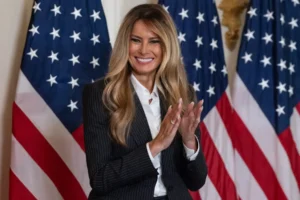
Melania Trump and Secretary Bessent hosted a formal launch event Thursday at 11 a.m. Eastern Time at the Treasury Department, unveiling the Fostering the Future Accounts program before a gathering that included invited state governors and media. The event was livestreamed through the White House’s official channels, marking it as a high-profile administration initiative. Melania spoke directly about the significance of the program for children who have historically been left outside the reach of wealth-building tools available to other American families.
“For the first time, children in foster care will have access to a dedicated investment and savings vehicle,” the First Lady said in her remarks. “Education and savings accounts are the first steps toward personal independence.” The accounts are structured as tax-deferred investment instruments that track a stock index, funded with a $1,000 initial contribution from the U.S. Treasury and available to the child when they turn 18. Children eligible are those born between January 1, 2025, and December 31, 2028, who are in state foster care systems during that period.
The program directly builds on Trump Accounts, the broader child investment account framework created under the One Big Beautiful Bill Act that President Trump signed in his first year of the second term. That legislation established investment accounts for children of parents or guardians, with the Treasury seeding each account with $1,000. The expansion announced Thursday extends that same benefit to state child welfare agencies acting as guardians for foster children — closing a gap that critics of the original program had identified as leaving one of the most vulnerable populations in America behind.
Idaho Governor Brad Little joined the launch event in Washington and announced that Idaho would participate in automatic enrollment for all eligible foster children within the state. Georgia Governor Brian Kemp separately announced earlier this week that Georgia had already moved to ensure all eligible foster children in the state would be automatically enrolled. Georgia’s move made it one of the first states in the country to take that step, and Thursday’s national launch is expected to accelerate similar decisions in other states.
Why It Matters
Foster care alumni represent one of the most economically vulnerable populations in the United States. Federal data indicates that over 23,000 young people age out of the foster system each year, typically at age 18, without the family financial support networks, savings, or investment assets available to most of their peers. Studies consistently show that foster care alumni face higher rates of housing instability, unemployment, and poverty in early adulthood than the general population. The absence of any dedicated savings vehicle has historically meant that aging-out foster youth enter adulthood with little financial cushion.
The Fostering the Future Accounts initiative directly addresses that gap by ensuring that eligible foster children benefit from compounding investment returns over the years they remain in care. A $1,000 investment in a stock-index-tracking account for a child born in 2025 and held for 18 years, assuming average historical market returns of approximately 7 percent annually, would be worth roughly $3,400 by the time the child reaches adulthood — a meaningful if modest financial foundation for young adults who typically have no comparable asset.
The initiative also carries constitutional and philosophical significance consistent with the administration’s broader policy agenda. By using market mechanisms rather than cash transfer programs to build wealth among vulnerable children, the administration positions the initiative as consistent with conservative principles of investment and individual empowerment rather than dependency. The framing reflects an effort by Melania Trump to establish a distinctive East Wing policy identity separate from the administration’s more combative political battles.
From a federalism standpoint, the program’s reliance on state participation is notable. States that choose to automatically enroll eligible foster children ensure maximum coverage; those that do not will leave some children out. The variation in state uptake will determine how equitably the program’s benefits are distributed, and advocacy groups have already signaled they will push for federal mandates to require automatic enrollment nationally.
Economic and Global Context
The Fostering the Future Accounts program arrives at a moment when the administration is under significant economic pressure on multiple fronts. While the launch is relatively modest in budgetary terms — $1,000 per eligible child, with roughly 400,000 children in care at any given time — it represents a targeted use of Treasury resources to address long-standing structural inequality in access to financial instruments. Treasury Secretary Bessent’s direct involvement signals that the department views the program as part of a coherent wealth-building policy framework, not a peripheral First Lady’s initiative.
The broader Trump Accounts program of which this is an extension is itself a notable economic policy experiment. By establishing government-seeded, market-linked investment accounts for an entire cohort of American children, the administration is making a significant bet that equity market participation will be the dominant wealth-building mechanism for the next generation. The program’s structure as a stock-index tracker means that its ultimate value to recipients will depend heavily on market performance over the coming decades — an inherently uncertain proposition.
Politically, the launch provides the administration with a rare piece of positive domestic policy news on a day dominated by military conflict, inflation concerns, and surveillance authority battles. The bipartisan appeal of programs designed to help foster children gives the White House a constructive narrative to offer to moderate voters who may be growing weary of wartime political turbulence.
Implications
The most immediate implication is for the approximately 400,000 children currently in foster care and for the cohorts that will follow. States that move quickly to enact automatic enrollment, as Georgia has already done, will ensure their foster children receive the $1,000 seed investment without bureaucratic delays or parental advocacy requirements. States that move more slowly will create disparities in benefit access, likely along lines that track existing socioeconomic inequalities in state government capacity and political will.
For Melania Trump, the Fostering the Future initiative establishes a policy legacy distinct from the combative political battles that dominate the administration’s public profile. The initiative builds on her prior “Be Best” campaign from the first term while adding a concrete financial component that advocates and nonpartisan child welfare experts can evaluate on measurable outcomes. The presence of multiple governors at Thursday’s launch indicates that the program has built genuine bipartisan support among state-level executives.
For the broader debate over child welfare policy, the program introduces a new model that blends conservative investment principles with the longstanding progressive goal of providing economic security for foster youth. Whether future administrations of either party would continue and expand the program will depend largely on whether the accounts demonstrably improve financial outcomes for young adults who age out of care — a question that will not have a clear answer for at least a decade.
Sources
“Melania Trump announces a new savings account for youth in foster care”
