
Story Highlights
- Workers removed Trump’s name from the Kennedy Center facade in the early hours of June 13, following a federal court order.
- A federal judge ruled that the Trump-appointed board did not have legal authority to rename the venue, as Congress designated it a living memorial to President John F. Kennedy.
- The Kennedy Center had argued that removing Trump’s name would cost it millions of dollars in donations secured under the renamed branding.
What Happened
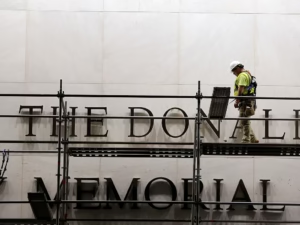
President Donald Trump’s name was removed from the Kennedy Center building in the early hours of Saturday morning, six months after it was added to the nation’s marquee cultural center, which Congress had designated as a living memorial to John F. Kennedy. Workers spent Friday evening erecting scaffolding in front of the building as crowds gathered below to watch.
Crews at the performing arts venue started removing the name from the front of the building around 3 a.m., several hours after the center missed a federal judge’s two-week deadline to do so. The judge had ruled that the decision by the center’s board of trustees to rename it was illegal.
The backstory traces to Trump’s first months back in office. The administration had ousted the Kennedy Center’s president, board chair, and board members, then replaced them with a group of trustees that soon named Trump as chairman. Shortly after, the president’s name was added to the building, so that it became “The Donald J. Trump and the John F. Kennedy Memorial Center for the Performing Arts.”
President Lyndon Johnson signed a bill in 1964 that designated the center as a living memorial to Kennedy following his assassination in 1963. The law prohibits the board of trustees from making the center into a memorial to anyone else or from putting another person’s name on the building’s exterior.
Rep. Joyce Beatty of Ohio, a Democratic ex officio board member who filed the lawsuit to remove references to Trump from the building and the center’s operations, was spotted in the plaza during the early-morning removal. She posted a video to social media and said, “No more stalling. It’s time for Trump to obey the law.”
Why It Matters
This legal episode goes well beyond the question of signage on a building. It represents a direct confrontation between executive authority and the constraints placed on that authority by Congress and the courts. The Kennedy Center’s original designation was an act of Congress. The Trump administration’s attempt to override that designation by installing a new board and renaming the institution tested whether executive power can circumvent legislative mandate through board control rather than legislation.
The restoration of the iconic Kennedy Center’s name is perhaps the most visible example of the courts pushing back on Trump’s aggressive efforts to reshape wide swaths of the federal government and Washington, D.C., life. In his second term, Trump has attached his name or image to U.S. passports, battleships, social welfare programs, and multiple federal buildings.
The administration’s last-ditch legal arguments also revealed the financial stakes involved. In a filing to a federal appeals court seeking to block the judge’s order, the center argued that taking Trump’s name off the building would result in having to return hundreds of millions of dollars, with the filing stating that “people and companies who have given, or will be giving, millions of dollars to the Center were only willing to do so with the name ‘Trump’ on the building.”
That argument was rejected by two courts. The episode raises an important question for American jurisprudence: can private fundraising incentives tied to a presidential name be used to override a congressional statute? The courts said no, but the administration’s willingness to make the argument signals it is willing to push the legal envelope on institutional renaming.
Economic and Global Context
The Kennedy Center’s financial situation adds another layer of complexity to the story. The same May court decision that ordered Trump’s name removed from the building also blocked a planned two-year closure for renovations scheduled to begin next month. The Kennedy Center’s calendar for the weeks ahead includes performances of “Moulin Rouge! The Musical” and “Bluey’s Big Play.” Comedian Bill Maher is to be awarded the Mark Twain Award for American Humor during a ceremony on June 28.
The center has also faced prolonged disruption as a result of the renaming controversy. Since the Trump-appointed board added the president’s name in December 2025, several major artists and performers canceled appearances, citing objections to the rebranding. These cancellations reduced revenue and audience engagement at an institution that depends heavily on ticket sales and philanthropic support.
The broader cultural economy of Washington, D.C. absorbs ripple effects whenever the Kennedy Center faces uncertainty. Hotels, restaurants, and transportation providers near the venue rely on steady performance traffic. Extended legal battles, threatened closures, and audience boycotts all affect the economic ecosystem surrounding one of the capital’s most visited landmarks.
Implications
For the Trump administration, the loss here is not just symbolic. It establishes a legal precedent that executive board appointments cannot be used to circumvent congressional naming statutes. That precedent could limit the administration’s ability to use similar maneuvers at other federally designated institutions in the future.
Trump’s signature is set to appear on future U.S. paper currency, making him the first living president to choose to do so. Paired with the Kennedy Center episode, the pattern illustrates a presidency that places significant weight on the symbolic power of naming — and a legal and political environment increasingly willing to push back on those ambitions.
For Congress, the episode may prompt renewed interest in legislation clarifying the limits of board authority at federally designated institutions. The Kennedy Center is not the only facility whose governing structure could theoretically be reshaped by executive-appointed trustees, and lawmakers on both sides may want clearer statutory protections.
For the American public, the scene outside the Kennedy Center on Friday night — crowds gathering to watch workers remove the president’s name from a building — captured something significant about the current political moment: the courts as the arena where the limits of executive power continue to be contested and, in this case, enforced.
Sources
