
Story Highlights
- Carlson apologized on his podcast in April 2026 for having “misled” his audience into voting for Trump, describing the moment as a cause of personal torment
- Trump dismissed Carlson as “low-IQ” on Truth Social and said he “doesn’t deal with” him anymore; the two once campaigned together before the 2024 election
- Carlson has praised Democratic Gov. Gavin Newsom as “fantastic” and indicated he expects Newsom to be the 2028 Democratic presidential nominee
What Happened
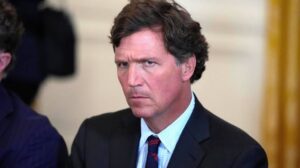
Tucker Carlson and President Donald Trump were among the most prominent allied figures in conservative politics heading into the 2024 election. Carlson gave Trump one of his most-watched interviews of the campaign, and the two appeared together on the trail. That alliance began fracturing in June 2025, when Carlson publicly opposed U.S. involvement in Israeli strikes on Iran, describing advocates of American military action as “warmongers” and arguing that the real divide in politics was between those who “casually encourage violence and those who seek to prevent it.”
Trump responded sharply to the criticism, and while a brief reconciliation followed, the relationship collapsed entirely after the United States joined Israel in launching major strikes on Iran on February 28, 2026. Carlson denounced the action as “Israel’s war,” accused Trump of being beholden to Israeli Prime Minister Benjamin Netanyahu’s ambitions, and made a series of escalating public statements accusing the president of betraying the America First movement he had campaigned on. Trump fired back on Truth Social, calling Carlson and like-minded anti-war podcasters people with “low IQs” and saying he no longer dealt with Carlson at all.
The feud reached a new emotional register in April 2026 when Carlson recorded a podcast episode in which he apologized for having “misled” his supporters into voting for Trump. He described the moment as a cause of “personal torment,” an unusually candid admission from a figure whose media brand had been built in significant part on backing Trump. Shortly afterward, Carlson called Trump a man of “low character,” which commentators noted appeared to be a direct response to Trump’s “low-IQ” characterization.
Most recently, following Trump’s announcement of the U.S.-Iran ceasefire deal, Carlson publicly criticized the agreement as well, suggesting in a June 15 episode of his show that the deal vindicated his opposition to the war by demonstrating that a diplomatic resolution had always been available. Trump’s allies responded that the president had secured a historic diplomatic achievement; Carlson’s supporters argued it demonstrated that the war had been unnecessary and that lives had been lost for a result that could have been achieved without conflict.
Why It Matters
The Trump-Carlson feud matters well beyond the personal dynamics between two public figures. Carlson built his media platform into one of the largest independent conservative audiences in the country, with his post-Fox podcast drawing millions of listeners who identified broadly with the America First political philosophy. His explicit repudiation of Trump — and his apologizing to his audience for supporting him — carries weight that a mainstream media critique would not, because it comes from within the very constituency Trump depends on for his political coalition.
The substantive disagreement is also genuinely ideological. Carlson has argued that interventionism, including the Iran war, contradicts the non-interventionist, sovereignty-focused principles that defined the original America First vision. He frames the conflict as evidence that Trump was captured by neoconservative foreign policy interests and donor-class pressures that are fundamentally at odds with the movement’s stated values. Many libertarian-leaning conservatives and anti-war populists share this view, and the fracture reveals a tension within the American right that predates Trump.
The feud also raises long-term questions about media power on the right. Carlson’s audience does not disappear because Trump has insulted him. If Carlson sustains his credibility with a meaningful slice of the Republican base — even a minority — he could become a complicating factor in future primaries, in the 2028 presidential race, and in the ongoing battle over what the Republican Party stands for after Trump.
Economic and Global Context
The political context of the feud intersects directly with the Iran ceasefire signed today in Switzerland. Carlson’s latest criticism — that the deal proves the war was unnecessary — puts pressure on the administration to demonstrate that the military campaign achieved specific strategic objectives that diplomacy alone could not have accomplished. White House officials have argued that Iran would not have agreed to terms without the military pressure applied since February, but that case must now be made publicly and persuasively.
The economic costs of the Iran war have been real and quantifiable. The closure of the Strait of Hormuz contributed directly to U.S. inflation reaching 4.2% annually in May, a three-year high. Energy prices surged across G7 economies. Defense spending increased. The human costs of military operations also factor into the political debate that Carlson has been driving. Whether voters ultimately credit Trump for ending the war or hold him responsible for starting it will shape the midterm environment.
The broader media landscape on the right has also shifted. Multiple podcasters and commentators who once aligned closely with Trump — including several figures beyond Carlson — have expressed varying degrees of skepticism about the Iran war. This represents an evolution in the right-wing media ecosystem that campaign strategists in both parties are monitoring heading into the fall.
Implications
The immediate political implication of the feud is that it provides a permission structure for some conservative voters to express doubts about Trump’s foreign policy without feeling they are crossing into the mainstream media’s anti-Trump camp. Carlson has effectively staked out a right-wing critique of the administration that Republican primary voters who prioritize non-interventionism may find compelling.
For Trump, the primary concern is whether the Carlson faction becomes large enough to affect turnout or primary outcomes in 2026 and beyond. Historically, Trump’s political coalition has proven more durable than fractures initially suggested, and Carlson’s audience overlap with Trump’s base is imperfect. However, the combination of foreign policy dissatisfaction, inflation concerns, and now a prominent media voice offering an ideological alternative represents a more complex political environment than the unified MAGA front of 2020 and 2024.
For the America First movement more broadly, the feud forces a reckoning with what the movement’s principles actually require in practice. The ceasefire deal may resolve the immediate military conflict, but the underlying ideological questions Carlson has raised — about interventionism, donor influence, and national sovereignty — will not be resolved by a memorandum of understanding signed in Switzerland.
Sources
“Tucker Carlson slams Donald Trump’s Iran strategy after ‘great settlement’ announced”
