


Story Highlights
- The Supreme Court heard arguments in April on Trump’s executive order ending birthright citizenship
- Every lower federal court that has reviewed the order has ruled against it
- A ruling is expected before the Court’s term ends in late June or early July
What Happened
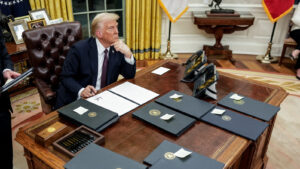
The U.S. Supreme Court is preparing to rule on one of the most significant constitutional questions of President Donald Trump’s second term: whether his executive order curtailing birthright citizenship under the 14th Amendment can stand. The order, signed on Trump’s first day back in office in January 2025, would deny automatic citizenship to children born in the United States to parents who are undocumented immigrants or in the country on a temporary basis, such as a student or work visa.
Oral arguments took place in April, with Trump attending in person, becoming the first sitting president to watch Supreme Court arguments live. Solicitor General John Sauer argued for roughly 65 minutes on behalf of the administration, while American Civil Liberties Union national legal director Cecillia Wang argued for the challengers. The case, formally titled Trump v. Barbara, centers on the meaning of the 14th Amendment’s citizenship clause, which guarantees citizenship to anyone born in the United States and “subject to the jurisdiction thereof,” with longstanding exceptions for children of foreign diplomats and enemy soldiers.
The administration argues that children of undocumented or temporary immigrants fall outside that jurisdictional language, since their parents owe primary allegiance to a foreign government. Challengers, including the ACLU and a coalition of state attorneys general, argue this interpretation contradicts more than a century of settled constitutional precedent, congressional statute, and the plain text of the amendment, which has been understood since the landmark 1898 case United States v. Wong Kim Ark to guarantee citizenship to virtually all children born on American soil.
Every federal court that has reviewed Trump’s order to date has blocked it from taking effect, finding it likely violates the Constitution. Legal observers noted that justices appeared skeptical of the administration’s position during oral arguments, though the court’s ultimate ruling remains uncertain given its composition and recent willingness to side with expansive views of presidential power in other cases. A decision is widely expected before the Supreme Court’s self-imposed end-of-term deadline.
Why It Matters
Few constitutional questions carry stakes as immediate and personal as birthright citizenship. A ruling upholding Trump’s order would mark the first time in American history that the federal government has successfully narrowed the scope of automatic citizenship under the 14th Amendment, a provision originally adopted after the Civil War specifically to guarantee citizenship to formerly enslaved people and their descendants, foreclosing any future repeat of the Dred Scott decision.
For families directly affected, the practical consequences would be significant and immediate. Children born in the United States to parents without permanent legal status could be rendered effectively stateless in some cases, depending on the citizenship laws of their parents’ home countries, creating a new and potentially permanent class of individuals born on American soil without full legal status anywhere.
The case also tests the limits of unilateral executive action over a constitutional provision that has never required congressional reauthorization to apply. If the Court allows the order to stand, it would establish that a president can substantially reinterpret long-settled constitutional text through executive order alone, a precedent with implications extending well beyond immigration policy into virtually any area where constitutional language has historically been read consistently for generations.
Conversely, a ruling against the administration would represent a significant defeat for one of Trump’s signature first-day policy actions and would reaffirm that even a sitting president, despite personally appearing before the justices, cannot reshape constitutional guarantees through executive action alone.
Economic and Global Context
The United States is one of roughly 33 countries worldwide, concentrated heavily in North and South America, that grant unconditional birthright citizenship, including Canada, Mexico, Brazil, and Argentina. Most European and Asian nations instead rely on citizenship based primarily on parental nationality, meaning a ruling against birthright citizenship would move the United States toward a citizenship model more common outside the Western Hemisphere.
Economists and demographers have noted that birthright citizenship has historically functioned as an engine of long-term economic integration, ensuring that children raised in the United States have full legal standing to work, vote, and participate in civic life as adults, rather than existing in extended legal limbo. Any disruption to that framework could have multi-generational effects on labor markets, particularly in states with large immigrant populations.
The ruling will also be closely watched internationally, given that countries with significant diaspora populations in the United States, including Mexico, India, and several Central American nations, have substantial interest in how their citizens’ U.S.-born children would be classified under a revised standard.
Implications
For families across the country, the ruling will determine whether currently pending state lawsuits and nationwide injunctions blocking the order become permanent or are dissolved, with significant practical consequences for hospitals, state vital records offices, and Social Security Administration processes that rely on consistent citizenship determinations at birth.
For Congress, a ruling in either direction is likely to reignite long-stalled legislative debates over codifying or restricting birthright citizenship through statute, an option that has been periodically proposed but never advanced given the constitutional question at its core.
For the legal community and future administrations, the case will serve as a major data point on how far the current Supreme Court is willing to extend deference to unilateral executive action on questions previously considered constitutionally settled, shaping strategy for future executive orders on a wide range of contested issues.
Sources
Supreme Court considers Trump’s fight to end birthright citizenship
