

Story Highlights
- Judge Talwani ruled that lawsuits against the executive order can proceed specifically as they relate to the 2026 midterm elections, while narrowing claims tied to future elections beyond this year
- The order directs the U.S. Postal Service to restrict mail ballot delivery to voters on state-approved lists and requires the Department of Homeland Security to compile nationwide citizenship lists
- Twenty-three states and the District of Columbia, along with voting rights groups including the League of Women Voters, are challenging the order as unconstitutional
What Happened
President Trump signed the executive order at issue on March 31, 2026, in the Oval Office, directing the Department of Homeland Security to work with the Social Security Administration to build lists identifying U.S. citizens for purposes of mail-in ballot eligibility, while simultaneously directing the U.S. Postal Service to develop rules restricting which ballots it would deliver based on those lists. The order also instructed the Department of Justice to prioritize investigation and prosecution of state and local election officials who issue mail ballots to individuals the federal government deems ineligible. Trump has said the order is intended to prevent noncitizen voting in federal elections, a practice that extensive research and multiple state-level reviews have found to be extremely rare.
Voting rights groups, including the League of Women Voters of Massachusetts, the national League of Women Voters, the Association of Americans Resident Overseas, and Delta Sigma Theta Sorority, filed suit in the U.S. District Court for the District of Massachusetts, joined by a coalition of 23 states and the District of Columbia in a related action led by Massachusetts Attorney General Andrea Joy Campbell. The plaintiffs argue that Article I of the Constitution vests authority over federal election administration in state legislatures and Congress, not the presidency, and that the order’s attempt to direct the Postal Service’s handling of election mail exceeds any statutory authority the agency possesses.
On June 18, Judge Talwani, an appointee of President Barack Obama, ruled that the plaintiffs’ challenges could proceed specifically with respect to this year’s primary and general elections, finding that the order “includes multiple specific directives as to certain actions that federal agencies must take at specified times” and requires “definite ‘substantive outcomes'” that would affect the upcoming election cycle. She simultaneously dismissed claims concerning elections beyond 2026, reasoning that uncertainty remains about how federal agencies will ultimately implement the order through final rules, leaving those claims available to be revived later if circumstances warrant. The ruling followed a separate decision in late May from U.S. District Judge Carl Nichols in Washington, D.C., who declined to temporarily block the order on the grounds that federal agencies had not yet fully executed its provisions, a posture that has since shifted as the Postal Service moved forward with proposed rules requiring states to provide voter names and tracking barcodes tied to mail ballots.
The legal dispute unfolds against a backdrop of practical complications acknowledged even by the government’s own attorneys. The Department of Justice has conceded in court filings that the citizenship lists the Department of Homeland Security is compiling will be “underinclusive and incomplete,” since the federal government does not maintain a single master database of citizenship status and must instead attempt to reconcile records scattered across the Social Security Administration, immigration databases, and other federal systems that were never designed to function as a comprehensive national voter eligibility registry.
Why It Matters
The case sits at the heart of American federalism, testing whether the executive branch can unilaterally reshape election administration that the Constitution explicitly assigns to states and Congress. The Constitution’s Elections Clause gives state legislatures primary authority over the times, places, and manner of holding elections, subject to congressional override, a structure the founders designed specifically to prevent any single branch of the federal government, let alone the presidency alone, from controlling how Americans vote. An executive order attempting to dictate Postal Service handling of ballots and compel state compliance with federally generated eligibility lists represents a direct challenge to that constitutional design.
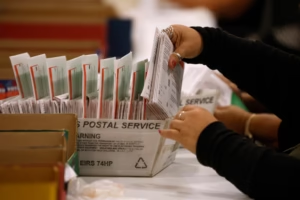
For the tens of millions of Americans who rely on mail-in voting, including seniors, voters with disabilities, military service members stationed overseas, and college students, the practical stakes are immediate and personal. Voting rights advocates have warned that the order’s implementation, even in its current incomplete state, has already begun creating confusion among voters and election officials who are simultaneously preparing for 2026 primaries while uncertain which federal rules will ultimately govern ballot delivery. A voter with cerebral palsy interviewed by the ACLU described mail-in voting as her “lifeline” for political participation, illustrating the order’s potential to disenfranchise voters who depend on accessible voting methods that in-person voting cannot always accommodate.
The case also carries direct electoral consequences given its timing. With control of the House and Senate at stake in November, and Democrats traditionally relying more heavily on mail-in voting than Republicans according to 2024 election data, any disruption to mail ballot delivery systems could disproportionately affect one party’s voter turnout relative to the other, a dynamic that has fueled bipartisan concern even among some Republicans wary of the order’s implications for their own constituents who use mail voting, including older and rural voters.
Beyond the immediate election cycle, the case will help establish precedent for how much latitude the executive branch has to use federal agencies like the Postal Service as instruments of election policy, a question with implications extending far beyond this specific order to any future president’s ability to influence election administration through agency action rather than legislation.
Economic and Global Context
The administrative costs of implementing the order have drawn scrutiny independent of its constitutional merits. Building and maintaining nationwide citizenship verification lists requires significant new federal infrastructure and interagency data-sharing arrangements between the Social Security Administration, Department of Homeland Security, and U.S. Postal Service, agencies that were not originally designed to perform this function together. State election officials, who must now prepare contingency plans for multiple possible regulatory outcomes simultaneously, have reported diverting resources and staff time away from routine election preparation to address the uncertainty created by the pending litigation.
This is Trump’s second major executive action attempting to overhaul federal election administration since returning to office. An earlier order requiring documentary proof of citizenship for voter registration was blocked by multiple federal judges, establishing a pattern in which the administration has pursued election policy changes through unilateral executive action after a broader legislative overhaul effort stalled in Congress. That pattern itself has become a point of contention, with critics arguing it reflects an attempt to achieve through executive fiat what could not secure sufficient legislative support.
Internationally, the case is being watched as part of a broader global conversation about election administration integrity and access, with the United States historically serving as a reference point in international democracy assessments. Significant litigation over core voting mechanics in a major Western democracy ahead of a consequential midterm election draws attention from international election monitoring organizations and allied democracies assessing the stability of American electoral institutions.
The U.S. Postal Service’s own institutional position has been complicated by the order, as the agency has historically operated as a neutral mail carrier rather than an arbiter of ballot eligibility, and postal worker unions have launched public campaigns defending mail voting’s security record even as the agency’s leadership works to implement the administration’s directive.
Implications
The litigation now moves toward substantive hearings on whether Judge Talwani will issue a preliminary injunction blocking the order’s implementation ahead of the 2026 primaries and November midterms, a decision that could come within weeks given the compressed election calendar. Should she grant such an injunction, the administration would likely seek emergency relief from the First Circuit Court of Appeals and potentially the Supreme Court, given the pattern of rapid appellate review that has characterized other major Trump administration executive order disputes this year.
For state election officials, the uncertainty surrounding the litigation’s outcome complicates preparation for primary elections already underway in several states, forcing secretaries of state and local election boards to develop contingency procedures for multiple possible scenarios regarding mail ballot handling with limited lead time before ballots must be printed and distributed.
For voters who rely on mail-in ballots, the practical advice from voting rights organizations remains consistent regardless of the litigation’s ultimate outcome: registering early, confirming registration status directly with state election officials, and requesting mail ballots as soon as legally permitted will provide the greatest protection against any disruption that might emerge from the order’s implementation or the ongoing legal uncertainty surrounding it.
For Congress, the case underscores the absence of comprehensive federal legislation governing mail-in voting standards, a gap that has allowed both the executive branch and state legislatures to pursue divergent and sometimes conflicting approaches to ballot access, a situation likely to generate renewed legislative proposals regardless of how the courts ultimately resolve the constitutional questions at the center of this case.
Sources
“US Judge Allows Challenges to Trump’s Mail-In Voting Order Ahead of November Elections”
