

Story Highlights
- Trump attempted to fire Federal Reserve Governor Lisa Cook in August 2025 over mortgage fraud allegations she denies
- It is the first time in the Fed’s history that a president has attempted to remove a sitting governor
- Multiple justices, including Trump appointee Brett Kavanaugh, voiced concern at oral argument that allowing the firing could “weaken, if not shatter” Fed independence
- Lower courts have repeatedly blocked the removal, allowing Cook to remain in her position while litigation continues
What Happened
In August 2025, President Trump moved to fire Lisa Cook, a member of the Federal Reserve’s Board of Governors and the first Black woman to hold the position, citing allegations that she had committed mortgage fraud related to how she described properties on financial disclosure forms. Cook has consistently and unequivocally denied the allegations, stating she is prepared to refute them in an appropriate legal forum. Her case moved quickly through the federal court system, beginning with a request for a temporary restraining order at a hearing where her legal team accused the administration of waging “an obvious smear campaign” based on “vague, unsubstantiated allegations.”
U.S. District Judge Jia Cobb issued a preliminary injunction on September 9, 2025, blocking Cook’s removal while the underlying lawsuit proceeded. Cobb concluded that Cook had made a strong showing that her firing violated the Federal Reserve Act’s “for cause” removal provision, writing that the statute “does not contemplate removing an individual purely for conduct that occurred before they began in office.” The U.S. Court of Appeals for the D.C. Circuit upheld that protection in a 2-1 ruling shortly afterward, rejecting an emergency appeal from the administration that sought to remove Cook before a scheduled Federal Open Market Committee meeting.
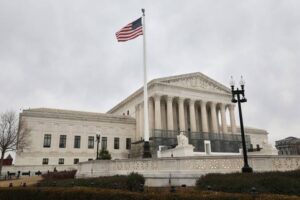
The case reached the Supreme Court on an emergency basis, with oral arguments held in January 2026. Both Cook and Fed Chairman Jerome Powell sat through nearly two hours of arguments in a packed courtroom. Justice Brett Kavanaugh, one of three Trump appointees on the Court, posed perhaps the most pointed challenge to the administration’s position, warning that allowing a president to remove a Fed governor without meaningful judicial review or a clearly defined standard for “cause” would “weaken, if not shatter, the independence of the Federal Reserve.” He further cautioned that such a precedent would inevitably be used by future presidents of both parties, observing that “once these tools are unleashed, they are used by both sides and usually more the second time around.”
At least five other justices, according to court observers, also expressed skepticism toward the administration’s position during argument, with Chief Justice Roberts and Justices Sotomayor, Barrett, and Jackson all raising pointed questions about the lack of process Cook was afforded before her attempted removal. Solicitor General Sauer maintained that Cook was not entitled to formal notice or a hearing before being fired, arguing that a public office does not constitute the kind of constitutionally protected “property” that requires due process before removal. Cook, for her part, issued a statement after arguments concluded: “For as long as I serve at the Federal Reserve, I will uphold the principle of political independence in service to the American people.”
Why It Matters
This case touches one of the most carefully guarded principles in American governance: that the institution responsible for setting interest rates and managing the money supply should operate free from day-to-day political pressure. No president, Republican or Democrat, has previously attempted to fire a sitting Fed governor in the institution’s 112-year history. The reason is not legal ambiguity alone but a long-standing, bipartisan understanding that political control over monetary policy invites the kind of short-term manipulation that can produce serious long-term economic damage, including runaway inflation.
The timing adds further significance. Trump has repeatedly and publicly pressured Fed Chairman Powell to lower interest rates faster than the central bank’s own data-driven judgment has supported, and Trump’s critics argue that removing Cook is fundamentally about gaining a Fed board majority sympathetic to his preferred rate policy rather than about the fraud allegations themselves. If that reading is correct, this case is less about one governor’s conduct than about whether a president can reshape an independent institution’s composition through removal power rather than through the ordinary appointment process Congress established.
Justice Kavanaugh’s warning about reciprocal escalation deserves particular attention from readers across the political spectrum. A ruling permitting Trump’s removal of Cook on the asserted grounds would not remain a one-directional tool. Any future Democratic president inheriting that same removal authority could, under the same legal logic, remove Republican-appointed governors on similarly contested factual grounds, transforming the Fed’s board into something that turns over with each administration rather than operating on staggered, insulated terms designed to outlast any single president.
For everyday Americans, Federal Reserve independence has tangible consequences for mortgage rates, savings yields, and the broader cost of borrowing. Markets have historically rewarded central bank credibility with lower long-term interest rates precisely because investors trust that monetary policy decisions are not being made for short-term political convenience. Undermining that credibility, even through a single contested removal, carries real economic risk.
Economic and Global Context
The Federal Reserve’s board had cut its benchmark interest rate three times in succession in the final months of 2025, a pace that fell short of what Trump had publicly demanded, and the board has since signaled it may hold rates steady amid continuing inflation concerns tied in part to tariff policy and, more recently, energy price pressure connected to the Iran conflict. A central bank board reshaped by presidentially motivated removals rather than ordinary appointment turnover could shift this delicate balancing act in ways markets would likely interpret as a loss of institutional credibility.
International observers and credit markets pay close attention to Federal Reserve independence specifically because of the dollar’s role as the world’s primary reserve currency. Any perception that U.S. monetary policy has become subject to presidential whim rather than data-driven analysis carries the potential to affect global investor confidence in dollar-denominated assets, a risk central bankers worldwide have historically taken seriously when commenting on this case.
Historically, comparable struggles over central bank independence in other nations — including periods of political interference with monetary policy in various emerging economies — have frequently preceded bouts of currency instability and elevated inflation expectations, a pattern American economists and former Fed officials have invoked repeatedly in discussing the stakes of Trump v. Cook.
Implications
A Supreme Court ruling against the administration would reinforce, likely for decades, the principle that Federal Reserve governors enjoy meaningful protection from removal absent a genuine, provable cause unrelated to policy disagreements. This outcome appears more probable given the breadth of skepticism multiple justices, including Trump’s own appointees, expressed at oral argument.
For markets and the broader economy, a definitive ruling preserving Fed independence would likely be received as a stabilizing signal, reducing uncertainty around the institution’s composition and policy trajectory heading into a consequential midterm election year.
For future presidents of both parties, this case will establish the durable boundaries of executive removal power over independent agency officials, a question that extends well beyond the Federal Reserve to other agencies Trump has already sought to reshape through similar removal actions.
For Lisa Cook personally, and for the broader principle of due process in public office, the ruling will determine whether public officials facing politically charged accusations are entitled to meaningful process before being stripped of statutorily protected positions.
Sources
“Supreme Court appears likely to prevent Trump from firing Fed governor”
