


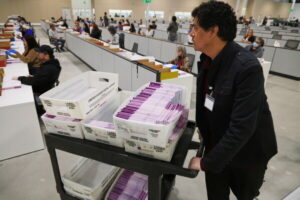
Story Highlights
- Watson v. Republican National Committee asks whether federal law requires mail ballots to be received by Election Day, not merely mailed by that date
- Fourteen states plus Washington, D.C., currently allow grace periods for ballots postmarked by Election Day but received afterward
- The Fifth Circuit Court of Appeals already ruled in the RNC’s favor, striking down Mississippi’s five-day grace period
- A decision is expected by late June or early July, leaving states a narrow window to adjust procedures before November
What Happened
The case originated with a 2020 Mississippi law, House Bill 1521, enacted in response to pandemic-era mail voting concerns, which allows absentee ballots to be counted as long as they are postmarked by Election Day and received by election officials within five business days afterward. In 2024, the Republican National Committee, the Mississippi Republican Party, and the Libertarian Party of Mississippi sued to challenge the law, arguing it conflicts with a federal statute dating to 1845 that establishes the Tuesday after the first Monday in November as the official “election day” for federal races. A federal district court initially ruled in Mississippi’s favor, but a panel of the U.S. Court of Appeals for the Fifth Circuit reversed, concluding that federal law requires ballots to be received, not merely cast, by Election Day. The full Fifth Circuit declined to rehear the case over a dissent from five judges, and Mississippi appealed to the Supreme Court, which agreed in November 2025 to hear the dispute.
Oral arguments took place on March 23, 2026, with Mississippi Attorney General Lynn Fitch defending the state’s law and arguing that “counting votes is not part of the election” under the relevant federal statutes. Representing the challengers, attorney Paul Clement argued that Congress’s designation of a single election day functions as a firm deadline, and that any state law extending the process beyond that day conflicts with and is preempted by federal law. Mississippi Solicitor General Scott Stewart countered that the case is fundamentally about federalism, asking the justices to consider whether Congress in 1845 intended to block a practice — counting ballots that arrive shortly after Election Day — that lawmakers at the time had no occasion to even consider.
According to court observers, the justices appeared receptive to the Republican challengers’ arguments during the more than two hours of oral argument, with several conservative justices raising concerns consistent with the position that federal election-day statutes set a firm, singular deadline rather than a flexible window. The Court’s more liberal justices, by contrast, indicated sympathy toward preserving state authority to set their own election administration rules, consistent with the Constitution’s Elections Clause, which gives states primary responsibility for the “Times, Places and Manner” of holding congressional elections, subject to congressional override.
The stakes extend well beyond Mississippi. Fourteen states and the District of Columbia currently maintain similar grace periods, and the case has drawn extensive friend-of-the-court briefing, including from a coalition of more than fifty retired military leaders and diplomats and eight organizations representing military and overseas voters, who argued that grace periods have historically existed specifically to protect ballots from service members stationed abroad, where mail delivery delays are common and largely outside voters’ control.
Why It Matters
This case touches a foundational question about who controls American elections: the states, which the Constitution generally tasks with setting election procedures, or Congress, whose statutes the challengers argue impose a uniform national deadline that preempts state flexibility. How the Court resolves this tension will shape election administration nationwide for years, regardless of which political party benefits in any particular election cycle.
The practical stakes for voters are significant but more nuanced than they might first appear. Research cited in briefing before the Court indicates that states with and without grace periods reject mail ballots for lateness at roughly similar rates, around 0.2 percent of all returned ballots, suggesting that voters generally adapt their behavior to whatever deadline exists. However, that adaptation requires advance notice, and a ruling issued close to the November election would leave states an extremely narrow window to inform voters of any changed deadline, retrain local election officials, and revise official guidance, particularly in states like Washington, which currently maintains a 21-day grace period, the longest in the nation.
Military and overseas voters represent a particularly important constituency in this dispute. Mail delivery delays affecting service members stationed abroad are frequently outside any individual voter’s control, and the friend-of-the-court brief filed on their behalf argues that grace periods exist precisely to ensure their votes are not systematically disadvantaged by circumstances of military service. A ruling striking down these provisions could disproportionately affect the ability of deployed troops and their families to have their votes counted, a concern that has drawn bipartisan attention in the past.
This case also exemplifies the broader principle underlying the Purcell doctrine, a legal presumption against courts altering election rules immediately before an election, given the practical burdens placed on election administrators and voters alike. Whether the Court’s ruling, expected by late June or early July, leaves sufficient time for orderly implementation before November’s midterms will itself become a significant point of contention regardless of the substantive outcome.
Economic and Global Context
The administrative costs of implementing a ruling against grace periods would fall most heavily on state and county election offices, which would need to revise procedures, retrain staff, and conduct voter education campaigns on a compressed timeline. Washington state, which operates an entirely vote-by-mail system across 39 county election departments and currently certifies elections at the 21-day mark, faces what officials there describe as a complete overhaul of established procedures should the Court rule broadly against grace periods.
According to data from the U.S. Election Assistance Commission’s biennial survey, approximately 103,000 mail ballots were rejected for arriving late in the 2024 election cycle, representing about 18 percent of all mail ballot rejections nationally. While a ruling against grace periods may not dramatically increase this figure given voters’ demonstrated tendency to adapt to deadlines, the transition period itself carries elevated risk of voter confusion and inadvertent disenfranchisement, particularly among rural voters who often face longer mail delivery times and fewer in-person voting alternatives.
The case also intersects with the broader national debate over voting access and election security that has intensified throughout Trump’s second term, including separate federal court rulings this year that have blocked key provisions of earlier Trump administration executive orders targeting state election procedures, mail-in voting, and voter registration requirements.
Implications
A ruling is expected before the Supreme Court’s summer recess, giving affected states a compressed but not nonexistent window to adjust procedures before the November midterm elections. Election administrators in the fourteen affected states and the District of Columbia will need to move quickly regardless of the ruling’s precise scope, given how close the decision will land to the start of absentee and early voting periods for the 2026 cycle.
For voters who rely on mail ballots, particularly those in rural areas, the elderly, voters with disabilities, and military families stationed overseas, the practical guidance will be the same regardless of outcome: mailing ballots as early as possible, using available ballot tracking systems, and confirming current deadlines directly with state election offices as the picture clarifies.
For state legislatures in affected states, a ruling against grace periods would likely prompt swift legislative responses, either to bring state and local election deadlines into alignment with a federal receipt deadline or to expand alternative voting methods such as in-person early voting and ballot drop boxes to offset the loss of mail flexibility.
For both political parties heading into a closely watched midterm election, the ruling carries obvious strategic stakes, though the underlying constitutional question, properly understood, is about the allocation of authority between state and federal government over election administration rather than a simple partisan outcome.
Sources
“Justices seem ready to overturn state law allowing for late-arriving mail-in ballots”
