


Story Highlights
- The Supreme Court ruled 6-3 that Trump’s executive order restricting birthright citizenship is unconstitutional, upholding the Fourteenth Amendment’s guarantee that those born in the U.S. are citizens at birth.
- The order, signed on Trump’s first day in office in January 2025, would have denied citizenship documents to children born to undocumented or temporarily present parents, including students and green card applicants.
- Chief Justice John Roberts wrote the majority opinion; Justice Samuel Alito authored one of three dissents, calling the ruling “a serious mistake.”
- Trump responded by urging Congress to pursue legislation ending birthright citizenship, saying no constitutional amendment would be necessary.
What Happened
On his first day back in the White House, January 20, 2025, President Donald Trump signed an executive order seeking to eliminate birthright citizenship as it has been understood under the Fourteenth Amendment for over 150 years. The order declared that, beginning 30 days after its effective date, babies born on U.S. soil would not be entitled to automatic citizenship documents if their parents were undocumented immigrants or present in the country only temporarily, a category that would have included international students and applicants for permanent residency.
The order was immediately challenged in federal courts across the country. On July 10, 2025, a federal court in New Hampshire provisionally certified a nationwide class action, Barbara v. Trump, blocking the order from taking effect against any child born in the United States while litigation proceeded. Multiple additional district courts ruled the order unconstitutional, and two federal appellate circuits upheld injunctions preventing its implementation, ensuring the policy never took effect anywhere in the country.
The case, formally titled Trump v. Barbara, reached the Supreme Court on appeal from the New Hampshire ruling, with oral arguments held April 1, 2026. The proceedings drew unusual attention when Trump himself attended the courtroom session, an unprecedented move that underscored how personally invested the president was in the case’s outcome. Cecillia Wang, the ACLU’s national legal director, argued on behalf of the plaintiffs, while Solicitor General D. John Sauer represented the administration.
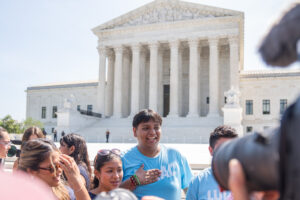
On June 30, 2026, the court ruled 6-3 against the administration. Chief Justice John Roberts wrote the majority opinion, holding that children born in the United States to parents who are unlawfully or temporarily present are “subject to the jurisdiction” of the United States and are therefore citizens at birth under the Fourteenth Amendment’s Citizenship Clause. Justice Samuel Alito wrote one of three dissents from the court’s conservative wing, declaring, “The Court has made a serious mistake.”
Trump reacted within hours on Truth Social, writing that the ruling was “too bad for our Country” but insisting the goal could still be achieved through ordinary legislation rather than a constitutional amendment. “Congress should start TODAY to work on ending expensive and unfair to our Country, Birthright Citizenship,” he wrote, pledging his “Complete and Total Support” for such an effort.
Why It Matters
The ruling represents one of the most significant defenses of constitutional text against executive overreach in the current term, reaffirming that the Fourteenth Amendment’s guarantee of birthright citizenship, ratified in 1868 in the aftermath of the Civil War, cannot be unilaterally reinterpreted or narrowed by presidential order. For constitutional scholars and civil liberties advocates, the decision underscores that even a conservative-majority court with a generally expansive view of executive authority was unwilling to permit the president to redefine who counts as an American citizen without going through Congress or a constitutional amendment process.
The practical stakes extend far beyond the estimated hundreds of thousands of babies born annually to immigrant parents in the United States. Had the order taken effect, it would have created what civil rights groups described as a permanent subclass of individuals born on U.S. soil but denied the citizenship rights guaranteed to all other Americans, a outcome with cascading implications for access to federal benefits, voting rights, passport eligibility and legal status that would persist across generations.
The ruling also matters as a marker of the limits of executive power more broadly. This term, the court has both expanded and constrained Trump’s authority across different cases, striking down his global tariff regime under emergency powers law earlier in the year while sometimes granting him broad latitude on immigration enforcement and agency personnel decisions. The birthright citizenship case stands as one of the clearest instances where the court drew a firm line rooted directly in constitutional text rather than statutory interpretation.
Trump’s pivot toward a legislative strategy signals that the fight over birthright citizenship is far from over, even though the constitutional question itself has now been definitively resolved by the nation’s highest court.
Economic and Global Context
Birthright citizenship, rooted in the legal principle of jus soli, has shaped American demographic and economic policy for over a century, distinguishing the United States from many nations that base citizenship primarily on parental nationality rather than place of birth. Immigration researchers note that the policy has historically been credited with facilitating integration of immigrant families into American economic and civic life across generations, a dynamic that opponents of the Trump order argued would have been fundamentally disrupted had the policy taken effect.
The ruling also carries international dimensions, given that birthright citizenship debates intersect with broader immigration and border policy questions being litigated simultaneously in federal courts nationwide. Just this week, a separate appellate ruling in the Tenth Circuit found against a Trump administration detention policy affecting a longtime U.S. resident, part of a broader pattern in which more than 450 district court judges have ruled against categorical immigration detention practices during the administration’s mass deportation push.
Business groups and universities that rely on international students and skilled immigrant workers had expressed concern that the birthright citizenship order, by extending to legally present temporary visa holders, could have complicated long-term workforce planning and family decisions for a significant portion of the skilled immigrant population central to sectors including technology, healthcare and academia.
Implications
With the constitutional question resolved, the political fight now shifts decisively to Congress, where Trump has vowed to pursue legislation ending birthright citizenship despite the practical reality that any such statute would almost certainly face immediate constitutional challenges given the Supreme Court’s explicit ruling that the practice is protected by the Fourteenth Amendment itself, not merely a policy choice subject to ordinary statutory revision.
For immigrant families and civil rights organizations, the ruling delivers immediate relief and certainty after eighteen months of litigation uncertainty that left hundreds of thousands of families unsure whether their children’s citizenship status might eventually be challenged. Organizations including the ACLU, the NAACP Legal Defense Fund and the Asian Law Caucus, which jointly litigated the case, have signaled they will remain vigilant against any legislative or administrative efforts to circumvent the ruling.
For congressional Republicans, Trump’s call to legislate around the ruling presents a difficult political choice: pursuing legislation that directly conflicts with a definitive constitutional ruling risks immediate legal defeat and expends political capital on a fight the courts have already settled, while resisting the president’s demands risks provoking his public criticism, a dynamic that has played out repeatedly this term whenever the courts have ruled against the administration’s immigration agenda.
Sources
“Supreme Court upholds birthright citizenship, blocks Trump order”
