
The Supreme Court delivered a major rebuke to President Trump’s use of federalized National Guard troops for domestic law enforcement, ruling that his administration lacked the statutory authority to deploy Guard units in Chicago over the objection of Illinois’ governor. The 6-3 decision reinforces the 1878 Posse Comitatus Act’s prohibition on using military forces for civilian policing and follows a similar federal court ruling finding the administration’s deployment in Los Angeles unlawful. The case stands as one of the most significant judicial checks yet on the administration’s expanding use of military force within American cities.
Story Highlights
- The Supreme Court ruled 6-3 that Trump lacked authority under federal law to federalize Illinois National Guard troops for deployment to Chicago
- A separate federal court had already ruled the Los Angeles Guard deployment violated the Posse Comitatus Act
- The rulings mark the first time courts have found the 1878 law violated by a sitting president’s actions
What Happened
The legal fight began after President Trump, citing crime and immigration enforcement concerns, directed Defense Secretary Pete Hegseth to federalize National Guard troops for deployment to Chicago over the strenuous objection of Illinois Governor JB Pritzker. Hegseth invoked 10 U.S.C. § 12406 to federalize up to 300 Illinois National Guard members, and the following day authorized an additional 400 troops from Texas, under Republican Governor Greg Abbott, to be sent into the city as well.
Illinois Attorney General Kwame Raoul filed suit, arguing that the federal statute the administration relied upon, which permits the president to call up the Guard only in cases of invasion, rebellion, or when regular forces cannot execute the laws, did not apply because none of those conditions existed in Chicago. Lower courts largely agreed, blocking the deployment, and the dispute reached the Supreme Court on an emergency basis. In a 6-3 ruling issued December 23, 2025, in Trump v. Illinois, the justices held that the administration had failed to meet the legal standard required to federalize the Guard, writing that “the President has not invoked a statute that provides an exception to the Posse Comitatus Act.” Justice Neil Gorsuch dissented, raising concerns about the practical distinction between the National Guard and the regular military under the statute.
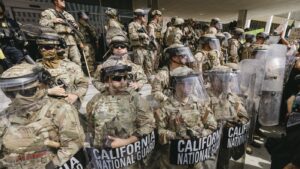
The Chicago ruling closely followed a parallel case in California, where U.S. District Judge Charles Breyer ruled after a three-day bench trial that the federalized deployment of California’s National Guard and U.S. Marines to Los Angeles, ordered over Governor Gavin Newsom’s objection, violated the Posse Comitatus Act. Breyer found the administration had used armed soldiers, their identities often obscured by protective gear, to establish security perimeters, conduct traffic and crowd control, and demonstrate a military presence throughout the city, activities the 1878 law was designed to prohibit. Breyer wrote pointedly that the administration had shown it wanted “the only check they want is a blank one,” and warned that Trump and Hegseth’s stated intention to deploy Guard troops to other cities risked “creating a national police force with the President as its chief.”
Trump ultimately abandoned his appeal of the California ruling on December 31, 2025, and the Ninth Circuit Court of Appeals returned command of the California Guard to Newsom. The rulings together represent the first time in the 148-year history of the Posse Comitatus Act that federal courts have found a sitting president in violation of it.
Why It Matters
The rulings reaffirm one of the oldest and most fundamental constitutional principles in American governance: the separation between military and civilian law enforcement authority. The Posse Comitatus Act was enacted in 1878 specifically to end the military occupation of former Confederate states following Reconstruction, and both courts found that the administration’s deployments echoed precisely the kind of domestic military policing the law was designed to prevent.
For state governors, the rulings affirm meaningful limits on a president’s ability to override state control of National Guard units, even though the Ninth Circuit separately clarified that governors do not hold outright veto power over federalization itself. The practical result is a legal framework in which a president can technically initiate federalization without a governor’s consent, but cannot then direct those federalized troops to perform actual law enforcement functions absent an act of Congress or invocation of the Insurrection Act, which Trump notably did not invoke in either the Illinois or California cases.
For civil liberties advocates, the decisions represent a significant check on what Judge Breyer characterized as a systemic, months-long effort to use military troops to execute federal drug and immigration laws across the country. The rulings underscore that even broad claims of inherent executive authority to protect federal functions and personnel cannot override the explicit constitutional design, rooted in the Constitution’s Calling Forth Clause, that grants Congress, not the president alone, control over when the military may be used domestically.
For Americans living in cities targeted by Guard deployments, including Los Angeles, Chicago, Portland, and Washington, D.C., the rulings offer a degree of legal reassurance that state and local governments retain the ability to challenge similar deployments in court, even as the administration has continued pursuing troop deployments in other cities under different legal theories.
Economic and Global Context
The domestic deployment of military and National Guard forces carries substantial direct costs, including troop pay, logistics, and equipment mobilization, expenses that fall on both federal and state budgets depending on the legal basis for deployment. Disputes over which government bears these costs have added an additional layer of litigation in several of the affected states.
The rulings also carry symbolic weight internationally, given that the use of domestic military force for civilian policing is often cited by international observers and democracy-monitoring organizations as a hallmark of democratic backsliding. By affirming that such deployments require clear congressional authorization, the courts have reinforced a distinction the United States has long emphasized in contrast to nations where blurred military-civilian law enforcement lines are more common.
Domestically, the rulings arrive amid a broader expansion of ICE’s 287(g) partnerships with state and local police, and the intersection of these two enforcement trends, deputized local police alongside federalized Guard units, has drawn sustained legal scrutiny over whether the administration is attempting to construct parallel law enforcement structures immune from ordinary state oversight.
Implications
In the near term, expect continued litigation as the administration pursues Guard deployments in additional cities, including reported plans involving Memphis and potentially New Orleans, with the Illinois and California rulings now serving as binding precedent that state attorneys general are likely to invoke in future challenges.
For Congress, the rulings place renewed attention on the scope of 10 U.S.C. § 12406 and whether legislative clarification is needed to more precisely define the circumstances under which a president may federalize state Guard units without gubernatorial consent.
For governors, particularly those from opposing political parties, the rulings provide a clearer legal roadmap for challenging future deployments, while also highlighting the practical limits of that protection given that federalization itself can proceed without their agreement.
For the broader debate over executive power, the rulings stand as a notable instance of the judiciary imposing a firm check on the administration’s use of military force domestically, a precedent likely to shape how future presidents, of either party, approach the use of the National Guard in response to civil unrest or immigration enforcement operations.
Sources
“Court Finds Trump’s Use of Soldiers in Los Angeles Is Illegal”
