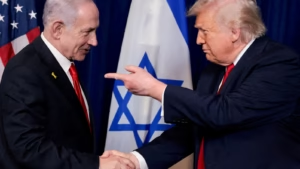
President Donald Trump declared Monday that Israeli Prime Minister Benjamin Netanyahu will not be arrested on American soil, directly rebuking New York City Mayor Zohran Mamdani, who said his administration was actively exploring whether city police could detain the Israeli leader under an International Criminal Court warrant. The clash sets up a legal and political confrontation over the limits of municipal authority, international law and executive power ahead of Netanyahu’s expected visit for the United Nations General Assembly in September.
Story Highlights
- Trump said on Truth Social that Netanyahu “will not be arrested, in any way, shape, or form” while in the United States
- Mamdani said his administration is in “active conversation” with New York City’s Law Department about detaining Netanyahu under an ICC warrant
- The ICC issued an arrest warrant for Netanyahu in November 2024 over alleged war crimes in Gaza, which Israel calls illegitimate
- The United States is not a signatory to the ICC and does not recognize its jurisdiction
What Happened
President Donald Trump posted on Truth Social Monday that Israeli Prime Minister Benjamin Netanyahu “will not be arrested, in any way, shape, or form, while in the United States of America,” directly responding to comments from New York City Mayor Zohran Mamdani. Trump’s statement came after Mamdani told The New York Times’ “The Interview” podcast, in an episode published over the weekend, that he believes Netanyahu “belongs in The Hague” and that his administration remains in “active conversation” with the city’s Law Department about whether police have the legal authority to detain the Israeli leader during a future visit.
Mamdani’s comments referenced the International Criminal Court’s November 2024 arrest warrant against Netanyahu, which charges him with war crimes connected to Israel’s military campaign in Gaza. The United States is not a signatory to the Rome Statute that created the ICC and does not recognize the court’s jurisdiction over American or allied officials, a position reaffirmed by both the Trump and Biden administrations. Netanyahu is expected to travel to New York in September to address the United Nations General Assembly, a trip that would place him within Mamdani’s jurisdiction as mayor.
In his Truth Social post, Trump credited Netanyahu with supporting the United States in its ongoing conflict with Iran, writing that the Israeli leader “is fighting against the Islamic Republic of Iran, which recently killed 52,000 innocent protestors, and has spent the last 47 years killing American Soldiers, and others.” Trump added that “the only ones that should be arrested are the people that led Iran into this unprecedented spiral of death and destruction,” framing his defense of Netanyahu within the broader context of the active U.S.-Iran military conflict.
Netanyahu’s office responded by dismissing the ICC as a “kangaroo court” with no jurisdiction over Israeli officials. Reaction among Mamdani’s own political allies was mixed. California Representative Ro Khanna, who is often aligned with Mamdani on issues involving Israel and Gaza, said on Fox News that in his view, Netanyahu “can come to the U.N. Assembly,” adding that he preferred to focus on cutting military aid to Israel rather than “creating a spectacle.” Democratic Representative Jerry Nadler of New York previously called a similar Mamdani proposal “simply unrealistic,” stating flatly that “the City of New York has no jurisdiction to do such a thing.”
Mamdani has maintained his position since first raising the possibility in a December 2024 interview, well before his election as mayor, and has said he remains uncertain whether he possesses the legal authority to direct police to detain a sitting foreign head of government, an authority that would raise significant questions under both federal law and long-standing principles of diplomatic and head-of-state immunity.
Why It Matters
The dispute raises a genuine constitutional question about the division of authority between federal and municipal governments in matters of foreign policy and international law. Under the Constitution, the conduct of foreign affairs, including decisions about diplomatic immunity and the recognition of international tribunals, falls squarely within federal executive authority. A municipal attempt to arrest a foreign head of government attending an official United Nations function would represent an unprecedented intrusion into an area the Constitution reserves for the federal government.
For American allies, particularly Israel, the episode signals the continued strength of the U.S.-Israel relationship under the Trump administration, even as domestic political figures increasingly challenge that alliance publicly. Trump’s forceful defense of Netanyahu reinforces a broader pattern in his approach to foreign policy, prioritizing alliances he views as strategically vital while dismissing international legal mechanisms the United States has never recognized.
The dispute also highlights growing friction between the Trump administration and progressive municipal leaders on foreign policy questions traditionally reserved for federal officials. Mamdani’s willingness to publicly explore using city law enforcement against a foreign leader, despite the ICC lacking recognized jurisdiction in the United States, raises questions about the limits of local government power and the potential for diplomatic complications arising from municipal-level political statements.
Economic and Global Context
The confrontation unfolds against the backdrop of an active U.S. military conflict with Iran, in which Israel has played a supporting role. Trump’s public defense of Netanyahu is closely tied to that alliance, framing Israeli military action against Iran as directly beneficial to American interests. Any diplomatic friction surrounding Netanyahu’s September visit could complicate coordination between Washington and Jerusalem at a moment when both governments are focused on managing an active regional war.
Internationally, the episode reinforces longstanding divisions over the legitimacy of the International Criminal Court. The United States, like Israel, does not recognize the court’s authority, a position shared by several major powers including Russia and China, though for different underlying reasons. European allies, many of whom are ICC signatories, face their own complications when hosting Netanyahu, a dynamic that has already led to diplomatic friction during his travels to European capitals since the warrant was issued.
The dispute also carries implications for New York City’s standing as host of the United Nations headquarters. Any effort by city officials to detain a visiting head of government attending an official U.N. session could trigger significant diplomatic and legal consequences affecting the city’s relationship with the federal government and international bodies, given that security and diplomatic protocols for U.N. events are typically coordinated at the federal and international level rather than by municipal authorities alone.
Implications
In the coming months, expect continued public sparring between Trump and Mamdani as Netanyahu’s September visit approaches. Mamdani has indicated his administration is still evaluating the legal question internally, meaning a final decision on any potential action may not be reached until closer to the United Nations General Assembly session itself.
For federal officials, the episode is likely to prompt clarification of the legal boundaries governing diplomatic immunity and head-of-state protections during official visits to the United States, particularly given the unprecedented nature of a major American city’s mayor publicly weighing an arrest of a sitting allied head of government.
For voters and political observers, the dispute is likely to become a flashpoint in the broader national debate over Israel policy, further highlighting divisions between the Trump administration’s approach to the U.S.-Israel alliance and the positions of progressive municipal leaders like Mamdani, whose stance has already drawn skepticism from more moderate members of his own party, including Representative Nadler.
Sources
“Trump says Netanyahu won’t be arrested on U.S. soil, as Mamdani weighs effort”
