


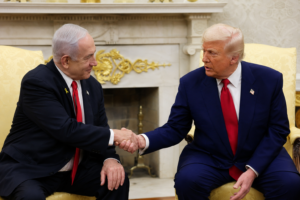
President Trump declared that Israeli Prime Minister Benjamin Netanyahu will face no arrest during his upcoming trip to the United States, directly countering New York City Mayor Zohran Mamdani’s repeated calls to enforce an International Criminal Court warrant against the Israeli leader. The clash sets up a pointed test of the relationship between international law, federal authority and local governance, as Netanyahu prepares to travel to Washington. It also underscores broader tensions between the Trump administration and Mamdani’s administration over a range of issues.
Story Highlights
- Trump declared on Truth Social that Netanyahu “will not be arrested in any way, shape, or form” while in the United States
- Netanyahu is subject to a November 2024 International Criminal Court warrant alleging war crimes tied to Israel’s military campaign in Gaza
- Mamdani has repeatedly called Netanyahu a “war criminal” but has acknowledged New York City lacks independent legal authority to execute an ICC arrest
- The United States is not a party to the International Criminal Court and does not recognize its jurisdiction over Israeli or American officials
What Happened
President Trump used Truth Social to declare that Israeli Prime Minister Benjamin Netanyahu “will not be arrested, in any way, shape, or form, while in the United States of America,” a direct response to escalating calls from New York City Mayor Zohran Mamdani for federal or local authorities to enforce an International Criminal Court arrest warrant against the Israeli leader. Netanyahu is expected to travel to Washington and meet with Trump, with a separate visit tied to the United Nations General Assembly expected in September.
Mamdani, a Democratic Socialist who took office as mayor earlier this year, has for more than a year maintained that New York City should honor the ICC’s November 2024 warrant, which accuses Netanyahu of war crimes and crimes against humanity, including allegations of using starvation as a method of warfare during Israel’s military campaign in Gaza. In a solemn video statement this week, Mamdani called Netanyahu “the architect of a horrific genocide against the Palestinian people” and said anyone with “eyes,” a “heart” and a “conscience” should recognize he belongs “before a court of law.” He cited Palestinian health ministry figures claiming more than 73,000 people have been killed in the conflict.
Despite the rhetoric, Mamdani has publicly acknowledged that New York City does not possess independent legal authority to execute an ICC warrant, telling reporters this week that city officials determined they lack the standing to carry out such an arrest on their own. That acknowledgment reflects a broader legal reality: the United States has never ratified the treaty establishing the International Criminal Court and does not recognize the court’s jurisdiction over American or allied officials, meaning any enforcement of an ICC warrant on U.S. soil would require action the federal government has explicitly refused to take.
Netanyahu’s office has pushed back sharply on Mamdani’s rhetoric, with a spokesperson previously suggesting the mayor should instead focus on “fixing the damage his policies have caused New York.” Representative Jerry Nadler, a New York Democrat, has separately called Mamdani’s proposal “simply unrealistic,” stating flatly that “the City of New York has no jurisdiction to do such a thing.” Trump, in his own remarks, framed Netanyahu’s position differently, describing him as an ally “fighting against the Islamic Republic of Iran” amid the ongoing broader Middle East conflict.
Why It Matters
The dispute raises a foundational question about the structure of American federalism and international law: whether a local government official can, or should, attempt to enforce an international legal body’s warrant that the federal government has explicitly rejected. Because foreign policy and the recognition of international tribunals fall squarely within federal constitutional authority, Mamdani’s repeated public statements, even as largely symbolic gestures, test the boundaries of what local officials can credibly claim to do independent of federal cooperation.
The episode also highlights the United States’ longstanding position on the International Criminal Court itself. Successive American administrations, both Republican and Democratic, have declined to join the ICC’s founding treaty, arguing the court’s jurisdiction over non-member states’ officials raises serious sovereignty concerns. Trump’s blunt assertion that Netanyahu will not be arrested reaffirms that position in unusually direct terms, reinforcing that any effort to enforce ICC warrants against allied leaders on U.S. soil will be met with firm federal resistance regardless of local political pressure.
For New York City specifically, the standoff illustrates the practical limits of municipal authority when local officials attempt to stake out foreign policy positions that diverge sharply from federal policy. While mayors retain considerable discretion over local law enforcement priorities, attempting to enforce an international arrest warrant against a foreign head of government would almost certainly trigger immediate federal intervention, given the Constitution’s clear assignment of foreign affairs authority to the national government.
The dispute additionally reflects deepening polarization over the Israel-Gaza conflict within American domestic politics, illustrating how international disputes increasingly reverberate through local governance fights far removed from their original geographic context.
Economic and Global Context
Netanyahu’s visit comes as the broader Middle East region remains gripped by an active and escalating conflict between the United States and Iran, now stretching past 145 days. Trump’s characterization of Netanyahu as a partner “fighting against the Islamic Republic of Iran” reflects the broader strategic alliance between Washington and Jerusalem that continues to shape American Middle East policy, even as international bodies like the ICC pursue separate legal proceedings against Israeli leadership over conduct in Gaza.
The ICC’s warrant against Netanyahu, issued alongside one for former Israeli Defense Minister Yoav Gallant in November 2024, was itself a landmark and controversial action by the Hague-based court, marking one of the first instances of the ICC targeting the sitting leader of a close U.S. ally. The warrant has complicated Netanyahu’s international travel calculus for over a year, though his ability to visit the United States remains unaffected given Washington’s non-recognition of the court.
Globally, the dispute underscores the growing gap between international legal institutions and major powers’ willingness to enforce their rulings, a dynamic playing out simultaneously across multiple conflicts and jurisdictions where ICC warrants exist but lack meaningful enforcement mechanisms absent cooperation from powerful member or non-member states.
Implications
For Netanyahu, Trump’s public assurance removes any practical uncertainty about his ability to travel to Washington and, later, New York for the UN General Assembly without facing arrest, reinforcing the durability of the U.S.-Israel relationship even amid international legal pressure.
For Mamdani, the episode is likely to continue generating friction with both the Trump administration and more centrist members of his own party, including Nadler, who have publicly distanced themselves from his position as legally unworkable. The mayor’s continued rhetorical pressure, absent any实际 mechanism to act on it, positions the dispute as largely symbolic but politically potent within his progressive base.
For federal policymakers, the standoff reinforces the administration’s broader posture toward the International Criminal Court and international legal bodies more generally, signaling continued resistance to any domestic enforcement of ICC actions against allied leaders.
For New York City voters and residents, the dispute is likely to remain a recurring flashpoint whenever Netanyahu or other ICC-indicted officials plan visits to the city, testing the limits of mayoral authority against federal foreign policy prerogatives well beyond this single episode.
Sources
Trump vows Netanyahu will not be arrested in the U.S. despite Mamdani’s calls for his arrest
