


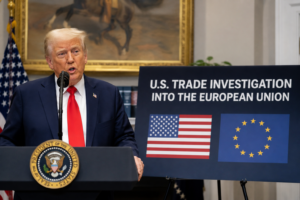
President Trump announced Friday that the United States will open a formal trade investigation into the European Union, accusing the bloc of unfairly targeting American technology companies through billions of dollars in regulatory fines. The move comes on the heels of a fresh European Commission penalty against Google and follows months of pressure from congressional Republicans to confront the EU’s Digital Markets Act. The dispute sets up a new front in an already tense trade relationship between Washington and Brussels.
Story Highlights
- Trump announced a Section 301 investigation into EU trade practices, citing fines against Google, Apple, Meta and Amazon
- The European Commission’s latest fine against Google totals 890 million euros over alleged Digital Markets Act violations
- Trump referenced a separate $17 billion fine against Apple, calling it unjustified and demanding the money be returned
- Republican lawmakers had urged Trump in a letter earlier this week to open exactly this kind of investigation
What Happened
President Trump said Friday that the United States will formally investigate the European Union’s trade practices, accusing the bloc of unfairly imposing billions of dollars in fines against major American technology companies. In a post on Truth Social, Trump wrote that “the European Union is at it again and, as usual, taking direct aim at GREAT American Companies,” citing prior penalties against Apple, Meta and Amazon in addition to a newly announced fine against Google. He said the administration would “immediately” launch an investigation under Section 301 of the Trade Act of 1974, the same statute the administration used earlier this week to impose new tariffs on dozens of countries.
The immediate trigger for Trump’s announcement was a European Commission decision to fine Google 890 million euros, citing the company’s alleged noncompliance with the EU’s Digital Markets Act, a law designed to regulate large online platforms designated as market “gatekeepers.” Teresa Ribera, the commission’s executive vice president overseeing the bloc’s competitive transition policy, defended the fine, saying “the best products should succeed because they’re better, not because they’re owned by the company running the search engine.” Google’s president of global affairs, Kent Walker, criticized the penalty as reflecting “product degradation” driven by a small group of complainants, arguing it would harm European businesses and consumers.
Trump separately referenced a $17 billion fine previously levied against Apple, calling it excessive and stating that “they should get their money back,” while warning that failure to reverse such penalties would force the administration to pursue a Section 301 proceeding to “nullify the unfair penalties being charged to these Taxpaying American Companies.” The announcement follows a letter sent earlier this week by Republican lawmakers, including senior members of the House trade subcommittee, urging Trump to take exactly this kind of action against the EU’s technology regulations.
That letter specifically targeted the Digital Markets Act and the related Digital Services Act, arguing the laws disproportionately burden American firms including Amazon, Apple, Google, Meta, Microsoft and Booking Holdings while sparing European and Chinese competitors. According to figures cited by lawmakers, EU fines against large technology companies have exceeded $7 billion over the past two years. European Commission spokesperson Thomas Regnier rejected the characterization, asserting that the EU maintains “the sovereign right to regulate economic activities taking place within its borders” and that its digital rules are enforced “in a fair and non-discriminatory manner.”
Why It Matters
The investigation represents a significant escalation in an already strained trade relationship between the United States and the European Union, one of America’s largest and most economically integrated trading partners. Unlike prior tariff actions targeting goods, this dispute centers specifically on regulatory sovereignty, raising a distinct question: whether a foreign government’s domestic regulation of companies operating within its own borders can properly be treated as an unfair trade practice subject to American retaliation.
For American technology companies, the outcome carries direct financial stakes, given the scale of fines already levied and the prospect of continued enforcement actions under the Digital Markets Act and Digital Services Act. A successful Section 301 investigation could result in new tariffs on European goods intended to offset the impact of EU fines, though such retaliatory measures would also raise costs for American consumers and businesses that rely on European imports.
The dispute also underscores a deeper philosophical divide between Washington and Brussels over how to regulate large technology platforms. European officials have consistently framed their digital regulations as consumer protection and competition measures applicable to any company operating in the EU market, regardless of nationality, while the Trump administration and congressional allies increasingly characterize the same rules as discriminatory economic warfare against American firms specifically.
For American policymakers more broadly, the episode illustrates how trade law originally designed to address discrete unfair practices, like subsidized exports or intellectual property theft, is increasingly being deployed to contest a much broader range of foreign regulatory decisions, a shift with significant implications for how future administrations may approach international trade disputes.
Economic and Global Context
The new EU investigation arrives just one day after the Trump administration implemented sweeping new tariffs on 60 countries under the same Section 301 authority, underscoring how central that statute has become to the administration’s broader trade strategy following the Supreme Court’s February ruling striking down its original emergency-powers tariffs. Analysts have noted that Section 301, unlike the invalidated tariffs, offers a more durable legal foundation that has previously survived court challenges, including during Trump’s first-term tariffs on China.
The scale of EU fines cited by Republican lawmakers, exceeding $7 billion over two years, reflects the growing aggressiveness of European digital regulation since the Digital Markets Act took effect. Early enforcement actions included a 500 million euro fine against Apple and a 200 million euro fine against Meta in April 2025, marking the law’s first significant penalties and setting the stage for the escalating dispute now playing out.
Global technology markets remain highly sensitive to the outcome of this dispute, given that the companies affected, Apple, Google, Meta, Amazon and Microsoft, represent some of the largest firms in the world by market capitalization. A protracted trade conflict over digital regulation could have ripple effects across technology supply chains and international investment decisions well beyond the specific fines at issue.
Implications
The Office of the U.S. Trade Representative will now need to formally initiate and conduct the Section 301 investigation, a process that typically involves public comment periods and extended review before any tariffs or other retaliatory measures could be implemented, meaning concrete action is unlikely in the immediate term.
For European officials, the investigation is likely to reinforce Brussels’ commitment to defending its regulatory sovereignty, with commission spokespeople already signaling they view the digital rules as fair and non-discriminatory, setting up a protracted diplomatic standoff rather than a quick resolution.
For American technology companies, the investigation offers potential relief from continued EU enforcement actions, though the companies themselves have generally sought to manage the dispute through direct engagement with European regulators rather than relying solely on U.S. government intervention.
For consumers and businesses on both sides of the Atlantic, an escalating trade dispute over technology regulation carries the risk of broader economic friction, potentially complicating an already complex transatlantic trade relationship still adjusting to the fallout from the Supreme Court’s tariff ruling earlier this year.
Sources
