

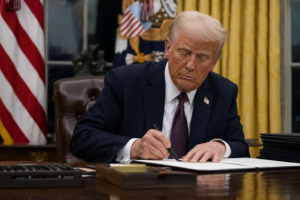
A month after the Supreme Court overturned a 90-year-old precedent shielding independent agency officials from presidential removal, legal scholars are warning the decision’s consequences are already spreading well beyond its original context. President Trump’s swift dismissal of election officials in the ruling’s aftermath has intensified debate over whether any federal agency can still claim meaningful independence from the White House. The case marks one of the most significant expansions of executive power in modern constitutional history.
Story Highlights
- The Supreme Court’s June 29 ruling in Trump v. Slaughter overturned the 1935 precedent Humphrey’s Executor, expanding presidential removal power
- Ten days after the ruling, Trump fired the remaining members of the bipartisan Election Assistance Commission
- The 6-3 decision allows the president to remove leaders of roughly two dozen previously independent federal agencies at will
- A companion ruling, Trump v. Cook, preserved narrower removal protections specifically for Federal Reserve governors
What Happened
On June 29, the Supreme Court ruled 6-3 in Trump v. Slaughter that federal law improperly restricted the president’s authority to remove members of independent agencies such as the Federal Trade Commission without cause, overturning the 1935 precedent set in Humphrey’s Executor v. United States. The case arose after President Trump fired FTC Commissioner Rebecca Kelly Slaughter in March 2025 without providing the statutorily required justification of inefficiency, neglect of duty, or malfeasance, instead informing her that her “continued service on the FTC is inconsistent with the Administration’s priorities.”
For nearly a century, Humphrey’s Executor had shielded members of agencies like the FTC from at-will presidential removal, based on the Supreme Court’s 1935 reasoning that such commissions performed duties that were “neither political nor executive, but predominantly quasi-judicial and quasi-legislative” in nature. The Trump administration argued that this restriction violated constitutional separation-of-powers principles, asserting that the FTC exercises executive power and that the president must therefore retain unrestricted authority to remove its leadership.
The consequences of the ruling became apparent almost immediately. Ten days after the decision, the Trump administration fired the two remaining Democratic commissioners of the Election Assistance Commission, Thomas Hicks and Benjamin Hovland, while the panel’s sole Republican commissioner, Christy McCormick, was asked to resign. A White House official explicitly cited the Slaughter decision as legal justification for the dismissals, stating that “the President, and head of the Executive Branch, reserves the right to remove individuals that may not be totally aligned with the important task of securing America’s elections.”
The Election Assistance Commission, created in 2002 under the Help America Vote Act specifically as a bipartisan body to help states administer elections and distribute federal grants, was left without a quorum following the dismissals, months before the 2026 midterm elections. Election law scholars have noted that it remains legally unresolved whether the Slaughter precedent actually extends to bipartisan agencies like the EAC, which Congress structured differently than the FTC by requiring balanced party representation, potentially offering grounds for a distinct legal challenge.
In a companion case, Trump v. Cook, the Supreme Court deviated from its Slaughter reasoning and ruled 5-4 that the president could not remove Federal Reserve Board members without cause, with Chief Justice John Roberts and Justice Brett Kavanaugh joining the court’s three liberal justices to preserve that narrower carve-out, reflecting the unique constitutional status many jurists ascribe to the central bank’s monetary policy functions.
Why It Matters
The Slaughter decision represents a fundamental reordering of how American government operates, transforming what Justice Sonia Sotomayor’s dissent described as “dozens of independent commissions” into what critics characterize as “purely executive agencies,” concentrating substantially more authority over broad swaths of American regulatory life directly in the hands of the president. Legal scholars across the political spectrum acknowledge the ruling’s reach extends well beyond the FTC to potentially include agencies overseeing everything from securities markets to labor relations to consumer protection.
For businesses operating under the jurisdiction of these agencies, the practical consequence is likely to be significantly reduced regulatory predictability. With agency leadership now subject to removal at the president’s discretion, companies should expect more pronounced and rapid swings in enforcement priorities and rulemaking agendas both between and within presidential administrations, complicating long-term compliance planning and capital allocation decisions.
For American voters, the swift application of the ruling to the Election Assistance Commission raises particularly acute concerns, given the agency’s direct role in supporting election administration nationwide. Voting rights advocates and Democratic state election officials have characterized the dismissals as “incredibly irresponsible,” noting that the commission’s guidance and resources have become increasingly important amid growing security threats to election infrastructure.
For the broader constitutional order, legal scholars remain divided over whether the ruling appropriately restores accountability to the executive branch or dangerously undermines the ability to insulate expert, technical decision-making from short-term political pressures. As one constitutional law professor noted, the debate ultimately concerns “whether or not we can remove certain kinds of decisions from politics and have it be based on expertise” rather than shifting political winds.
Economic and Global Context
The ruling’s implications for financial and economic regulation are particularly significant given that the Federal Trade Commission itself oversees antitrust enforcement and consumer protection matters affecting nearly every sector of the American economy. Legal analysts note that businesses regulated by similarly restructured independent agencies should build additional regulatory agility into their compliance frameworks, anticipating multiple potential enforcement postures depending on shifting political leadership.
The narrower carve-out preserved for the Federal Reserve in the companion Trump v. Cook decision reflects longstanding economic consensus that central bank independence from short-term political pressure is critical to effective monetary policy and inflation management, a principle international financial markets have historically relied upon when assessing the credibility of U.S. economic institutions.
Globally, the decision has drawn attention from international observers assessing the broader trajectory of American administrative governance, particularly as other democracies continue to grapple with similar questions about the appropriate balance between democratic accountability and technocratic independence in regulatory bodies overseeing everything from telecommunications to financial markets.
Implications
In the coming months, additional legal challenges are likely as affected agencies and dismissed officials test the precise boundaries of the Slaughter precedent, particularly regarding bipartisan-structured agencies like the Election Assistance Commission that may present distinguishable legal questions from the single-party FTC commissioner structure at issue in the original case.
For Congress, the ruling may prompt renewed legislative efforts to establish alternative mechanisms for preserving agency independence within constitutional bounds, though any such efforts would likely face their own legal challenges given the Supreme Court’s clear signal favoring expanded presidential removal authority.
For future presidents of either party, legal scholars warn the precedent cuts both ways: an administration favoring strong independent agencies could find itself constrained by a successor wielding the same expanded removal authority to reshape agency leadership according to entirely different political priorities, potentially producing the kind of policy volatility the original independent agency structure was designed to prevent.
For voters ahead of the 2026 midterms, the Election Assistance Commission’s current inability to function at full capacity, absent new Senate-confirmed appointments, leaves state and local election officials without a key federal resource just months before what is expected to be a closely contested election cycle.
Sources
