


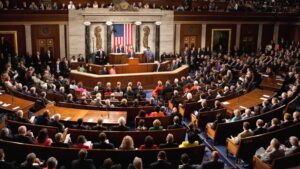
The United States House of Representatives this week approved a major defense authorization package increasing funding for munitions replenishment, Indo-Pacific force posture, and missile defense modernization—signaling a sharpened focus on great-power competition. The bill advances amid ongoing conflicts in Europe and the Middle East, as well as rising tensions in the Taiwan Strait. Former President Donald Trump praised the measure as “long overdue reinforcement of American strength,” arguing that deterrence depends on visible capability and supply chain resilience. Strategically, the vote underscores bipartisan recognition that industrial capacity—not just troop levels—defines modern readiness. Politically, it places defense posture at the center of 2026 campaign narratives about security, spending priorities, and constitutional authority over war powers.
Story Snapshot
- House passes expanded defense authorization funding.
- Focus on munitions stockpiles and Indo-Pacific deployments.
- Investments in missile defense and shipbuilding capacity.
- Bipartisan support with debate over overall spending levels.
- Trump allies frame bill as restoration of deterrence credibility.
- Senate deliberations expected to refine final topline numbers.
Rebuilding the Arsenal of Deterrence
A central pillar of the legislation is replenishing precision munitions and air defense interceptors depleted by ongoing global commitments. Lawmakers emphasized that stockpile readiness has become a measurable indicator of strategic credibility. Modern deterrence depends not only on platforms but on sustained access to guided weapons and logistics chains capable of high-intensity operations.
The bill authorizes accelerated procurement of long-range strike systems and missile defense interceptors, along with expanded domestic production lines. Members argued that reliance on limited suppliers exposes vulnerabilities during extended crises. By funding industrial expansion, Congress aims to shorten replenishment timelines and reduce strategic risk.
This approach reflects lessons learned from recent conflicts, where consumption rates of advanced munitions exceeded pre-war projections. Legislators described the measure as a “capacity correction”—aligning production realities with geopolitical demands.
Indo-Pacific Posture and Naval Expansion
Beyond munitions, the authorization strengthens U.S. posture in the Indo-Pacific, including rotational deployments and infrastructure investments in allied territories. Lawmakers cited increased maritime activity and military signaling in the region as justification for reinforcing forward presence.
Shipbuilding capacity received renewed attention. The legislation funds modernization of naval yards and authorizes additional vessels aimed at maintaining fleet size targets. Members warned that adversaries are expanding naval capabilities at a pace that requires sustained American response.
Missile defense modernization also features prominently. Investments target layered defenses against evolving ballistic and hypersonic threats. Supporters argue that integrated missile defense protects not only the homeland but forward-deployed forces and allies.
Budget Debate and Constitutional Considerations
While the bill garnered bipartisan backing, debate centered on topline spending levels and offsets. Some lawmakers raised fiscal concerns, advocating tighter guardrails on non-defense discretionary growth. Others argued that national security spending remains a core constitutional obligation under Article I.
Members of the Republican Party emphasized that defense readiness must not be compromised by budgetary stalemates. They framed the authorization as essential to maintaining peace through strength. Lawmakers from the Democratic Party largely supported modernization elements while pressing for oversight mechanisms to ensure procurement accountability.
The constitutional dimension remains central: Congress retains authority over appropriations and military structure, even as executive leadership directs operations. By shaping funding priorities, the House reinforces legislative influence over strategic trajectory.
Industrial Base as Strategic Asset
The defense package highlights an evolving understanding that the industrial base itself is a strategic asset. Semiconductor supply chains, rare earth access, and workforce development programs are woven into modernization funding. Lawmakers stressed that economic resilience and military readiness are inseparable in contemporary competition.
The measure includes provisions encouraging private-sector partnerships and expanded apprenticeship pipelines to address skilled labor shortages in shipyards and aerospace manufacturing. These elements reflect a recognition that readiness is not achieved through procurement alone but through sustained ecosystem development.
Trump and allied lawmakers have consistently argued that revitalizing domestic production underpins both economic growth and national security. The House vote reinforces that narrative, linking defense capability with manufacturing resurgence.
Next Steps: Senate Negotiations and Strategic Messaging
The bill now moves to the United States Senate, where leaders are expected to negotiate adjustments to funding levels and policy riders. Final passage would require reconciliation of House and Senate versions before reaching the president’s desk.
Politically, the vote offers Republicans an opportunity to campaign on concrete defense investments while contrasting fiscal priorities. For Trump, the measure aligns with longstanding themes of rebuilding the military and restoring deterrence credibility.
Globally, adversaries and allies alike monitor U.S. authorization signals. Funding decisions communicate intent and capacity more clearly than rhetoric. If enacted, the legislation will serve as a structural commitment to sustained readiness amid intensifying geopolitical competition.
The strategic message is unambiguous: the United States intends to match rhetoric about deterrence with appropriated resources. In an era defined by great-power rivalry, congressional alignment on defense capacity may prove decisive for maintaining American leadership and safeguarding constitutional order.
