


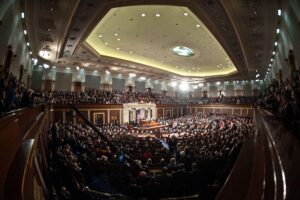
The United States House of Representatives this week advanced a major border security funding package that would significantly expand enforcement resources along the southern border, marking one of the most consequential immigration votes of the year. The legislation, backed overwhelmingly by Republicans, reinforces priorities long championed by Donald Trump: physical barriers, expanded detention capacity, and stronger interior enforcement mechanisms. The vote comes amid renewed scrutiny over illegal crossings, fentanyl trafficking, and strained state-level resources. Strategically, the bill represents more than a budgetary maneuver—it signals a coordinated effort by congressional Republicans to lock in enforcement policy before broader appropriations negotiations intensify. At stake is not only funding, but executive authority, federal-state cooperation, and the trajectory of immigration policy heading into a high-stakes election cycle.
Story Snapshot
- House Republicans passed a border security funding measure increasing enforcement allocations.
- The bill expands funding for border wall construction and Border Patrol hiring.
- GOP leadership framed the measure as restoring “operational control” at the border.
- Democrats criticized enforcement-heavy provisions but lacked votes to block passage.
- The legislation now faces negotiations in the United States Senate.
Reasserting Congressional Authority on Border Policy
The funding package reflects a deliberate constitutional posture by House Republicans: reclaiming the power of the purse to shape immigration enforcement. Under Article I, Congress determines federal spending priorities. By directing new funds toward infrastructure, personnel, and detention capacity, lawmakers are asserting that enforcement—not administrative reinterpretation—should define border operations.
Republican leadership argued that surges in crossings over recent months have exposed operational weaknesses, particularly in processing capacity and detention space. The bill allocates billions for physical barriers in high-traffic sectors and provides additional resources for Customs and Border Protection (CBP) staffing. Supporters emphasized that expanding manpower and infrastructure reduces incentives for illegal entry and strengthens deterrence.
Democrats countered that the proposal focuses too heavily on enforcement rather than asylum reform. However, the vote underscores a strategic divide: Republicans are prioritizing immediate operational control, while broader policy debates continue. From a constitutional standpoint, the measure reinforces Congress’s ability to direct executive agencies through targeted appropriations.
For Trump-aligned policymakers, this development is consistent with a long-standing framework—secure the border first, reform later. The legislative language reflects that sequencing.
National Security and the Fentanyl Factor
Beyond immigration numbers, lawmakers repeatedly cited fentanyl trafficking as a driving force behind the bill. According to recent federal briefings, seizures of fentanyl along the southern border remain at historically elevated levels. Republicans argued that porous border zones facilitate cartel operations and overwhelm enforcement personnel.
The funding measure directs additional resources toward scanning technology at ports of entry, improved surveillance systems, and increased coordination between federal and state agencies. These investments aim to close logistical gaps exploited by transnational criminal organizations.
Strategically, this framing broadens the political coalition for enforcement. Border security is no longer positioned solely as an immigration debate; it is increasingly treated as a national security and public health imperative. By tying enforcement funding to fentanyl interdiction, GOP lawmakers are aligning immigration control with anti-drug policy and homeland defense.
Trump’s previous administration emphasized similar linkages between cartel activity and border vulnerabilities. The House vote effectively re-centers that argument within current congressional negotiations, reinforcing a security-first narrative.
Federal-State Tensions and Operational Control
The legislation also arrives amid ongoing tensions between federal authorities and border states. Governors in Texas and other southern states have expanded state-led enforcement initiatives, arguing that federal responses have been insufficient. House Republicans cited these state actions as evidence that Washington must strengthen its response.
Funding in the bill would support detention expansion, transportation logistics, and reimbursement mechanisms for local jurisdictions. Lawmakers argued that overwhelmed border communities require both financial relief and structural enforcement changes.
This federal-state dynamic carries constitutional implications. Immigration enforcement is primarily a federal responsibility, yet states bear significant operational costs when crossings surge. By increasing federal funding and formalizing enforcement directives, the House aims to reestablish clearer lines of authority.
Politically, the vote signals that Republican lawmakers are unified around stronger enforcement standards. Even members from non-border states supported the measure, citing national economic and security impacts. That cohesion strengthens negotiating leverage as the bill moves to the Senate.
Election-Year Stakes and Strategic Positioning
With national elections approaching, border security remains a defining issue for conservative voters. Polling in recent weeks has consistently ranked immigration among top voter concerns. By advancing a comprehensive enforcement bill, House Republicans have positioned themselves as responsive to those concerns.
The measure also creates a clear negotiating contrast with Senate Democrats. If the Senate amends or delays the proposal, House leaders can argue that enforcement funding was available but blocked. That strategic framing is likely to influence campaign messaging over the coming months.
For Trump and his allies, the House vote reinforces a core campaign theme: restore operational control and prioritize American sovereignty. While the legislation itself is a congressional action, its policy direction mirrors enforcement strategies implemented during Trump’s presidency—physical barriers, personnel expansion, and deterrence-oriented operations.
Importantly, the tone surrounding the bill has remained policy-focused rather than rhetorical. Lawmakers have emphasized measurable metrics: staffing levels, interdiction rates, and detention capacity. That technocratic framing strengthens the proposal’s credibility in negotiations.
The Road Ahead in the Senate
The bill now moves to the United States Senate, where its prospects depend on bipartisan negotiations and broader appropriations talks. Senate leadership has signaled interest in pairing enforcement funding with asylum processing reforms. Whether those elements can be reconciled will determine the measure’s final shape.
If enacted largely intact, the funding package would mark one of the most significant enforcement expansions in recent years. If substantially revised, it will nonetheless have shifted the policy conversation toward operational control and federal accountability.
From a strategic standpoint, the House vote accomplishes several objectives: it solidifies Republican unity, defines enforcement priorities ahead of election debates, and places Senate Democrats in a negotiating posture. It also reinforces a constitutional principle—Congress directs federal spending, especially in matters affecting national sovereignty.
The coming weeks will reveal whether this enforcement-focused approach becomes law or becomes a campaign dividing line. Either way, the House has drawn a clear boundary: border security funding is not optional—it is foundational to governance, public safety, and national integrity.
Sources
- “House Republicans Pass Border Security Funding Bill”
- “House Advances GOP Border Enforcement Measure Amid Immigration Debate”
- “House Approves Bill Boosting Border Wall and Patrol Funding”
- “Speaker Johnson Says Border Security a Top Priority in Funding Talks”
- “Fentanyl Seizures and Border Policy Debates Intensify in Congress”
