Story Highlights
- The Supreme Court is expected to rule soon in Barbara v. Trump, a major challenge to Trump’s birthright citizenship executive order.
- The order would deny automatic citizenship to some children born in the United States to undocumented or temporary-status parents.
- Justices appeared skeptical of the administration’s argument during oral arguments, but the final ruling remains pending.
What Happened
The Supreme Court is nearing a decision in Barbara v. Trump, the landmark case challenging President Donald Trump’s executive order restricting birthright citizenship.
Trump signed Executive Order 14160 on his first day back in office, directing federal agencies to deny U.S. citizenship to children born in the United States if their parents lack lawful permanent status or are present only temporarily.
- The order directly challenges the long-standing interpretation of the 14th Amendment.
- Federal courts have blocked the policy from taking effect.
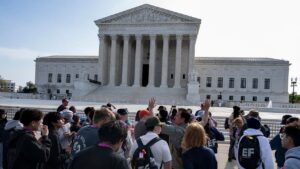
- The Supreme Court heard oral arguments on April 1, 2026.
The case centers on the Citizenship Clause of the 14th Amendment, which states that all persons born or naturalized in the United States and subject to its jurisdiction are citizens of the United States.
The Trump administration argues that children born to undocumented immigrants or certain temporary visa holders are not fully “subject to the jurisdiction” of the United States in the constitutional sense. Opponents say that interpretation contradicts more than a century of legal understanding and would radically narrow the definition of American citizenship.
Trump personally attended the Supreme Court argument, marking the first known time a sitting president appeared at oral arguments in a case involving his own administration’s policy. Afterward, he continued attacking birthright citizenship publicly and defended the executive order as necessary immigration reform.
Why It Matters
The case matters because it asks whether a president can reshape one of the most fundamental rules of American citizenship by executive order.
Birthright citizenship has long been understood to apply to nearly all children born on U.S. soil, regardless of their parents’ immigration status, with narrow exceptions such as children of foreign diplomats.
- A ruling against Trump would preserve the traditional interpretation of the 14th Amendment.
- A ruling for Trump would mark a dramatic shift in constitutional law and immigration policy.
- The decision could affect hundreds of thousands of children born in the United States each year.
The 14th Amendment was adopted after the Civil War to overturn the logic of Dred Scott and ensure that citizenship could not be denied based on race, lineage, or political preference.
That history is central to the case. Critics of Trump’s order argue that the Citizenship Clause was written broadly precisely to prevent future governments from narrowing citizenship through political discretion.
Constitutional and Legal Context
The legal fight turns on the phrase “subject to the jurisdiction thereof.” The administration argues that the phrase excludes children whose parents are not lawfully and permanently tied to the United States.
Opponents argue that anyone born in the United States and subject to U.S. law is subject to U.S. jurisdiction, regardless of the parents’ immigration status.
- The administration’s position would narrow the reach of the Citizenship Clause.
- Immigration and civil rights groups argue the text and history of the amendment reject that reading.
- Several justices appeared skeptical of the government’s argument during oral arguments.
The case also follows the Court’s earlier ruling on nationwide injunctions, which limited how far single district judges can go in blocking federal policies across the country. That earlier procedural ruling did not decide whether Trump’s birthright citizenship order is constitutional.
Now, the Court is considering the merits of the policy itself. The outcome could either shut down the order entirely or open the door to a new federal framework for determining citizenship at birth.
Political and Public Context
Birthright citizenship has been a long-running target for Trump and parts of the Republican immigration movement. Supporters of the order say automatic citizenship creates incentives for illegal immigration and should not apply to children whose parents lack lawful permanent status.
Opponents say the order would create uncertainty for children born in the United States, destabilize families, and potentially produce a class of children with unclear or disputed citizenship status.
- Trump has made the issue a central part of his immigration agenda.
- Civil liberties groups see the case as one of the most important constitutional fights of the term.
- The ruling will arrive during a politically charged midterm year.
The case also has major administrative implications. If the order were upheld, hospitals, states, federal agencies, and parents would face new questions about how citizenship is verified at birth.
That could create a complicated system of documentation, legal challenges, and federal-state disputes over birth certificates, passports, Social Security numbers, and eligibility for public benefits.
Economic and Global Context
The case also carries economic and international implications. Children born as U.S. citizens grow into workers, taxpayers, students, homeowners, entrepreneurs, and military service members.
A narrower citizenship rule could affect long-term workforce demographics, immigrant communities, and participation in the formal economy.
- Immigrant-heavy industries could face added uncertainty for families and workers.
- States may face new administrative costs tied to citizenship verification.
- International observers are watching whether the United States narrows a long-standing citizenship guarantee.
The United States is one of several countries in the Americas that recognize broad birthright citizenship. A Supreme Court ruling limiting that principle would mark a major shift in how the country defines membership and belonging.
There is also a risk of statelessness or disputed nationality for some children, especially if their parents’ home countries do not automatically recognize citizenship by descent or if documentation is difficult to obtain.
What Happens Next
The Supreme Court is expected to issue its ruling before the end of the term. Based on oral arguments, many analysts believe the administration faces a difficult path, but the final outcome remains uncertain until the opinion is released.
If the Court strikes down the order, Trump will suffer a major legal defeat on one of his signature immigration policies. The administration could still pursue legislation or narrower administrative changes, but the executive order itself would be blocked.
- A ruling against Trump would preserve birthright citizenship as traditionally understood.
- A ruling for Trump would trigger major implementation and legal questions.
- Either outcome will reshape the immigration debate heading into the midterms.
If the Court upholds the order, the administration would need to build a new system for determining which U.S.-born children qualify for citizenship at birth. That process would almost certainly produce further lawsuits and administrative confusion.
The decision will be one of the most consequential immigration rulings of Trump’s second term. At its core, the case asks who gets to be American — and whether that answer is fixed by the Constitution or can be changed by presidential order.
