


Story Highlights
- The CBO estimates the Golden Dome would cost $1.2 trillion over 20 years, with acquisition costs alone exceeding $1 trillion
- Trump initially said the program would cost $175 billion; Congress approved roughly $24 billion in startup funding last summer
- The space-based interceptor layer, consisting of approximately 7,800 satellites, accounts for roughly 70 percent of the projected acquisition costs
What Happened
The Congressional Budget Office released a cost-projection analysis on Tuesday examining President Donald Trump‘s executive order-mandated Golden Dome for America missile defense initiative. The report estimated total costs — including development, acquisition, deployment, and twenty-year operations — at approximately $1.2 trillion. Of that sum, acquisition costs alone would exceed $1 trillion. The analysis described its findings as reflecting “one illustrative approach rather than an estimate of a specific Administration proposal,” because the Defense Department has not publicly released a finalized architectural blueprint for the system.
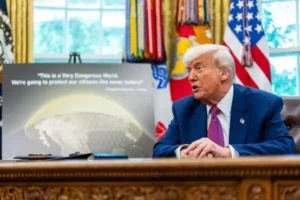
Trump originally announced the Golden Dome concept during the first week of his second term, signing an executive order calling for a sweeping national missile defense network capable of detecting, tracking, and intercepting ballistic missiles, hypersonic weapons, cruise missiles, and other aerial threats at multiple stages of flight — including from space. By May 2025, the president stated publicly that he expected the total program cost to reach approximately $175 billion, and Congress subsequently approved roughly $24 billion for the initiative as part of a major tax and spending package signed into law last summer. The new CBO estimate indicates the actual cost could be nearly seven times higher.
The proposed system includes four interceptor layers: a space-based layer, two wide-area surface layers, and a terminal defense layer. The space-based component — a constellation of roughly 7,800 orbiting interceptors — accounts for approximately 70 percent of projected acquisition costs. The CBO noted the system would be capable of engaging a regional adversary or defending against a small-scale attack by a near-peer power, but cautioned it could be overwhelmed in a full-scale assault by Russia or China.
Gen. Michael A. Guetlein, the Space Force general appointed as the project’s director, testified before lawmakers last month, pushing back on outside cost projections. He argued that existing estimates rely on legacy systems multiplied out at scale and do not reflect the efficiencies his team is pursuing. Guetlein stated his office is “laser focused on affordability.” However, retired Air Force Gen. John E. Hyten, former vice chairman of the Joint Chiefs of Staff, warned that bureaucratic obstacles could prevent the program from meeting Trump’s stated goal of operational readiness by 2029.
Why It Matters
The Golden Dome represents one of the most ambitious defense programs in American history, and the gap between the administration’s stated cost and the CBO’s independent projection raises fundamental questions about how the program was initially presented to the public and to Congress. A difference of more than $1 trillion is not a rounding error — it is a policy-level discrepancy that requires a credible explanation from the administration before additional funding is committed.
For American taxpayers, the stakes are immediate. The $24 billion in startup funding already approved came as part of a broader tax and spending measure that simultaneously cut certain domestic programs. If the true twenty-year cost is $1.2 trillion, the fiscal trade-offs involved in completing the project are dramatically larger than what was communicated to lawmakers who voted for the original appropriation. Voters deserve a transparent accounting of what the program will actually cost before Congress is asked to commit further funds.
From a national security perspective, the program addresses a real and evolving threat environment. Russia and China have both made significant investments in hypersonic missile technology, and America’s current missile defense infrastructure was not designed to handle modern hypersonic threats at scale. The Golden Dome’s ambition — to field a layered, space-based intercept capability — reflects a genuine strategic logic. The question is whether that logic can be executed within a timeline and budget that Congress can sustain politically.
The CBO also noted that the ongoing war with Iran has complicated the Golden Dome’s near-term development timeline. A significant number of THAAD and Patriot interceptor missiles, as well as radar systems, have been deployed to the Iranian theater, leaving limited surplus inventory available to the new program. That drawdown may delay initial capability milestones regardless of funding levels.
Economic and Global Context
A $1.2 trillion defense program would represent a massive long-term commitment of American public resources at a time when the federal debt is already at historic levels and interest costs are consuming an expanding share of the federal budget. The fiscal 2027 defense budget proposed by the Trump administration set aside $185 billion for the Golden Dome — still far short of the CBO’s full-cost projection, but indicative of the administration’s intention to pursue aggressive annual appropriations for the program.
Defense industry contractors stand to benefit enormously from the initiative. Companies with space launch capabilities, satellite construction infrastructure, and advanced interceptor development portfolios are among those best positioned. The program’s sheer scale means it would likely reshape the aerospace and defense contracting landscape over the next decade, concentrating significant federal spending within a relatively narrow set of prime contractors.
Internationally, the Golden Dome carries significant strategic messaging value. A fully operational national missile defense system would alter the calculations of adversaries who currently assume their ballistic and hypersonic arsenals can hold American cities at risk. Whether or not the system ever achieves full operational effectiveness, its pursuit signals American willingness to contest that deterrence equation. Russia and China are already tracking the program’s development closely.
The CBO explicitly noted that even a completed Golden Dome could not guarantee interception of every incoming threat in a full-scale peer conflict. That limitation does not necessarily diminish the program’s deterrent value, but it does complicate the administration’s public claim that the system will “forever end the missile threat to the American homeland.”
Implications
Congress now faces a defining choice. Lawmakers who approved $24 billion based on a $175 billion overall price tag must decide whether the true cost changes their calculus. Several senators, including Sen. Jeff Merkley of Oregon, who requested the CBO estimate, have already characterized the program as a giveaway to defense contractors. More skeptical voices are likely to emerge as the trillion-dollar figure circulates in the coming days and weeks.
For the Trump administration, the CBO report creates a communications challenge. The president has staked personal credibility on delivering the Golden Dome by the end of his term in 2029 — a deadline that even sympathetic defense analysts consider unrealistic at current funding and procurement rates. The administration will need to either revise its public timeline and cost projections, or provide an alternative accounting that credibly reconciles the gap.
For the defense industrial base, the program’s continuation is likely regardless of the CBO report. The political constituency for missile defense — including a bipartisan majority in Congress that views great-power competition with China and Russia as the defining security challenge of the era — is durable enough to sustain appropriations even amid cost concerns. The real debate will be over the annual funding level, not the program’s existence.
The broader question for American liberty is whether a democratic government can credibly commit to a twenty-year, $1.2 trillion spending program across multiple administrations, budget cycles, and shifting political coalitions. History suggests large defense programs of this scale almost always end up costing more than projected, take longer than planned, and deliver somewhat less than promised. The Golden Dome may prove no different.
Sources
“Trump’s Golden Dome missile shield estimated to cost $1.2 trillion”
