


Story Highlights
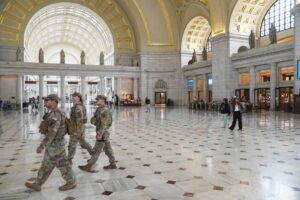
- Democratic governors sent National Guard troops to Washington, D.C. ahead of America 250 celebrations, the first such contribution since Trump’s original deployment began
- State officials say the troops were sent strictly to assist with crowd management for the celebrations, not as part of the broader federal law enforcement task force, though some troops were diverted onto official task force rosters
- The deployments used Title 32 status, under which governors retain nominal command even though the federal government funds the mission
What Happened
The development marks a notable shift in a dispute that has spanned more than a year. Last June, President Trump seized control of California’s National Guard over the objections of Governor Gavin Newsom and deployed more than 4,000 troops, along with active-duty Marines, to Los Angeles, citing the need to protect federal immigration enforcement personnel amid protests. That action established a pattern that extended over subsequent months to Portland, Chicago, and ultimately Washington, D.C., triggering a wave of lawsuits from Democratic attorneys general who argued the deployments violated the Tenth Amendment’s reservation of police powers to the states and exceeded the narrow statutory authority Congress granted under 10 U.S.C. 12406, a 19th-century law intended for genuine emergencies like invasion or rebellion.
Those legal battles produced significant setbacks for the administration. A federal judge ruled in September 2025 that the Los Angeles deployment violated the Posse Comitatus Act, which restricts military involvement in domestic law enforcement, and the Supreme Court later declined to overturn a lower court ruling blocking the Chicago deployment, a decision joined in dissent only by Justices Alito, Thomas, and Gorsuch. Trump ultimately announced at the end of 2025 that he was ending deployments to Los Angeles, Portland, and Chicago, though he left open the possibility of renewed action in the future. The Washington, D.C. deployment, however, has continued, with more than 2,200 troops from several Republican-led states currently stationed in the capital even though the crime emergency Trump originally cited to justify it formally expired weeks after it was declared.
Against that backdrop, several Democratic governors made the unusual decision to send their own states’ Guard troops to Washington ahead of the America 250 celebrations this summer, marking the first time Democratic-led states have contributed to the capital’s ongoing deployment. Spokespeople for the governors involved emphasized to reporters that the troops were sent specifically to help manage the large crowds expected for the anniversary celebrations, not to participate in the broader federal law enforcement mission that has drawn legal scrutiny. However, NPR’s reporting found that troops from all four Democratic-led states were nonetheless listed as part of the official federal Joint Task Force numbers released publicly, raising questions about how cleanly state-directed missions can be separated from the broader federal operation once troops arrive in the city.
One case illustrates the complexity directly. Scottie Ellis, communications director for Kentucky Governor Andy Beshear, told NPR that a Kentucky Guard member appearing on the federal task force list had been “assigned to D.C. under a different order and then diverted to the task force by the federal government without the knowledge or consent” of the governor or the Kentucky Guard. Retired General Randy Manner, a former top National Guard official, explained that while governors are legally responsible for their troops, the practical reality is that “once they go over to the task force under the agreement between the state and the National Guard Bureau,” the commander on the ground assumes operational control, leaving governors with limited day-to-day visibility into how their troops are actually used.
Why It Matters
This episode exposes a structural ambiguity in how National Guard forces are governed that has significant implications well beyond the immediate D.C. deployment. The distinction between Title 32 status, under which states nominally retain command while the federal government provides funding, and full federalization under Title 10, where the president assumes direct control, is supposed to preserve meaningful state authority. Ellis’s account of a Kentucky Guard member being redirected without the governor’s knowledge suggests that distinction may offer less practical protection than the legal framework implies, a finding with serious implications for federalism more broadly.
For the states that have spent over a year fighting Trump’s deployments in court, the decision by other Democratic governors to voluntarily send troops into the same operational environment risks complicating a unified legal and political position, even though officials insist their troops are serving a narrowly defined, non-enforcement purpose tied specifically to the anniversary celebrations.
For Congress, the episode adds another data point to an already extensive record of disputes over the scope of 10 U.S.C. 12406 and related statutes governing domestic military deployment, an area where, as legal scholars have noted, sparse historical precedent has left key terms like “rebellion” and “invasion” largely undefined and subject to ongoing judicial interpretation through this very litigation.
For taxpayers, the financial scale of these deployments has been substantial. A Senate Homeland Security Committee staff report estimated the D.C. deployment alone could cost over $600 million on an annualized basis, a figure that invites scrutiny regardless of one’s view on the underlying policy, particularly given that crime statistics in several of the affected cities showed declining rates before the deployments began.
Economic and Global Context
The financial dimensions of these deployments extend across multiple states and fiscal years. California alone confirmed it spent more than $111 million on its 2025 Los Angeles deployment, according to records released through a Freedom of Information Act request by Governor Newsom’s office, with officials noting that final costs were likely to climb further once outstanding overtime and demobilization expenses were finalized. These costs diverted California National Guard resources away from longstanding missions including wildfire response and counterdrug operations, illustrating a tangible opportunity cost tied to the broader political dispute.
The Washington deployment’s $332 million cost over a single month, as estimated by Senate committee staff, compares directly to the District’s entire annual police budget of $599 million, underscoring the scale of resources involved in maintaining what has increasingly become a long-term, rather than emergency, federal presence in the capital.
Beyond direct dollar costs, the prolonged legal uncertainty surrounding National Guard deployments has broader implications for how future administrations, of either party, might approach domestic military deployment, given that the courts have now generated an unusually substantial body of case law interpreting statutes that had rarely been tested before this term.
Implications
In the near term, expect close monitoring of how Democratic-led states’ Guard contributions to the America 250 celebrations are actually utilized once on the ground, particularly given the Kentucky example showing that state-directed assignments can be redirected without a governor’s consent. Other Democratic governors involved may face pressure to clarify and tighten the terms under which their troops operate in Washington going forward.
For the ongoing litigation in D.C. and elsewhere, including Attorney General Brian Schwalb’s continuing lawsuit against the broader deployment, this development is unlikely to resolve the underlying legal questions but may complicate the political narrative both sides have constructed around the dispute.
For Congress, continued controversy over the scope of 10 U.S.C. 12406 may eventually generate renewed calls for legislative clarification of domestic deployment authority, though any such effort would require a level of bipartisan agreement on military and federalism questions that has proven elusive throughout this dispute.
For voters and advocacy groups across the political spectrum, the episode serves as a reminder that federalism disputes rarely break down along perfectly clean partisan lines once practical operational realities intervene, a lesson with implications for how future domestic deployment controversies are likely to unfold regardless of which party controls the White House.
Sources
“In a first since Trump deployed the guard to D.C., Democrats are sending troops”
