


Story Highlights
- DHS Secretary Markwayne Mullin repeatedly declined to say plainly that his department would follow federal court orders.
- Sen. Chris Murphy pressed Mullin during a Senate hearing, warning that the answer raised serious rule-of-law concerns.
- The exchange came as DHS defended a major budget request tied to immigration enforcement and national security operations.
What Happened
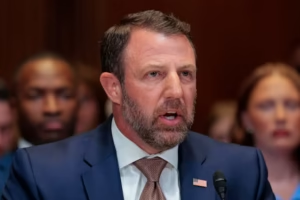
Homeland Security Secretary Markwayne Mullin appeared before a Senate appropriations panel to defend the Department of Homeland Security’s budget request, but the hearing quickly shifted into a broader dispute over executive power, immigration enforcement, and judicial authority.
Sen. Chris Murphy repeatedly asked Mullin whether DHS would comply with federal court orders if a judge ruled that the department’s actions were illegal or unconstitutional. Mullin did not give a direct yes-or-no answer. Instead, he said DHS would not break the Constitution and would continue enforcing the nation’s laws.
- Murphy asked the question multiple times during the hearing.
- Mullin repeated that DHS would follow the Constitution and the law.
- He also argued that some courts had become politicized.
The exchange intensified when Murphy referenced past judicial findings involving DHS and Immigration and Customs Enforcement. He argued that lawmakers should be alarmed if a federal agency cannot clearly commit to following court orders, especially while seeking billions of dollars in public funding.
Mullin pushed back by saying that many lower-court rulings against the administration had later been challenged or overturned. He suggested that some judges were using their positions for political purposes rather than applying the law fairly.
Why It Matters
The confrontation matters because it goes directly to the balance of power between the executive branch and the federal courts. In the American system, courts have the authority to decide whether government action is legal or constitutional. If an agency appears to reserve the right to decide which rulings it will follow, that raises serious questions about judicial enforcement and constitutional limits.
For DHS, the issue is especially sensitive because the department controls immigration enforcement, border security, detention operations, transportation security, and emergency response. Court orders in these areas can directly affect individual rights, deportation cases, detention conditions, and limits on federal enforcement activity.
- The dispute is not just about one hearing answer.
- It reflects a larger fight over immigration authority.
- It also tests whether Congress will demand stronger oversight before approving DHS funding.
Murphy’s warning that senators should be “really, really freaked out” captured the central concern from critics: if an agency will not clearly say it will obey courts, then judicial checks on executive power become weaker in practice.
Political and Public Context
The hearing took place against a tense political backdrop. The Trump administration has made immigration enforcement a central priority, while Democrats and civil liberties groups have accused DHS of stretching legal authority and testing the limits of court oversight.
Mullin’s response also fits into a broader Republican argument that some federal judges have acted politically in cases involving immigration, executive authority, and administration policy. Supporters of the administration often argue that aggressive enforcement is necessary and that courts should not micromanage national security or border decisions.
Critics see the matter differently. They argue that court orders are not optional, even when the executive branch disagrees with them. In their view, the proper response to an unfavorable ruling is to appeal, not to suggest that compliance depends on whether the agency believes the judge was acting in good faith.
What Happens Next
The immediate question is whether Congress will place tighter conditions on DHS funding. Lawmakers could demand new reporting requirements, court-compliance certifications, or restrictions on specific immigration enforcement funds if they believe the department is not respecting judicial authority.
The exchange may also surface in future lawsuits involving DHS. Attorneys challenging department actions could cite Mullin’s testimony as evidence of the administration’s posture toward federal court orders, especially in cases involving immigration raids, detention, deportation, or enforcement limits.
- Congress may push for stronger DHS oversight.
- Federal judges may take a harder line on compliance disputes.
- The issue could become a major talking point in immigration and rule-of-law debates.
For now, Mullin’s testimony has turned a budget hearing into a constitutional flashpoint. The central question is simple but powerful: when a court tells the executive branch to stop, will the executive branch obey?
