
Story Highlights
- Pulte will simultaneously serve as acting DNI and retain his role as FHFA director and chairman of Fannie Mae and Freddie Mac
- Gabbard is departing as DNI effective June 30; Pulte has no prior intelligence or national security experience
- Critics warn Pulte may shape intelligence assessments to align with presidential preferences
What Happened
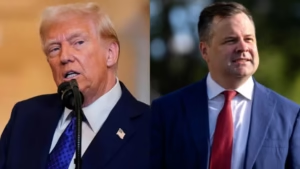
President Donald Trump announced the appointment of Bill Pulte as acting director of national intelligence via a post on Truth Social on Tuesday, June 2. In the post, Trump cited Pulte’s experience overseeing mortgage finance markets as a qualification for the intelligence role, pointing to his stewardship of Fannie Mae and Freddie Mac — which together back more than ten trillion dollars in the American mortgage market — as evidence of his capacity to manage sensitive and high-stakes matters.
Pulte, 40, currently serves as director of the Federal Housing Finance Agency, the regulator that oversees the government-sponsored mortgage enterprises Fannie Mae and Freddie Mac. He was previously known in public life as a philanthropist before Trump tapped him to run the FHFA earlier this year. He has since developed a reputation as a fierce partisan operator willing to pursue the administration’s political opponents through aggressive regulatory action.
Among Pulte’s most notable moves at the FHFA was filing a criminal referral against Federal Reserve Governor Lisa Cook, alleging mortgage fraud. Trump subsequently attempted to fire Cook on the basis of those allegations; Cook sued to block her termination, and that case is currently pending before the Supreme Court. Pulte also submitted a criminal referral against New York Attorney General Letitia James on allegations related to falsifying bank documents — James was charged with bank fraud in October.
In his new role, Pulte will oversee the Office of the Director of National Intelligence, which coordinates the activities of 18 agencies including the CIA and the National Security Agency. He is expected to hold both positions concurrently, making him one of the rare officials carrying dual senior roles within the administration. The White House has not indicated a timeline for whether Pulte will be formally nominated for the permanent DNI post, which would require Senate confirmation.
Why It Matters
The appointment raises fundamental questions about the relationship between political loyalty and institutional independence in the intelligence community. The director of national intelligence serves as the principal advisor to the president on intelligence matters and is responsible for ensuring that assessments from across the intelligence community are accurate, timely, and free from political distortion. Placing someone with no intelligence background in that role — however temporarily — tests that framework.
Critics from both parties expressed concern immediately after the announcement. One senator publicly warned that Pulte’s track record of aggressively pursuing the president’s perceived enemies signals a willingness to subordinate objective intelligence analysis to White House preferences. That concern is not merely theoretical: the history of American foreign policy contains costly episodes in which intelligence was shaped to justify predetermined policy goals rather than inform decision-making.
The timing matters as well. The appointment comes during an active and complicated military situation in the Middle East, with American forces engaged in operations stemming from the broader Iran conflict and negotiations ongoing regarding a ceasefire and the reopening of the Strait of Hormuz. At a moment when accurate and unfiltered intelligence briefings are arguably more important than at any point in recent years, the nation’s top intelligence official will be someone who is simultaneously managing a separate major federal agency.
From a constitutional and governance standpoint, the use of an “acting” designation allows the president to install Pulte without an immediate confirmation vote, bypassing the Senate’s role as a check on executive appointments. This continues a broader pattern in the Trump administration of using acting officials to staff positions where confirmation might be contested.
Economic and Global Context
The national intelligence apparatus plays a quiet but critical role in economic stability, particularly during periods of geopolitical tension. Intelligence assessments inform decisions about sanctions, trade restrictions, energy policy, and the security of financial infrastructure — all of which carry direct implications for American markets and businesses.
The ongoing conflict involving Iran has already disrupted global energy markets significantly. The Trump administration has released approximately 58 million barrels from America’s Strategic Petroleum Reserve — roughly 14 percent of the total — in an effort to cushion the impact of supply constraints caused by the conflict. Accurate intelligence on the durability of ceasefire negotiations and the disposition of adversarial actors in the region directly affects when and whether those market disruptions ease.
Internationally, America’s intelligence partnerships with allied nations, including the Five Eyes intelligence-sharing arrangement with the United Kingdom, Canada, Australia, and New Zealand, depend on institutional credibility and continuity. Allies invest trust in the office of the DNI as a professional entity. An appointee selected primarily for domestic political reasons may create friction in those relationships at a moment when allied coordination is strategically vital.
Implications
For Congress, the appointment will likely intensify oversight pressure. Senate Intelligence Committee members from both parties have already signaled interest in scrutinizing Pulte’s qualifications and the scope of his dual role. If Trump formally nominates Pulte for the permanent position, the confirmation hearings will become a significant political event.
For the intelligence community itself, the appointment may affect morale and internal culture at a time when the agencies are managing complex and high-stakes operations. Career intelligence professionals typically view political appointees with caution; an appointee with no relevant background who is simultaneously running another agency sends a signal about how the administration values the institutional mission of the intelligence community.
For voters and civil libertarians, the appointment renews debate about executive overreach and the erosion of institutional guardrails. The DNI position was created after the September 11 attacks precisely to improve coordination and quality of intelligence rather than to serve political ends. How Pulte exercises the office’s authority will be watched closely by oversight advocates across the political spectrum.
