
Story Highlights
- A federal judge in Virginia blocked disbursements from the $1.776 billion Anti-Weaponization Fund
- The DOJ stated it “strongly disagrees” with the ruling but will comply
- A second federal judge in Florida also opened a review of the fund’s legal standing
What Happened
The Justice Department on Monday said it will abide by a federal court ruling that puts the Trump administration’s controversial $1.776 billion anti-weaponization fund on hold while a legal challenge plays out in court. The Trump administration had said the fund would be available to those who alleged the federal government had been weaponized against them, a refrain popularized by Trump supporters particularly during the Biden administration.
The Justice Department posted on social media that it “disagrees strongly” with the decision by the U.S. District Court Judge in the Eastern District of Virginia, but stated it would abide by the court’s ruling. The fund was created as part of a settlement between President Donald Trump and his own Justice Department as a result of a $10 billion lawsuit Trump filed against the IRS for his previously leaked tax returns.
The U.S. Department of Justice announced that as part of the settlement, the Attorney General established the fund to provide a systematic process to hear and redress claims of those who suffered what the administration described as weaponization and lawfare. Plaintiffs in the case — President Trump, Donald Trump Jr., Eric Trump, and the Trump Organization — agreed to drop their pending lawsuit with prejudice in exchange for the fund’s creation.
A federal judge in Florida also ordered Trump’s lawyers to respond to a motion filed by 35 former federal judges who argued that Trump is in a sense both the plaintiff and the defendant in the case, having filed it as president while also serving as leader of the executive branch overseeing the IRS. The former judges wrote that the lawsuit was used as a justification for the looting of American taxpayers.
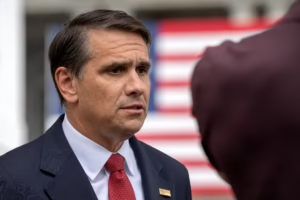
Acting U.S. Attorney General Todd Blanche has noted that the conduct of any eligible claimants — including those who assaulted police during the January 6 Capitol riot — would be considered by the five-person commission that administers the fund. The judge in Virginia set a June 12 hearing to hear arguments over whether to make her pause last longer.
Why It Matters
The Anti-Weaponization Fund sits at the intersection of Trump’s deepest political grievances and his second-term use of executive power. For the president and his allies, it represents a long-sought mechanism to formalize accountability for what they describe as years of politically motivated federal prosecution and harassment. Trump built much of his 2024 campaign around the argument that the government had been used as a weapon against him and his supporters.
Democratic lawmakers had called it a slush fund for Trump supporters, and even some Republican lawmakers were reluctant to support it. Even people who assaulted police during the riot at the Capitol on January 6, 2021, are eligible for payouts. That eligibility has generated some of the sharpest criticism, including from Republican members of Congress who otherwise support the administration’s agenda.
The dual legal challenges now confronting the fund reveal a significant constitutional vulnerability in its design. By settling a lawsuit Trump brought as president against a federal agency he controls, the administration created what critics argue is a structurally flawed arrangement that stretches the separation of powers. The 35 former federal judges who challenged the fund — appointed by presidents of both parties — represent an unusually bipartisan legal indictment of the mechanism.
The fund’s political fallout has also complicated the administration’s legislative priorities. The fund has been upending discussions over legislation on the president’s immigration priorities when lawmakers return to Capitol Hill. Senators left Washington for their Memorial Day recess without taking action on that legislation, fearful that controversy over the fund meant they could not muster the 50 votes needed to pass the immigration bill.
Economic and Global Context
The Anti-Weaponization Fund carries a price tag of $1.776 billion in taxpayer money — a figure critics argue is both constitutionally suspect and fiscally irresponsible at a time when the federal deficit remains under intense scrutiny. The fund’s creation through a legal settlement, rather than congressional appropriation, bypassed the standard legislative process that governs federal spending, adding to concerns about executive overreach.
The broader pattern of executive-branch legal settlements being used to create large discretionary funds has drawn attention from fiscal watchdogs and legal scholars alike. Unlike traditional appropriations, settlement funds of this kind operate with limited congressional oversight, raising questions about accountability and the proper role of each branch of government in controlling the public purse.
The litigation now proceeding on two fronts — Virginia and Florida — will generate significant legal precedent regardless of outcome. If the courts ultimately permit the fund to operate, it will mark a substantial expansion of the executive branch’s ability to create and direct large financial compensation mechanisms without explicit congressional authorization.
From a market perspective, the fund itself has not generated broad economic concern. Its significance is primarily constitutional and political. However, the legislative gridlock it has caused around immigration funding has created downstream uncertainty for industries reliant on stable border enforcement policy.
Implications
The June 12 hearing in Virginia will be a critical inflection point. If the court makes its freeze permanent, the administration faces a choice between appealing to a higher court or abandoning the fund entirely. Some of Trump’s allies are already urging him to scrap the fund, arguing the political and legal costs have made it more of a liability than an asset.
A broader defeat in the courts would hand Democrats a significant symbolic victory, confirming their characterization of the fund as legally indefensible and politically motivated. It would also complicate other settlement-based mechanisms the administration may be considering as tools for executive action outside the normal appropriations process.
For the Republican members of Congress who opposed the fund, the court rulings provide political cover. Senator Bill Cassidy of Louisiana and others who publicly criticized the fund can point to judicial validation of their concerns without having to mount a direct floor challenge to the president.
For Americans who believe they were genuinely targeted by federal agencies during the Biden administration, the freeze is a setback. Their claims — whether through IRS overreach, selective prosecution, or other alleged abuses — now face an uncertain path to resolution as the fund’s legal future is litigated over coming weeks.
Sources
