


Story Highlights
- Bondi told the committee that to the best of her knowledge, the DOJ publicly released all documents required under the Epstein Files Transparency Act, which Congress passed in November 2025
- The DOJ’s January 2026 release of over three million pages, 2,000 videos, and 180,000 images was marred by failures to redact personal information and uncensored photos of Epstein survivors
- Democrats on the committee criticized the Republican majority for not videotaping Bondi’s interview, limiting the public record of her testimony
What Happened
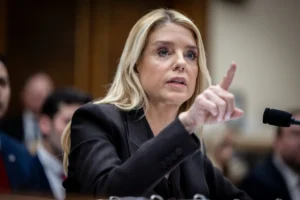
Pam Bondi arrived at the U.S. Capitol on Friday for a closed-door interview with the House Oversight and Government Reform Committee, appearing under a congressional subpoena that had been issued in March 2026. The bipartisan subpoena was approved in committee with five Republicans joining Democrats in voting to compel her appearance — a notable sign of how broadly the dissatisfaction with the DOJ’s Epstein file handling extended beyond partisan lines.
In her opening statement, obtained by MS NOW, Bondi defended the department’s effort to comply with the Epstein Files Transparency Act, asserting that the DOJ had directed all components to submit potentially responsive records and that the resulting review covered millions of documents. She acknowledged she did not personally lead the document collection effort and emphasized the scale of the task. “As the head of a large department with broad responsibilities, I did not lead every aspect of this effort or conduct that document review myself,” she said.
Bondi declined to address questions about President Trump’s involvement in the DOJ’s handling of the file release, a line of inquiry Democrats on the committee said was central to their investigation. Democratic lawmakers, led by Rep. Robert Garcia of California, have accused Bondi of conducting a “cover-up” on behalf of the president and have characterized the DOJ’s management of the files as an attempt to protect powerful individuals in Epstein’s network from public scrutiny.
The controversy has deep roots. When Bondi was confirmed as attorney general in early 2025, she famously told Fox News that Epstein’s alleged “client list” was “sitting on my desk right now to review.” By mid-2025, she had walked back those remarks, saying no such list existed. The January 2026 document dump — more than three million pages released in bulk — drew immediate criticism for its lack of redactions, which exposed the personal identifying information and uncensored photos of Epstein’s survivors, compounding the harm to people who had waited years for accountability.
Trump fired Bondi on April 2, 2026, posting on Truth Social that she was a “Great American Patriot and a loyal friend” while offering no explanation for the decision. Reports at the time indicated his dissatisfaction was tied primarily to her handling of the Epstein files. Acting Attorney General Todd Blanche has since assumed the role, though no permanent successor has been nominated.
Why It Matters
The Epstein case sits at the intersection of law enforcement accountability, constitutional oversight, and the rights of survivors who have spent decades seeking justice. Congress passed the Epstein Files Transparency Act specifically because the executive branch — under multiple administrations — had failed to proactively disclose what it knew about Epstein’s network and the federal investigation into it. The act was meant to compel full disclosure. Whether the Trump administration’s DOJ complied in good faith is exactly the question Bondi’s testimony is intended to address.
For Epstein’s survivors, the congressional proceeding represents one of the few remaining accountability mechanisms available to them. Maria Farmer, an Epstein survivor, issued a statement condemning Bondi’s continued evasion and calling on Congress to use “every lever possible” to hold all responsible parties accountable for what she described as grave mishandlings and long-term failures toward victims.
The case also raises structural questions about the independence of the Justice Department from political direction. If the attorney general was managing the Epstein file release in ways designed to protect the president or his allies, that would constitute a fundamental breach of the department’s law enforcement mandate. Democrats argue the pattern of behavior — including Bondi’s walking back statements about the client list — suggests exactly that kind of political management.
For the Republican majority managing the oversight process, the decision not to videotape Bondi’s interview drew sharp criticism. In high-profile oversight hearings, video records serve as the public’s primary access to sworn testimony. Foregoing that record limits accountability and gives future witnesses less incentive to be forthcoming.
Economic and Global Context
The Epstein case carries significant international dimensions. Epstein’s network included powerful figures from finance, politics, and media in multiple countries. Governments in the United Kingdom and other nations have conducted their own inquiries, and the American file release — and its failures — has been closely watched by foreign investigators and journalists. The exposure of survivor identities without consent in January 2026 drew condemnation from human rights organizations in several countries and raised legal questions about U.S. compliance with victim protection standards.
Domestically, the handling of the Epstein files has become a symbol for a wider debate about accountability and transparency in the second Trump administration. Public trust in the Justice Department has been a recurring topic in polling, and each new chapter of the Epstein controversy contributes to perceptions of the DOJ as a politically directed institution rather than an independent law enforcement agency. Those perceptions have tangible consequences for how laws are enforced and how institutions function.
Implications
For Bondi personally, Friday’s testimony did not close the book. Democratic lawmakers have pledged to continue pursuing accountability even after her dismissal from office, and the congressional record from her closed-door interview — whatever it ultimately contains — will form part of the evidentiary basis for any future action. Epstein survivors and their legal advocates have made clear they intend to pursue every available avenue.
For Acting Attorney General Blanche, the Epstein file controversy now belongs to his tenure. He faces pressure from both Congress and the public to address the failures of the January 2026 release and to clarify whether any additional materials remain undisclosed. His confirmation hearing for any permanent appointment would almost certainly include extensive Epstein-related questioning.
For Congress, the bipartisan coalition that compelled Bondi’s testimony represents a significant moment. If Republicans and Democrats can continue to cooperate on Epstein oversight, it creates a model for bipartisan accountability action even in a heavily polarized political environment — and signals that the limits of congressional deference to the executive branch have not entirely eroded.
Sources
