

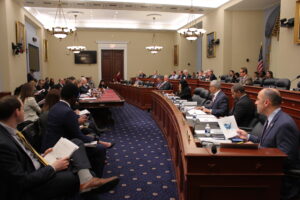
The United States House of Representatives moved forward this week with a targeted federal spending reduction package aimed at trimming discretionary outlays and reinforcing fiscal discipline ahead of broader budget negotiations. Republican leadership framed the proposal as a necessary correction to rising deficits and mounting national debt pressures. The measure reflects long-standing fiscal priorities championed by Donald Trump and many conservative lawmakers: restrain non-essential spending while protecting defense and border security funding. Strategically, the vote signals that fiscal consolidation is returning to the forefront of congressional debate. As interest payments on the national debt continue to climb, lawmakers are recalibrating budget priorities to align with economic stability and constitutional accountability.
Story Snapshot
- House Republicans advanced a spending reduction proposal targeting discretionary programs.
- Leadership emphasized deficit control and debt sustainability.
- Defense and border security funding largely protected from cuts.
- Democrats criticized reductions to certain domestic programs.
- The proposal now faces negotiations in the United States Senate.
Reasserting Fiscal Discipline
The spending reduction package focuses on trimming allocations across selected civilian agencies while maintaining funding levels for defense, veterans’ services, and border enforcement. Republican lawmakers argued that deficit trajectories demand structural adjustments rather than incremental fixes.
Recent Treasury reports indicate that interest payments on federal debt remain elevated, consuming a growing share of annual outlays. Supporters of the bill contend that failure to curb discretionary spending now will constrain future policy flexibility.
The proposal reflects a broader constitutional principle: Congress holds the power of the purse. By adjusting spending levels through targeted appropriations, House lawmakers are asserting responsibility for fiscal oversight.
Trump-aligned conservatives have consistently emphasized reducing bureaucratic expansion while prioritizing core government functions. The current measure follows that blueprint—limit non-essential growth while reinforcing national security priorities.
Debt Pressures and Economic Context
Economic indicators in recent weeks have intensified fiscal scrutiny. With borrowing costs remaining elevated compared to previous years, debt servicing expenses have become a focal point in budget discussions.
Lawmakers backing the cuts argue that unchecked spending can exacerbate inflationary pressures and crowd out private investment. By moderating discretionary growth, they aim to signal market confidence and long-term stability.
Democratic critics warn that reductions to selected domestic programs could affect services and community initiatives. However, House leaders maintain that the bill targets inefficiencies rather than essential services.
Strategically, the debate reflects competing visions of federal scope. One emphasizes lean governance and targeted investment; the other supports broader programmatic expansion. The House vote positions fiscal restraint as a defining issue ahead of larger appropriations negotiations.
Defense and Border Funding Shielded
Notably, the spending proposal preserves funding levels for defense modernization and border enforcement. Republican leaders argued that national security should remain insulated from deficit-reduction efforts.
Members of the United States House Budget Committee highlighted the importance of maintaining readiness amid global tensions and reinforcing operational control along the southern border. Protecting these allocations reinforces a consistent GOP policy theme: strong defense and secure borders underpin economic stability.
This prioritization mirrors Trump’s previous budget frameworks, which emphasized military readiness and border infrastructure while advocating reductions elsewhere. By shielding security-related accounts, House leaders seek to maintain strategic deterrence even as fiscal tightening proceeds.
From a constitutional perspective, the decision reflects Congress’s authority to set spending hierarchies aligned with national priorities.
Senate Negotiations and Political Leverage
The proposal now moves to the United States Senate, where bipartisan negotiations will shape its ultimate trajectory. Senate leaders have indicated that some adjustments may be necessary to secure broader support.
Republican lawmakers view the House passage as leverage. By establishing a baseline for reductions, they enter negotiations with a defined fiscal framework. If the Senate resists substantial cuts, the contrast could become a central theme in campaign messaging.
Election-year dynamics amplify the stakes. Voters increasingly cite economic stability and government accountability as top concerns. By advancing a concrete spending reduction plan, House Republicans are positioning themselves as responsive to fiscal anxieties.
Trump and allied policymakers have argued that economic growth depends on disciplined governance. The House vote reinforces that message in legislative form rather than rhetorical terms.
The Path Forward
As appropriations talks continue, the spending reduction proposal will test congressional resolve on fiscal discipline. If the Senate modifies or delays the measure, negotiations could extend into broader budget packages later this year.
Regardless of final passage, the House has reintroduced deficit control as a central policy objective. In a period marked by global uncertainty and domestic economic pressures, fiscal stewardship carries both economic and political implications.
The coming weeks will determine whether Congress can reconcile competing visions of federal scope. For supporters of spending restraint, the message is clear: sustainable governance requires measurable limits, prioritized security investments, and transparent accountability.
In that framework, the House vote represents more than a procedural milestone—it is a strategic signal that fiscal discipline remains integral to national strength and constitutional order.
Sources
- “House Republicans Advance Spending Cuts Package Amid Budget Talks”
- “GOP Leaders Push Deficit Reduction Plan in House Vote”
- “Budget Debate Intensifies as House Targets Discretionary Spending”
- “Lawmakers Clash Over Federal Spending Priorities”
- “Speaker Outlines Fiscal Discipline Goals Ahead of Senate Talks”
