


Story Highlights
- Israeli strikes continue in Lebanon despite regional ceasefire
- Conflict persists outside scope of U.S.-Iran agreement
- Highlights limits of partial ceasefire arrangements
What Happened
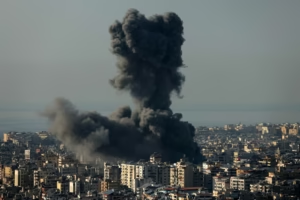
Despite the broader ceasefire between the United States and Iran, Israel has continued conducting strikes in Lebanon, underscoring the complexity of regional dynamics. The ceasefire agreement, while effective in reducing direct tensions between the U.S. and Iran, does not extend to all ongoing conflicts in the Middle East.
Reports indicate that Israeli forces carried out targeted operations in response to perceived threats, maintaining their security posture along the Lebanon border. These actions are part of a separate set of tensions involving regional actors that are not directly covered by the U.S.-Iran agreement. As a result, localized conflicts continue even as broader efforts at de-escalation are underway.
The situation highlights the fragmented nature of conflicts in the region. Multiple actors with differing interests and objectives operate simultaneously, making it difficult for a single agreement to address all areas of tension. While the ceasefire has reduced risks in one dimension, other areas remain active and volatile.
International observers have noted that such developments are not uncommon in complex geopolitical environments. Ceasefires often focus on specific parties or issues, leaving other conflicts unresolved. The continuation of strikes in Lebanon reflects these limitations and the need for broader engagement to achieve comprehensive stability.
Why It Matters
The continuation of strikes is significant because it demonstrates that regional stability cannot be achieved through isolated agreements alone. While the ceasefire has provided relief in one area, ongoing conflicts elsewhere can still pose risks to overall stability.
The situation also highlights the importance of understanding the scope of diplomatic agreements. Clear awareness of what is and is not covered can help set realistic expectations and prevent misunderstandings. In this case, the ceasefire’s limited scope means that other tensions remain active.
Additionally, the development underscores the interconnected nature of regional conflicts. Actions in one area can influence perceptions and conditions in others, even if they are not directly related. This makes it essential to consider the broader context when evaluating stability.
The issue also reflects the challenges of achieving comprehensive peace in regions with multiple overlapping conflicts. Addressing these challenges requires coordinated efforts that involve a wide range of stakeholders.
Political and Geopolitical Impact
Geopolitically, the continued strikes in Lebanon add complexity to the broader situation in the Middle East. While progress has been made in reducing tensions between certain parties, the persistence of other conflicts highlights the need for a more inclusive approach to diplomacy.
For regional actors, the situation may influence strategic decisions and alliances. Countries are likely to reassess their positions based on ongoing developments, balancing security concerns with opportunities for engagement.
Internationally, the development may shape perceptions of the ceasefire’s effectiveness. While it remains a positive step in reducing specific tensions, the continued conflict elsewhere underscores its limitations. This may influence how future agreements are structured and implemented.
The situation also highlights the role of individual countries in managing their own security priorities. Israel’s actions reflect its approach to addressing threats, which may not always align with broader regional agreements.
Implications
If localized conflicts such as those in Lebanon continue, they could undermine broader efforts to stabilize the region. Persistent tensions may create conditions where escalation remains a possibility, even if larger agreements are in place.
However, the situation also presents an opportunity for expanded diplomatic efforts. Addressing additional areas of conflict could help build on the current ceasefire and move toward more comprehensive stability.
In the long term, the development emphasizes the importance of inclusive and multi-layered approaches to conflict resolution. Agreements that consider multiple actors and issues are more likely to produce lasting results. The current situation serves as a reminder of the complexity involved in achieving regional peace.
