
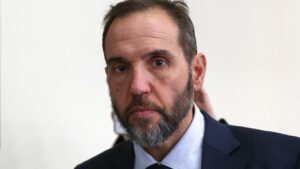
Former special counsel Jack Smith broke his silence this week with a pointed warning that the U.S. Justice Department has become fundamentally unable to perform its basic functions because federal judges across the country no longer trust its prosecutors. In his first interview since resigning ahead of Trump’s second inauguration, Smith described what he called a rapid erosion of institutional trust built over generations, along with concerns about retribution-driven prosecutions targeting the administration’s perceived political adversaries. The comments add a prominent voice to an intensifying national debate over the health of American legal institutions under the current administration.
Story Highlights
- Jack Smith said in a television interview that federal judges “across the country” have stated they no longer trust Justice Department prosecutors.
- Smith warned of an “attack on the rule of law” and expressed concern about the integrity of upcoming elections.
- He cited the firing of career agents and prosecutors, including a decorated FBI agent, as evidence of lost institutional expertise.
- Smith acknowledged he could personally face indictment for prosecuting Trump but said he does not regret his work as special counsel.
What Happened
Former special counsel Jack Smith delivered a sharp public warning this week about what he described as a fundamental breakdown in the U.S. Department of Justice’s ability to function, in his first television interview since resigning from the department ten days before President Trump’s second inauguration. Speaking with Nicolle Wallace on MS NOW’s “Deadline: White House,” Smith stated bluntly that the department “can’t do its job right” because federal judges across the country have lost confidence in its prosecutors. “If you go to court and the judges don’t trust you, you can’t do the basic things that you need to do to represent the American people in court,” Smith said. “And we have seen judges across the country say they can’t trust prosecutors anymore.”
Smith, who was appointed by then-Attorney General Merrick Garland in 2022 to investigate Trump’s handling of classified documents and his efforts to overturn the 2020 election, described the erosion of institutional trust as unprecedented in both speed and scope. He noted that a single adverse judicial opinion questioning a prosecutor’s credibility would traditionally have been treated as a seismic event within the department, but such rulings are now occurring with troubling regularity. “Trust that’s been built over generations has been lost in days, right? And that’s happening every day,” he said, framing the concern as fundamentally nonpartisan in nature rather than a matter of political disagreement.
Smith connected this institutional erosion to what he characterized as a pattern of “retribution prosecutions” pursued by the current Justice Department against individuals perceived as political adversaries of the administration, specifically citing the indictments of former FBI Director James Comey and New York Attorney General Letitia James. Both cases have faced significant legal challenges related to the manner in which the prosecuting U.S. Attorneys were appointed. Smith also pointed to personnel changes within the department, including the dismissal of prosecutors and agents who had worked on cases involving Trump, as evidence of a broader loss of institutional expertise and independence.
Among the specific examples Smith raised was the August 2025 firing of Brian Driscoll, a career FBI agent he described as a decorated counterintelligence expert and hostage rescue specialist, after Driscoll refused to provide the administration with a list of department agents who had worked on cases connected to the January 6, 2021, Capitol riot. Smith argued that removing experienced personnel of this caliber for such reasons carries direct consequences for national security, regardless of the political motivations behind the decision. He also noted that law students and young attorneys he encounters during university visits have expressed diminished interest in pursuing careers at the Justice Department, a trend he said reflects broader concerns about the institution’s current direction.
Smith further acknowledged the personal risk he faces given his role in prosecuting Trump, stating it “could happen” that he might himself be indicted in an act of political retaliation, following what he characterized as a pattern involving other perceived adversaries of the administration. He expressed continued confidence in the integrity of his own investigative work, noting that both cases he brought against Trump were conducted using standard, well-established prosecutorial techniques without a predetermined outcome, a contrast he drew explicitly with what he described as the current department’s approach to politically sensitive cases.
Why It Matters
Smith’s comments, coming from a former senior Justice Department official with direct experience overseeing some of the highest-profile prosecutions in modern American history, carry significant weight in the ongoing national debate over the independence and integrity of federal law enforcement institutions. The rule of law depends fundamentally on public and judicial confidence that prosecutors will pursue cases based on evidence and established legal standards rather than political direction, and a documented erosion of that trust among the federal judiciary itself represents a serious institutional concern regardless of one’s views on any individual case.
The specific concern about judges declining to trust department representations in court carries practical consequences that extend well beyond high-profile political cases. Federal prosecutors handle an enormous volume of matters daily, from routine criminal prosecutions to complex civil litigation, and a documented erosion of judicial trust in the department’s representations could complicate the government’s ability to function effectively across the full range of its legal responsibilities, not merely in politically sensitive matters.
Smith’s warning about diminished institutional expertise, particularly regarding the departure of experienced national security and counterintelligence personnel, raises questions with direct bearing on public safety that transcend partisan considerations. The loss of career expertise built over decades cannot be easily or quickly replaced, and Smith’s specific example involving a decorated agent removed for defending colleagues from what he characterized as improper political targeting illustrates the potential long-term costs of personnel decisions driven by political loyalty rather than professional qualification.
Economic and Global Context
While Smith’s comments are primarily focused on institutional and legal concerns, they carry indirect economic implications tied to the Justice Department’s role in enforcing federal law across sectors ranging from antitrust to financial regulation to national security. A department perceived as operating under diminished judicial trust or compromised independence could face greater difficulty securing favorable outcomes in complex civil and regulatory litigation, with potential downstream effects on businesses and industries that rely on consistent, predictable federal enforcement.
The departure of experienced national security personnel that Smith highlighted also carries implications for America’s broader counterintelligence and counterterrorism posture at a moment of heightened global tension. Allied intelligence services that coordinate closely with U.S. counterparts have reportedly expressed private concerns about personnel turnover within key national security-adjacent roles at the Justice Department and FBI, concerns that could affect the depth and quality of international law enforcement cooperation on matters ranging from terrorism to transnational organized crime.
Domestically, the debate over Justice Department independence intersects with broader questions about institutional stability that markets and international observers monitor closely when assessing the predictability of the American legal and regulatory environment. Sustained uncertainty about the department’s operational independence could factor into how businesses and foreign governments assess long-term regulatory and legal risk associated with U.S. federal enforcement actions.
Implications
For Congress, Smith’s comments are likely to fuel continued oversight efforts, particularly among lawmakers concerned about the department’s independence and the treatment of career personnel, though any substantive legislative response would likely require bipartisan cooperation that has proven difficult to achieve on Justice Department oversight matters in the current political environment.
For the Justice Department itself, Smith’s public warning adds to a growing body of criticism from former officials and outside legal observers regarding the department’s current operations, criticism the department has generally dismissed as politically motivated given Smith’s own history prosecuting the president.
For voters and the broader public, Smith’s remarks contribute to an ongoing national conversation about institutional trust in federal law enforcement that is likely to remain a significant point of contention heading into the 2026 midterm elections, with implications for how both parties frame their platforms around government accountability and the rule of law.
Sources
