
Story Highlights
- The No Kings movement has organized events in 21 states, with a flagship concert in New York City featuring Bette Midler, Patti Smith, and Jane Fonda
- The White House will host a UFC Freedom 250 fight on the South Lawn on the same day as part of America 250 celebrations
- June 14 coincides with Flag Day, Trump’s 80th birthday, and the lead-up to the nation’s 250th anniversary on July 4
What Happened
President Donald Trump turns 80 years old on Sunday, June 14, a date that simultaneously marks Flag Day and falls in the final weeks before the nation’s 250th anniversary of independence on July 4. The White House has planned a large-scale celebration anchored by the UFC Freedom 250 fight on the South Lawn, a high-profile mixed-martial arts event that Trump announced months ago and that has been integrated into the broader America 250 anniversary programming. UFC CEO Dana White, a longtime Trump ally, confirmed that fighters would walk to the octagon from the Oval Office in a spectacle designed to blend sport, patriotism, and presidential celebration.
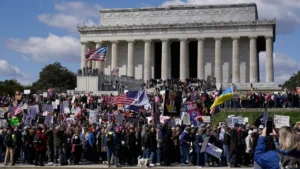
The No Kings Coalition, a grassroots network that has organized multiple rounds of anti-Trump demonstrations since June 2025, has announced a different kind of event to mark the same day. The centerpiece is a 90-minute concert titled Rise Up, Sing Out, scheduled at The Town Hall in New York City on Sunday evening and featuring performances and speeches from Jane Fonda, Bette Midler, Patti Smith, Rufus Wainwright, and Sasha Allen. The event is being presented with the Committee for the First Amendment and is designed to stream nationwide, with close to 500 watch parties organized across the country in both red and blue states.
The No Kings movement has positioned its June 14 actions as a defense of First Amendment freedoms and a rebuke of what organizers describe as strongman politics and the concentration of presidential power. The movement’s website invokes the approaching 250th anniversary explicitly, stating that the next 250 years starts with its participants and framing the day as a choice between celebrating democracy and normalizing what it calls authoritarian tendencies. Organizers have emphasized that this round of events differs from previous street protests, representing a shift toward community-based cultural action rather than mass street demonstrations.
In response to the planned events, White House spokeswoman Abigail Jackson told Newsweek that the administration was dismissive of the protests, characterizing them as a form of political grievance therapy. The contrast between the administration’s framing of June 14 as a day of patriotic celebration and the movement’s framing of it as a day of democratic resistance reflects the profound disagreement over what American liberty means and who speaks for it as the nation approaches a landmark anniversary of its founding.
Why It Matters
The No Kings movement’s decision to organize around June 14 is not incidental. The date carries symbolic weight that cuts in multiple directions simultaneously. As Flag Day, it is a federally observed holiday dedicated to the American flag and the values it represents. As Trump’s birthday and the occasion for a White House celebration, it is a moment of presidential pageantry. And as the eve of the nation’s 250th year, it sits within a national conversation about the meaning of American democracy and whether its foundational commitments are being honored or eroded. The movement is making a deliberate claim on all three of those symbolic registers at once.
The First Amendment themes that organizers have emphasized reflect a specific set of concerns that have animated the anti-Trump movement throughout the second term. Critics have raised objections to the deployment of the National Guard in states including California, Oregon, and Illinois over the objections of those states’ governors. They have also pointed to the use of armed federal agents in immigration operations that resulted in civilian deaths, and to the administration’s unilateral imposition of tariffs on nearly 100 countries without congressional authorization. The No Kings framing argues that these actions collectively represent a concentration of executive authority that exceeds constitutional boundaries.
The cultural approach of Rise Up, Sing Out marks a strategic evolution for the No Kings movement. The June 2025 protests, held on Trump’s 79th birthday, drew an estimated five million participants across more than 2,100 cities in what was one of the largest single-day protest mobilizations in American history. Subsequent rounds of action in October 2025 and March 2026 maintained momentum. By shifting toward a concert model with 500 watch parties, organizers are attempting to deepen community roots and sustain civic engagement beyond the one-day surge that mass street protests produce. That strategic pivot reflects lessons learned from the limitations of protest movements that generate peak attention but struggle to maintain organizational coherence.
The competing events on June 14 — the White House UFC celebration and the No Kings concert — offer a vivid illustration of the cultural and political divide that defines American life in the Trump era. Both sides are appealing to patriotism. Both claim to represent authentic American values. And both are staging events designed for broad media reach and emotional resonance. The contest between them is not merely political but cultural, representing a genuine disagreement about what the country’s 250th year of independence should mean and who gets to define it.
Economic and Global Context
The political polarization visible in the June 14 events has economic dimensions that extend beyond cultural symbolism. The No Kings movement’s critiques of Trump’s tariff policy touch directly on economic anxiety that has grown throughout 2026. The administration’s imposition of tariffs on imports from nearly 100 countries, which the movement’s organizers characterize as a unilateral national sales tax, has contributed to inflationary pressure that has eroded consumer purchasing power. Inflation reaching some of the highest levels in recent years has been a persistent drag on the administration’s approval ratings and a genuine source of financial stress for American families.
The UFC Freedom 250 event at the White House carries its own economic footprint. UFC CEO Dana White has noted that replacing the South Lawn grass following the event will cost $700,000, giving a sense of the scale of the production. The event is integrated into the America 250 commemoration, which represents a major federal investment in anniversary programming designed to boost tourism, civic pride, and public engagement with American history in the year leading up to the July 4 semiquincentennial celebration. The economic stakes of that programming include significant contracts and spending across the hospitality, media, and entertainment sectors.
The international dimension of the protest movement reflects how America’s domestic political conflicts are observed abroad. Foreign governments and populations watching American democracy grapple with questions of executive authority, constitutional limits, and civic mobilization draw their own conclusions about the stability and health of American democratic institutions. In an era of intense competition between democratic and authoritarian governance models globally, the spectacle of mass protests on a sitting president’s birthday draws international attention to questions about the direction of the world’s leading democracy.
The media economics of the competing June 14 events are also significant. The White House UFC fight is expected to draw massive broadcast audiences and generate extensive earned media coverage. The No Kings concert, by contrast, will reach its audience through streaming and local watch parties, reflecting the different organizational and financial resources of a grassroots movement versus a sitting presidential administration with institutional backing. How those competing media footprints play out will influence the political narrative heading into the summer.
Implications
The June 14 events will likely be watched closely as a measure of the No Kings movement’s organizational vitality heading into the final months before November’s midterm elections. If the concert and watch parties generate substantial turnout and media coverage, they will signal that civic opposition to the Trump administration remains energized and capable of coordinated national action. If the events fail to generate meaningful attention, they could suggest that the protest energy of earlier rounds has dissipated.
For the Trump administration, the 80th birthday milestone is both a personal landmark and a political moment that requires careful navigation. The White House’s decision to host a UFC fight rather than a traditional political event reflects a deliberate branding strategy aimed at projecting energy, vitality, and cultural populism. But the president’s age is also a genuine political variable. As Trump approaches his 80th birthday, media coverage has increasingly noted parallels with the age-related scrutiny that dogged his predecessor, Joe Biden, making visible management of the president’s public image a strategic priority.
For American democracy more broadly, the competing events underscore the degree to which basic civic occasions — national holidays, presidential birthdays, anniversary commemorations — have become contested political territory. The country that approaches its 250th year of independence does so in a moment of profound disagreement about its foundational values, the limits of executive power, and the meaning of patriotism itself. Those questions will not be resolved on June 14, but the day will add another chapter to the ongoing national argument.
Sources
“No Kings Events Set For Trump’s 80th Birthday: List of Celebrities Involved”
