
Story Highlights
- The SAVE America Act failed its second Senate vote on June 4, 2026, with four Republicans joining a unified Democratic caucus to defeat the amendment 48-50
- The bill would require photo ID to vote in federal elections and proof of U.S. citizenship to register — provisions that would take effect immediately upon passage
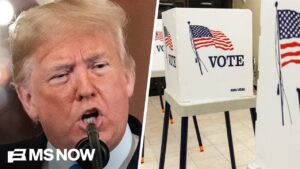
- Trump threatened to impose voter ID requirements via executive order if Congress fails to act, saying: “There will be Voter I.D.”
What Happened
The SAVE America Act — short for Safeguarding American Voter Eligibility — is the centerpiece of President Donald Trump’s second-term election integrity agenda. First passed by the House in February 2026 with the support of Speaker Mike Johnson, the bill would require every voter to show photo identification at the polls and submit proof of U.S. citizenship when registering to vote in federal elections. The requirements would take effect immediately upon passage, a timing provision that drew fierce opposition from Democrats given that the 2026 midterm elections are months away.
The legislation is sponsored in the Senate by Sen. Mike Lee of Utah and passed the House with Republican backing. Senate Majority Leader John Thune brought it to the floor and argued it represents “common sense” that polls show Americans broadly support. On March 17, the Senate voted 51-48 to open debate, with only Sen. Lisa Murkowski of Alaska joining Democrats in opposing the procedural vote. Despite clearing that threshold, the bill requires 60 votes to overcome a filibuster — a number Republicans, with a 53-47 majority, cannot reach.
The first substantive floor vote ended in failure when four Republicans broke ranks to vote with Democrats. On June 4, a second attempt to attach the SAVE Act to a nearly $70 billion immigration funding package also failed, 48-50, with the same Republican coalition again joining Democrats. Sen. Josh Hawley publicly fumed over the defections, arguing that federal voter ID is both constitutional and overwhelmingly popular with Republican voters. Sen. Alex Padilla of California noted that a similar proposal had already been defeated on a bipartisan basis just weeks earlier.
Trump escalated the pressure significantly in February when he declared on Truth Social that if Congress failed to pass the legislation, he would impose voter ID by executive order. “If we can’t get it through Congress, there are Legal reasons why this SCAM is not permitted. I will be presenting them shortly, in the form of an Executive Order,” he wrote. More recently, Trump linked his refusal to support renewal of FISA Section 702 to the SAVE Act’s passage, creating a legislative jam that has simultaneously endangered both election integrity legislation and critical national security surveillance authority.
Why It Matters
The SAVE Act strikes at the heart of a debate over access to the ballot versus the integrity of the electoral roll. Trump and supporters argue that requiring proof of citizenship to register and ID to vote is a basic security measure that prevents noncitizen voting and electoral fraud. Democrats and voting rights advocates counter that documented instances of noncitizen voting are vanishingly rare and that the requirements — particularly proof of citizenship documentation — would effectively disenfranchise eligible American voters who lack easy access to birth certificates or passports, disproportionately affecting low-income, elderly, and minority communities.
The Heritage Foundation’s voter fraud database, a conservative tracker, lists just 1,620 documented instances of fraud dating back to 1982 across billions of ballots cast — a number that critics argue does not justify sweeping new barriers to participation. Proponents respond that undocumented fraud by definition goes uncounted and that the integrity of the electoral process requires preventive measures regardless of known case volumes.
The constitutional dimension of Trump’s executive order threat is particularly significant for Liberty Tribunal readers. Federal election law has historically been a matter of congressional authority under Article I of the Constitution, which grants Congress the power to regulate the time, place, and manner of federal elections. Whether a president can unilaterally impose voting requirements by executive order — effectively usurping Congress’s enumerated power over federal elections — raises profound separation of powers questions that courts would almost certainly be asked to resolve.
Economic and Global Context
The broader political context includes a November midterm election in which control of both the House and Senate is at stake. Democrats need a net gain of four Senate seats to take the majority; Republicans are defending a narrow majority in both chambers. Any last-minute change to voting rules — whether through legislation or executive order — would be immediately challenged in court and could create administrative chaos for state election officials attempting to prepare voter rolls and polling procedures for a general election already in motion.
State election officials in both parties have warned that imposing new federal identification requirements on short notice would be logistically unworkable. The National Association of Secretaries of State has historically opposed federal mandates that override state voting systems without adequate implementation time. The SAVE Act’s immediate-effect provision has been specifically cited by critics as evidence that the legislation is designed more for political confrontation than practical election administration.
Internationally, American debates over voter access and election integrity are watched closely by democratic allies and adversaries alike. Russia, China, and other authoritarian governments have long sought to amplify domestic divisions over U.S. elections as a tool of information warfare. A prolonged and unresolved constitutional battle over federal voting requirements heading into midterms provides ample material for foreign interference narratives.
Implications
If Trump follows through on his executive order threat, it would set up an immediate court battle over whether the president has the constitutional authority to impose federal voting requirements unilaterally. Such an order would almost certainly be challenged by multiple states and civil rights organizations within hours of its issuance, and lower courts would likely issue injunctions blocking its enforcement pending litigation. The Supreme Court, already overloaded with major Trump-related cases this term, could be asked to weigh in before the November elections.
For Republican Senate leaders, the repeated failure to advance the SAVE Act reflects a persistent gap between the base-driven priorities of the president and the institutional realities of the Senate’s 60-vote threshold for legislation. The four Republicans who have voted against the bill have not publicly identified themselves as a bloc, but their continued resistance has made clear that even on a flagship Trump priority, the Senate cannot be fully whipped into line.
For voters across the political spectrum, the outcome of the SAVE Act battle will shape not only the 2026 elections but the longer-term architecture of federal election law. If a legal path exists for the president to impose voting requirements by executive action, it represents a fundamental shift in how elections are administered — with potentially lasting consequences for the constitutional balance between federal executive power and congressional authority over elections.
Sources
