


Story Highlights
- The Senate passed a $70 billion immigration enforcement bill after a marathon overnight voting session.
- The package funds ICE and Customs and Border Protection for the next three years, through the end of President Donald Trump’s term.
- Sen. Lisa Murkowski was the only Republican to vote against the bill, while no Democrats supported it.
What Happened
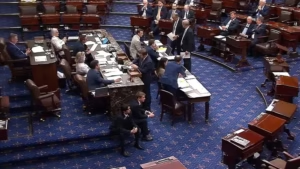
The U.S. Senate passed a $70 billion immigration enforcement funding bill early Friday morning after an all-night “vote-a-rama” that stretched for hours and exposed internal Republican tensions over a separate Trump-backed settlement fund.
The bill passed 52–47 and now heads to the House, where Republican leaders are expected to take it up next week. The measure provides long-term funding for Immigration and Customs Enforcement and Customs and Border Protection, giving the Trump administration a major legislative victory on one of its central priorities.
- The bill provides funding for ICE and Border Patrol for three years.
- Republicans used the reconciliation process to avoid a Democratic filibuster.
- Democrats opposed the bill after failing to add oversight and accountability measures.
The package includes tens of billions of dollars for immigration enforcement agencies, including funding for ICE, Customs and Border Protection, and flexible Department of Homeland Security priorities. Supporters said the bill ends months of budget uncertainty and gives federal immigration agencies the resources needed to carry out Trump’s enforcement agenda.
Senate Majority Leader John Thune framed the vote as a victory for border security and for the administration’s immigration mandate. Republicans argued that the funding is necessary to strengthen enforcement capacity, expand detention resources, and support border operations.
The vote followed a long and contentious amendment process. Democrats sought to add restrictions and oversight requirements, while some Republicans pushed to address a controversial $1.8 billion “anti-weaponization” fund tied to claims of federal targeting.
Why It Matters
The bill matters because it gives Trump’s immigration enforcement agencies a stable funding stream through the remainder of his term. For months, ICE and Border Patrol funding had been caught in a broader spending fight, leaving the administration to rely on temporary or leftover resources while trying to maintain enforcement operations.
With this vote, Senate Republicans moved to lock in Trump’s border and deportation strategy as a major governing priority. The funding could support additional detention capacity, expanded enforcement operations, more personnel, and longer-term planning across DHS.
- The bill strengthens Trump’s immigration enforcement agenda.
- It gives ICE and Border Patrol longer-term budget certainty.
- It also sets up a House fight over funding, oversight, and political risk.
The vote also showed how strongly immigration continues to unite most Senate Republicans. Although several GOP senators objected to the separate anti-weaponization fund, nearly the entire conference ultimately backed the immigration package.
Democrats argued that the bill gives the administration too much money without enough accountability. They pushed for stronger safeguards around enforcement tactics, detention conditions, and the use of federal funds, but those efforts failed during the amendment process.
Political and Public Context
The political fight around the bill extended beyond border funding. Much of the overnight drama centered on the $1.8 billion anti-weaponization fund, which critics say could be used to compensate Trump allies or people claiming they were unfairly targeted by the federal government.
Republican senators in competitive states appeared uneasy about the fund, while Democrats labeled it a political slush fund. Several amendments aimed at eliminating, redirecting, or limiting the fund failed before the final vote.
- Democrats tried to remove or restrict the anti-weaponization fund.
- Some Republicans expressed concern but still supported final passage.
- Murkowski broke with her party and voted against the bill.
For Trump, the Senate vote gives him a clear political win on immigration. Border security remains one of his strongest issues with Republican voters, and the funding package allows the White House to argue that it is delivering on its promise to strengthen enforcement.
For Democrats, the vote provides a campaign issue heading into the midterms. They are likely to argue that Republicans prioritized aggressive immigration enforcement and a controversial Trump-linked fund over household costs, healthcare, and other domestic concerns.
Economic and Global Context
The scale of the funding has major budget and labor-market implications. A $70 billion enforcement package represents a significant federal commitment at a time when both parties are already debating deficits, spending priorities, and the cost of Trump’s broader second-term agenda.
The funding could also affect industries that rely heavily on immigrant labor, including agriculture, construction, food processing, hospitality, and service work. If enforcement expands beyond the border and deeper into workplaces, some sectors could face new hiring pressure and labor shortages.
- Expanded enforcement could increase pressure on immigrant-heavy industries.
- Detention and border infrastructure spending may benefit federal contractors.
- The bill could also raise budget concerns among fiscal conservatives.
Internationally, the bill signals that the United States intends to maintain a hard-line enforcement posture. Countries whose nationals are frequently affected by U.S. deportation policy, including Mexico and Central American nations, will be watching how the new funding is used.
Remittances from workers in the United States remain economically important for several countries in the region. A major increase in deportation activity could therefore have effects beyond the U.S. border, including diplomatic and economic consequences for partner governments.
What Happens Next
The bill now moves to the House, where Republican leaders must manage a narrow majority and decide how quickly to bring the measure to the floor. Because the package is tied closely to Trump’s immigration agenda, House Republicans will face pressure to pass it without major changes.
The anti-weaponization fund controversy could still complicate the House vote. Some Republicans may want clearer restrictions before supporting the bill, while Trump-aligned lawmakers may resist changes that weaken the broader package.
- The House is expected to consider the bill next week.
- Republican leaders will need to keep their narrow majority united.
- Final passage would give Trump a major immigration enforcement win before the midterms.
If the House passes the measure, Trump would be positioned to sign one of the most significant immigration enforcement funding bills of his second term. The administration would then move from the funding fight to implementation, including how quickly DHS can expand capacity and deploy the new resources.
The Senate vote does not end the political fight. It shifts the battle to the House, where the future of the bill — and the scale of Trump’s immigration enforcement buildup — will be decided.
Sources
- US Senate passes $70 billion ICE funding; fails to ban Trump’s ‘anti-weaponization’ fund
- Senate passes bill to fund ICE for 3 years, without ban on Trump’s anti-weaponization fund
- Senate approves $70 billion immigration enforcement bill
- Senate passes $70 billion immigration enforcement funding package after overnight voting session
