
Story Highlights
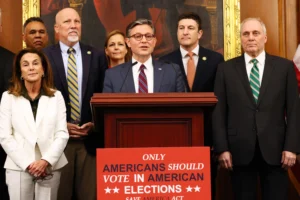
- Senators Susan Collins, Lisa Murkowski, Mitch McConnell, and Thom Tillis joined all Democrats to defeat the SAVE Act amendment for the second time on June 4
- The bill would require proof of U.S. citizenship to register for federal elections and photo ID to vote, and would take effect immediately if signed into law
- Trump has threatened on Truth Social to impose voter ID and ban mail-in ballots by executive order if Congress fails to deliver the bill
What Happened
On June 4, Senate Republicans attempted for the second consecutive time to attach the Safeguard American Voter Eligibility Act — known as the SAVE Act — to a budget reconciliation package moving through the chamber. The effort failed when four Republican senators broke with the party and voted with Democrats to defeat the amendment. Senator Susan Collins of Maine, Senator Lisa Murkowski of Alaska, Senator Mitch McConnell of Kentucky, and Senator Thom Tillis of North Carolina repeated the same vote they had cast on the bill’s prior attempt, creating an identical bloc sufficient to sink the effort again. The SAVE Act itself had passed the House in February on a party-line vote after receiving strong backing from Republican leadership and direct promotion from Trump himself.
The bill’s core provisions are sweeping in scope. It would require any person seeking to register to vote in federal elections to present documentary proof of United States citizenship — a requirement that most Americans would need to satisfy in person at an election office, as the bill provides limited accommodation for online or mail-based compliance. It would additionally require government-issued photo identification from every voter at the time of casting a ballot. Critically, both requirements would take effect immediately upon enactment, meaning that their implementation would need to be absorbed by state and local election officials simultaneously with their preparations for the November midterm elections.
The opposing Republican senators have expressed different but related objections. Murkowski issued a statement warning that imposing new federal requirements on election officials while those officials are deep into midterm preparation would damage, rather than enhance, election integrity. She described the approach as “federal overreach” and said the timeline creates an unworkable operational challenge for states. McConnell’s opposition reflects his long-standing concerns about federal interference in state-administered elections, a principle he has defended for decades across administrations of both parties. Collins and Tillis have expressed similar concerns, each framing their votes as procedural rather than substantive objections to election security.
Trump’s reaction has been sharp. Following the second defeat, he posted on Truth Social that voter ID for the midterm elections would happen “whether approved by Congress or not,” and separately floated pursuing the requirement through executive action. In a lengthier follow-up post, Trump argued there are legal grounds to impose the requirements unilaterally and said he would be presenting them in the form of executive action.
Why It Matters
The SAVE Act fight sits at the intersection of constitutional authority over elections, states’ rights, and voting access — three of the most legally and politically consequential issues in American governance. The Constitution grants states primary authority to administer elections, subject to Congress’s power under Article I to regulate the manner in which federal elections are conducted. The SAVE Act represents a significant federal assertion of that Article I power, and the question of whether it is constitutionally appropriate has divided legal scholars.
Critics of the bill, including election law experts and civil liberties organizations, point out that noncitizen voting in federal elections is already illegal and verifiably rare. They argue that the practical effect of the citizenship documentation requirement would be to disenfranchise millions of American citizens — disproportionately elderly, low-income, and minority voters — who do not have easy access to the documentary proof the law requires. The prospect of immediate implementation ahead of November elections compounds those concerns by creating an enrollment bottleneck with no adequate preparation time.
Supporters, including Trump and Republican leadership, argue that the bill is straightforwardly necessary to maintain voter confidence and election integrity, and that no legitimate voter should have difficulty producing either citizenship proof or photo identification. For the Republican base, the SAVE Act represents one of the administration’s clearest commitments to election security and a direct response to Trump’s years-long campaign against what he characterizes as a compromised electoral system.
Economic and Global Context
The election integrity debate carries real economic dimensions. States and localities that administer elections would face significant implementation costs under the SAVE Act’s immediate effective date — costs that critics argue have not been adequately assessed or funded. Election officials in states with large, geographically dispersed rural populations have raised particular concerns about the infrastructure requirements of universal in-person citizenship verification.
The broader political uncertainty generated by the SAVE Act fight also has economic dimensions in the context of investor and business confidence. A contentious midterm election cycle, particularly one shadowed by disputes over new and potentially litigated voting requirements, introduces instability that market participants factor into their medium-term planning. Elections that generate significant legal challenges in courts tend to extend periods of political uncertainty that affect regulatory and legislative output.
The international dimension is also relevant. Several allied democracies that observe American elections closely have noted that debates over voting access and requirements touch on America’s claimed leadership role in promoting democratic governance abroad.
Implications
Trump’s executive order threat creates a significant pending constitutional confrontation. Presidents have broad authority over certain executive functions, but the administration of federal elections is generally understood to fall within Congress’s power under Article I and the states’ administrative authority. A presidential executive order purporting to impose voter ID requirements on federal elections would almost certainly face immediate legal challenge, and the courts that have already blocked other Trump executive actions on election-related matters may be especially skeptical.
The midterm timeline adds urgency to every dimension of this story. With November less than five months away, any new voting requirements — legislative or executive — would need to be implemented against a backdrop of ongoing voter registration drives, state election system preparations, and candidate campaigns operating under existing rules.
For Republican senators who voted against the bill, the political consequences will unfold in primary contexts and in Trump’s continued public pressure. For Trump, the inability to deliver the SAVE Act through normal legislative channels represents a test of his second-term ability to convert agenda priorities into law — and an inflection point in his stated willingness to pursue unilateral action.
Sources
“Four Senate Republicans again vote to kill Trump’s SAVE Act voter ID bill”
