


Story Highlights
- The Supreme Court ruled 6-3 in December that Trump likely lacked authority to federalize National Guard troops for deployment to Illinois, a rare setback in emergency appeals.
- A federal judge separately ruled that Trump’s use of soldiers in Los Angeles violated the Posse Comitatus Act, which bars military involvement in civilian law enforcement.
- An appeals court has allowed National Guard deployment in Washington, D.C. to continue for now, reasoning Trump may have unique authority in the federal district.
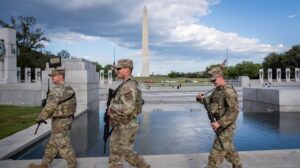
- More than 2,200 troops from Republican-led states remain deployed in Washington despite the underlying crime emergency Trump declared having expired months ago.
What Happened
Since taking office in January 2025, President Donald Trump has repeatedly deployed federalized National Guard troops to American cities, citing crime concerns and protests against Immigration and Customs Enforcement activities as justification. The administration’s legal basis for these deployments has rested primarily on a rarely used statute, 10 U.S.C. § 12406, which permits presidential federalization of Guard forces when the president is unable to execute federal laws using regular forces, along with broader claims of inherent constitutional authority under the Take Care Clause.
The strategy first triggered major legal confrontation in Los Angeles, where U.S. District Judge Charles Breyer ruled that the administration’s use of federalized California National Guard troops for security patrols, traffic control and crowd control violated the Posse Comitatus Act, a 19th-century law barring military involvement in civilian law enforcement absent explicit congressional authorization. Breyer found that Trump, Defense Secretary Pete Hegseth, and the Department of Defense had “violated the Posse Comitatus Act willfully” as part of a systemic effort to use troops to enforce drug and immigration laws across hundreds of miles over several months.
The dispute escalated further when Trump attempted similar deployments in Illinois, prompting Attorney General Kwame Raoul to sue, joined by amicus support from California, Oregon and other states. A federal district court found “no credible evidence” of rebellion or an inability to execute federal law in Illinois, blocking the deployment. On December 23, 2025, the Supreme Court sided against the administration by a 6-3 vote, holding that Trump likely lacked authority to federalize Guard forces under the statute for that purpose, with only Justices Alito, Thomas and Gorsuch dissenting. Following that ruling, Trump ordered troops withdrawn from California, Oregon and Illinois, though he warned on social media the deployments could return “in a much different and stronger form” if crime increased again.
The legal picture in Washington, D.C. has moved in the opposite direction. D.C. Attorney General Brian Schwalb sued to block Guard deployment in the capital, and U.S. District Judge Jia Cobb ruled in November that the deployment illegally intruded on local officials’ authority over law enforcement in the District. However, a three-judge panel of the D.C. Circuit Court of Appeals stayed that ruling, finding Trump may possess a “unique power” to mobilize the Guard specifically in Washington because it is a federal district rather than a state, allowing more than 2,200 troops from several Republican-led states to remain deployed in the capital well into 2026, even though the underlying crime emergency Trump originally declared expired months ago.
Why It Matters
The patchwork of conflicting rulings across California, Illinois, Oregon and Washington, D.C. reflects a genuinely unsettled area of constitutional law regarding the limits of presidential military authority over domestic law enforcement, a question with profound implications for civil liberties and federalism. The Posse Comitatus Act has stood for nearly 150 years as a foundational safeguard against military involvement in ordinary civilian policing, and Judge Breyer’s finding of a “willful” violation by the administration represents one of the most serious judicial rebukes of the deployment strategy to date.
For Americans living in cities where deployments have occurred or been threatened, including Chicago, Portland, Memphis and Washington, the legal uncertainty has real consequences for daily life, protest rights and the visible presence of armed federalized troops in civilian spaces. Democratic governors and attorneys general have argued consistently that these deployments represent an unprecedented expansion of federal military power into domains traditionally reserved for state and local authorities, while the administration maintains it retains constitutional authority to protect federal property, personnel and law enforcement operations.
The distinction the D.C. Circuit drew between deployments in states versus the federal district itself is legally significant and likely to shape future litigation, since it suggests courts may ultimately recognize different constitutional authorities depending on a city’s federal versus state status, a nuance that could allow continued Guard presence in Washington even as similar deployments remain blocked elsewhere.
Economic and Global Context
The cost of sustained National Guard deployments across multiple cities has drawn scrutiny from fiscal watchdogs and lawmakers, given that federalized troops require significant logistical support, housing and compensation drawn from Defense Department budgets, expenses that mount considerably when deployments extend for months beyond their original stated emergency justification, as has occurred in Washington.
International observers, including allied governments and human rights organizations, have periodically noted the domestic deployment pattern as part of broader assessments of American governance during the current administration, particularly given the historical rarity of using military forces for domestic policing functions in peacetime outside of natural disaster response or extreme civil unrest.
State-level fiscal and political dynamics have also emerged, with Republican-led states like Texas voluntarily sending Guard troops to support deployments in Democratic-led cities, creating interstate tensions and raising novel legal questions about whether governors of non-affected states can lend forces to support federal operations in jurisdictions whose own leadership opposes the deployment.
Implications
The Supreme Court’s Illinois ruling, while not a final resolution on the merits, has already influenced litigation strategy nationwide, giving Democratic attorneys general a stronger legal foundation to challenge future deployment attempts under the same statutory authority. However, the D.C. Circuit’s contrary approach for the federal district signals that courts may continue reaching different conclusions depending on jurisdictional specifics, ensuring continued legal fragmentation rather than a single unified national standard.
For the Trump administration, the setbacks in California and Illinois have not deterred continued reliance on Guard deployments where legally permissible, and officials have signaled openness to invoking the more expansive Insurrection Act in the future, a step that would grant significantly broader deployment authority and has already been referenced by Trump in response to protests in cities including Minneapolis.
Governors and state attorneys general, particularly in Democratic-led states, are likely to continue coordinated legal responses to any new deployment attempts, drawing on the cooperative litigation strategies developed during the California, Oregon and Illinois fights. Meanwhile, residents of Washington, D.C. face continued uncertainty as litigation over the appropriate scope of federal authority in the nation’s capital works its way through the appeals process, with no clear resolution expected before the 2026 midterms.
Sources
“Appeals court says Trump’s National Guard deployment in Washington can continue for now”
