Story Highlights
- Trump’s December 2025 executive order directed a DOJ AI Litigation Task Force to challenge state AI laws and conditioned $42 billion in broadband funding on states pausing AI regulation
- California is advancing the “No Robo Bosses Act of 2026,” which would prohibit employers from relying solely on AI to fire or discipline workers
- Congress has stalled on comprehensive federal AI legislation, leaving no statutory basis for federal preemption of state laws
What Happened
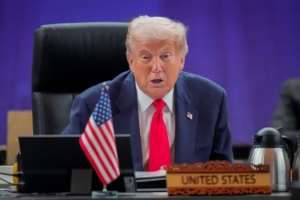
President Donald Trump signed the “Ensuring a National Policy Framework for Artificial Intelligence” executive order on December 11, 2025, directing federal agencies to challenge state AI laws and establishing a DOJ AI Litigation Task Force specifically for that purpose. The order framed its central goal as sustaining U.S. global AI dominance through what it called a “minimally burdensome” national regulatory framework — one that, by design, would displace the growing patchwork of state-level rules.
The order used two primary enforcement tools. First, it directed the Department of Commerce to condition $42 billion in previously allocated broadband infrastructure funding on states refraining from enacting or enforcing AI regulations deemed inconsistent with the administration’s policy. Second, it established the DOJ task force to identify and litigate against state laws seen as overreaching. In March 2026, Trump followed up by releasing a four-page National Policy Framework for AI calling on Congress to pass legislation formally preempting state AI laws.
On June 2, 2026, Trump signed a second AI-related executive order, titled “Promoting Advanced Artificial Intelligence Innovation and Security,” expanding AI’s role in federal cybersecurity infrastructure and reinforcing the administration’s preference for a light-touch commercial regulatory approach. A bipartisan group of House lawmakers simultaneously released the “Great American AI Act,” the most comprehensive federal AI legislative proposal to date, but the bill faces steep headwinds.
As of Sunday, June 14, however, states are pressing forward regardless. California lawmakers are advancing the “No Robo Bosses Act of 2026,” which would bar employers from using AI as the sole basis for firing or disciplining workers. California is also moving to prohibit chatbot-generated content targeting children from being used for advertising. In Illinois and other states, legislators are advancing narrower AI bills focused on worker rights, child safety, and consumer disclosure. Colorado‘s AI Consumer Protections Act — specifically called out by name in Trump’s December executive order — has had its effective date pushed to June 30, 2026.
Even within the Republican Party, the preemption fight has produced fractures. Florida Governor Ron DeSantis introduced an AI “Bill of Rights” legislation only to see the Florida House refuse to advance it, with Florida House Speaker Daniel Perez deferring to the federal government’s position. DeSantis himself then broke with that posture, noting bluntly that the federal government is not, in fact, acting on AI regulation.
Why It Matters
The conflict between Trump’s AI preemption strategy and state-level legislative action is, at its core, a constitutional dispute about the limits of executive power and the continued vitality of federalism. Legal scholars have broadly noted that executive orders do not, by themselves, carry the force needed to preempt state law — that authority generally flows from Congress. Without a federal statute, Trump’s order is better understood as policy guidance and political pressure than as binding law.
For Americans, this matters because AI is already shaping daily life in concrete ways — influencing hiring decisions, moderating social media, powering recommendation systems, and interacting directly with children through companion chatbots. The question of which government body, if any, sets guardrails for these systems has immediate practical consequences for workers, parents, and consumers nationwide.
The administration’s argument is that a fragmented 50-state regulatory environment creates compliance burdens for American AI companies, undermines U.S. competitiveness against China, and risks embedding political biases into AI systems through state-mandated requirements. Those are legitimate concerns, but critics point out that federal inaction cannot simultaneously justify federal supremacy — states cannot be expected to stand down if Washington declines to fill the void.
The broadband funding leverage point is particularly significant for Liberty Tribunal readers concerned about federal overreach. Using $42 billion in previously appropriated infrastructure funds as a coercive tool to suppress state legislative authority is an aggressive exercise of executive power that may itself face legal challenge, echoing past Supreme Court rulings limiting conditional federal spending used to commandeer state policy.
Economic and Global Context
The United States is in a race with China for global AI dominance, and the regulatory environment surrounding AI development is a genuine economic variable in that competition. The Trump administration’s deregulatory stance on AI reflects a real concern that overly restrictive domestic rules could slow the pace of American innovation and give Chinese AI developers a structural advantage in global markets.
American AI companies — particularly in California, the epicenter of the industry — are caught between federal encouragement to innovate freely and state-level rules that impose specific obligations around transparency, bias mitigation, and worker protections. Large frontier AI developers generally prefer a single national framework over competing state rules, even if that framework includes some regulation, because compliance with 50 different regimes is operationally expensive.
Globally, the European Union has moved in the opposite direction from the Trump administration, implementing the EU AI Act, which imposes tiered regulatory requirements based on risk levels of AI applications. That divergence between U.S. and EU regulatory philosophies has created uncertainty for multinational companies and raised questions about how AI products will be governed when they cross borders.
The Great American AI Act, if passed, would provide the statutory basis for federal preemption that currently does not exist. But with the midterm election calendar shrinking the legislative window, passage before November 3 is considered unlikely by most observers.
Implications
The most immediate implication is legal: as states continue advancing AI laws, and as Colorado’s act potentially takes effect on June 30, the DOJ AI Litigation Task Force is likely to move toward filing formal legal challenges. Those cases will test whether the Trump administration’s executive framework carries any enforceable preemptive weight, and the outcomes could redefine the boundaries of federal authority over technology regulation for a generation.
For state legislators, the practical calculation is shifting. Earlier, more sweeping AI regulation bills were vetoed or withdrawn under pressure. What’s emerging now is a second wave of narrower, more targeted legislation — focused on children, workers, and consumer disclosure — that is harder to characterize as anticompetitive and easier to defend politically. That tactical evolution may make state AI laws more durable against both legal challenge and political criticism.
For the Trump administration, the failure of Congress to deliver a federal AI statute is a significant gap in the preemption strategy. Without legislation, the executive order functions largely as pressure rather than law. Administration officials will likely intensify lobbying efforts for the Great American AI Act in the post-birthday legislative calendar, framing it as a national security and economic competitiveness imperative.
For American workers and families, the ultimate question is whether anyone is governing AI at all. As the federal-state standoff continues, AI systems are being deployed in workplaces, schools, and homes at an accelerating pace, largely without binding regulatory oversight at either level of government.
