
Story Highlights
- The Supreme Court is expected to rule by early July on Trump’s executive order that would deny citizenship to children born in the U.S. to parents who are in the country illegally or on temporary visas
- During oral arguments, conservative justices including Amy Coney Barrett and Neil Gorsuch questioned the administration’s central legal theory, with Chief Justice John Roberts responding to the government’s argument by saying “It’s the same Constitution”
- Trump attended the April oral arguments personally, becoming the first sitting president to observe Supreme Court arguments, and posted afterward that the U.S. is “STUPID” for allowing birthright citizenship
What Happened
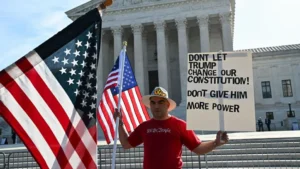
Several justices — including those Trump appointed — aggressively questioned the president’s effort to reimagine birthright citizenship during oral arguments. In response to the Trump administration’s argument that “we’re in a new world” since the Fourteenth Amendment was passed, Chief Justice John Roberts shot back: “It’s the same Constitution.” Conservative justices Amy Coney Barrett and Neil Gorsuch also questioned Trump’s central arguments.
Trump attended the arguments for about 90 minutes, the first sitting president to do so. The court’s decision, expected by the end of June, could have enormous practical implications for millions of people, including U.S. citizens.
The future of President Trump’s executive order attempting to limit access to birthright citizenship is now positioned for a final decision from the Supreme Court. Questioning from the justices during approximately two hours of oral arguments in Trump v. Barbara suggests an icy reception for the Justice Department’s claim that the constitutional guarantee of citizenship turns on an innovative interpretation of the legal concept known as “domicile.” Without acceptance of that interpretation by the court, the Trump administration is unlikely to successfully defend the president’s directive.
Trump’s executive order says babies born in the U.S. are not entitled to citizenship if their parents are illegal immigrants or undocumented workers. After leaving the court, Trump wrote on Truth Social: “We are the only Country in the World STUPID enough to allow ‘Birthright’ Citizenship!”
President Trump has again sharply criticized the Supreme Court on social media, predicting the justices will rule against him on birthright citizenship and accusing members of the conservative majority — three of which he nominated — of undermining his economic agenda.
Why It Matters
Birthright citizenship is enshrined in the Fourteenth Amendment’s Citizenship Clause, ratified in 1868: “All persons born or naturalized in the United States, and subject to the jurisdiction thereof, are citizens of the United States.” That language has been interpreted consistently for over 125 years, since the Supreme Court’s 1898 ruling in United States v. Wong Kim Ark, to guarantee citizenship to virtually all children born on American soil regardless of their parents’ status. Trump’s executive order attempts to reinterpret the phrase “subject to the jurisdiction thereof” to exclude children of undocumented immigrants — a reading that every federal court to consider it has rejected as unconstitutional.
The constitutional stakes are profound. The Fourteenth Amendment was written specifically to prevent the government from stripping citizenship from individuals based on their origins or the status of their parents. It was a direct response to the Dred Scott decision, which had held that Black Americans could not be citizens. Reinterpreting the amendment’s plain text to deny citizenship to an entire class of people born on American soil would be a departure from 130 years of settled constitutional law — and would require the Court to essentially reverse Wong Kim Ark without ever explicitly doing so.
For the millions of Americans whose own citizenship or whose children’s citizenship could be affected, the case is existential. The executive order does not apply retroactively, but if upheld prospectively it would create a permanent underclass of U.S.-born individuals without legal citizenship status — people who would be stateless in the country of their birth, ineligible for federal benefits, unable to obtain passports, and vulnerable to deportation.
The case also implicates the separation of powers in a fundamental way. If the president can unilaterally redefine citizenship by executive order, it means the protections of a constitutional amendment can be circumvented without the consent of Congress or the states — a structural innovation that would significantly expand executive authority over matters the framers placed in the Constitution precisely to remove from ordinary political control.
Economic and Global Context
The economic dimensions of birthright citizenship policy are substantial. Researchers have documented that the children of immigrants, including undocumented immigrants, contribute disproportionately to economic growth, innovation, and workforce participation over time. Policies that create legal uncertainty about the citizenship status of those children affect investment in human capital, educational attainment, and long-term labor market participation in ways that have measurable macroeconomic consequences.
More immediately, the uncertainty generated by the executive order since it was signed in January 2025 has affected hospitals, state birth registration agencies, and immigrant communities across the country. Institutions that issue birth certificates and social security numbers have been navigating conflicting legal obligations as courts have issued varying injunctions in different jurisdictions. That administrative confusion has real costs for government agencies and for families trying to establish legal status for newborns.
There are nearly 33 countries, mainly in North and South America, that have birthright citizenship — including Canada, Mexico, Brazil, and Argentina. Trump’s claim that the U.S. is uniquely “stupid” for the policy is factually inaccurate, and the framing has created diplomatic sensitivities with hemispheric partners who share the same legal tradition. NPR
Implications
The Court’s ruling, expected within weeks, will almost certainly resolve the constitutional question definitively. Based on the oral argument record, legal scholars across the ideological spectrum anticipate the Court will strike down the executive order. If it does, the ruling will constitute the most significant constitutional rebuke of Trump’s second-term agenda and will close off executive action as a pathway to restricting birthright citizenship. Any future change would require a constitutional amendment — a threshold deliberately set high by the framers.
For Congress, an adverse ruling would create pressure to act. Some Republican lawmakers have long sought to address birthright citizenship legislatively, arguing that Congress has authority to define the scope of citizenship under the Fourteenth Amendment’s second clause. That theory has also been consistently rejected by legal scholars, but a Supreme Court ruling that forecloses the executive route may revive the legislative conversation.
For the broader constitutional order, the outcome will send a signal about how far the Court is willing to go in supporting the executive branch’s most ambitious claims. The Court that ruled against Trump’s tariffs in February, and appears poised to rule against his citizenship order, is exercising its traditional role as a check on executive overreach — a function that is central to the constitutional design that Liberty Tribunal’s readership holds dear.
Sources
“April 1, 2026: Supreme Court oral arguments on Trump’s birthright citizenship order”
